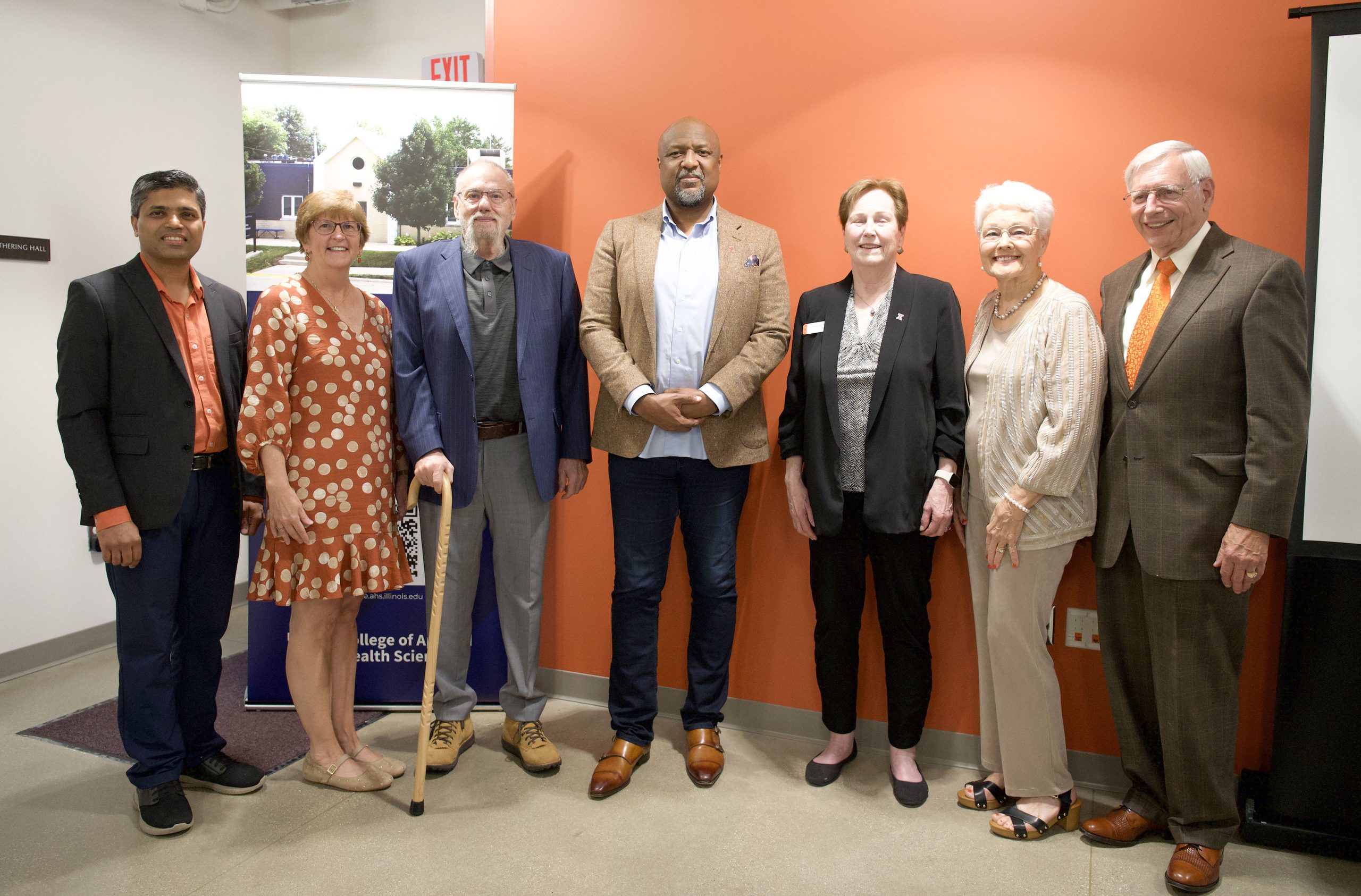
Photo Charles and Kay Stenberg Professor and SHS Department Head Pamela Hadley (Photo by Bradley Leeb)
Dear Students, Faculty, Alumni and Friends of the Department of Speech and Hearing Science,
As we step into the energy of spring 2025, I’m excited to share the latest updates from our department. It’s been a remarkable year, and we have so much to celebrate!
Our commitment to advancing the field of communication sciences and disorders continues to grow. In this edition, we highlight the inspiring achievements of our faculty, students and alumni. We have stories on a newly established aphasia group, multiple grants on understanding and improving hearing in noise, how our research translates to the lives of friends and family and an introduction to one of our new faculty members.
Take a moment to explore the stories in this newsletter and reflect on the incredible work in SHS. Together, we’re pushing boundaries, advancing new approaches to treatment, and improving lives of children and adults.
A heartfelt thank you to our dedicated faculty, staff and students—your passion and perseverance are the heart of our success.
Wishing you a vibrant and inspiring spring season!
Sincerely, Pamela Hadley, Ph.D. Charles and Kay Stenberg Professor and Head
AAC refers to a range of methods that people use to communicate, other than spoken language
Savanna Brittlebank first became interested in AAC after working with children who had trouble communicating (Photo provided)
By ADELYN MUI
Savanna Brittlebank has dedicated her academic career to improving communication for individuals with complex needs. As a new faculty member in the Department of Speech and Hearing Science in the College of Applied Health Sciences, she brings knowledge and experience to the field of augmentative and alternative communication, or AAC.
AAC refers to a range of methods that people use to communicate, other than spoken language. It includes gestures, symbols, pictures, writing or use of electronic devices to express thoughts, needs and wants.
Brittlebank first became interested in AAC after working with children who had trouble communicating. She initially majored in psychology but worked extensively with individuals with disabilities. One of the reasons she decided to come to the University of Illinois is that she values the robust resources that the university has.
“There’s a lot of opportunity as well for expansion of my research because there is just a strength across different disciplines of the research that’s going on,” Brittlebank said. “The university really values that and has a lot of support to kind of push that growth as well, which drew me here. I keep learning more and more.”
Brittlebank recalled a time when she worked with a 3-year-old girl who was hearing-impaired and blind. The child also had an intellectual and developmental disability and no speech.
“She was still developing language, and I didn’t know what to do,” Brittlebank said. “I didn’t know how to best support her communication. Whenever I spoke to my supervisors and when I looked in the research, there really wasn’t anything. I realized I wasn’t the only one who didn’t know how to help this population. I realized that’s more where my passion was, and so I went back and studied further, and I’ve focused on research on that ever since.”
Brittlebank grew up in Zimbabwe and completed her BSc Hons (comparable to a U.S. bachelor’s degree) at University of York in England before coming to the United States to complete her M.S. at Pennsylvania State University. After her M.S., she worked clinically in Wisconsin as a speech-language pathologist, then returned to Penn State for her Ph.D. From there, she made her way to Illinois as an assistant professor in SHS.
“University of Illinois is one of the most disability-friendly campuses,” Brittlebank said. “There’s so many different resources available for individuals with disabilities, and there’s so much accessibility, more so than I’ve seen in a lot of other places. That was really encouraging considering I often work with people with disabilities who have limited speech.”
Since joining the university in fall 2024, Brittlebank has been in the process of getting new projects up and running and finishing old ones. She said one of her goals is to expand the accessibility of these interventions in lower-resource communities. In late April, Brittlebank received an award from the Campus Research Board for her project titled “Communication Partner Training to Support Language Outcomes in Children with Significant Disabilities.” This intervention research will investigate the effectiveness of training communication partners (e.g., paraprofessionals, direct support staff) of young children with significant challenges in both speech and motor abilities (i.e., multiple disabilities) in an evidence-based strategy to enhance child language outcomes.
In addition to access for lower-resource communities, Brittlebank also said that AAC is still moving forward in terms of representation for different cultures and different languages.
“AAC can be particularly challenging. I think one of the biggest barriers is access to technology,” Brittlebank said. “We can definitely support communication with photographs or with writing, but a lot of what’s out there as well is access to these computer- or tablet-like systems where you can access the internet. Families might not have it readily in the home as it’s a more costly system.”
AAC can be particularly challenging. I think one of the biggest barriers is access to technology.
Savanna Brittlebank
Assistant Professor
Brittlebank has worked on projects such as Transition to Literacy or T2L, a software that provides dynamic speech and text output upon selecting a graphic symbol. She said that traditional systems can be limiting—if every single word is not programmed, an individual cannot say everything that they want. However, the T2L feature helps support literacy by teaching individuals.
“It’s the idea that it’s an additional support to direct literacy instruction, but it’s a great way that it can be embedded and someone can get exposure to literacy learning throughout the day,” Brittlebank said.
Brittlebank said literacy is powerful: if an individual has the alphabet, they can say anything they want.
“Literacy, in this day and age as well—it really enables social communication and building friendships. If someone has trouble with speech, and then they have trouble with communication, that has a series of impacts from not being able to engage in education or limiting employment opportunities and limiting the ability to make friendships,” Brittlebank said. “It’s really important to make sure that individuals have access to language and communication and have appropriate access to language and communication.”
Steve Serio had seven assists to lead Team USA over host France in the 2024 Paralympics in Paris (Photo by Naomi Baker/Getty Images)
The U.S. men’s wheelchair basketball team is a step closer to a record third straight gold medal.
Led by Illini Paralympians Steve Serio and Brian Bell, Team USA routed France 82-47 on Wednesday in Paris.
Serio and Bell each had seven assists as Team USA had 34 assists total and just one turnover.
“They’re not ready for the speed that we can bring,” U.S. coach Robb Taylor told reporters. “It’s probably not something that they can practice. So when they see us coming up in a press Steve, Tre (Jenifer), Jake (Williams), Brian, (John Boie), it’s a formidable five to try to beat.”
From the very start of the game, Team USA was not fazed by the boisterous French crowd. Within the first 70 seconds, the score was 6-0, and France was forced to take a time out.
“Our starting five has been there before,” Taylor said. “A number of them have been around for a couple of Paralympics so they know how to handle crowd size. Those are the guys that we lean on when we need to… and they set the tone for us early.”
The U.S. next faces Canada on Thursday in the semifinals.
Students, faculty and staff got a taste of the findings from AHS’ budding student researchers during the AHS Undergraduate Research Expo
Kinesiology juniors Elizabeth Martinez, center, and Aubrey Cervantes, left, present their research at the AHS Undergrad Research Expo (Photo by Ethan Simmons)
For a freshman at the College of Applied Health Sciences, Saiesha Bollapragada’s research portfolio is impressive.
At last week’s Undergraduate Research Symposium, the I-Health major got to present the results from her first research project, “Public Health Preparedness Among UIUC Students During Extreme Heat Conditions,” where she examined students’ awareness and handling of severe heat in the spring semester.
She completed her study with a push from Students Pursuing Applications, Research and Knowledge, or SPARK, an AHS program that jump-starts incoming undergraduate students research experiences by pairing them with professors in the college. Bollapragada was placed with Recreation, Sport, and Tourism Associate Professor Mariela Fernandez, whose experience with urban environmental injustices fit her research topic perfectly.
“Professor Fernandez motivated me to start this project on my own,” Bollapragada said. “There’s a lot more reading involved than I thought there was, it was a lot of work preparing for the symposium, but if it’s something you’re interested in it’s a fun process.”
Students, faculty and staff got a taste of the findings from AHS’ budding student researchers during the AHS Undergraduate Research Expo at Huff Hall on Wednesday, April 24, where a roster of undergraduates gave poster presentations on a diverse range of research topics.
Many students spearheaded their own research projects with significant support and guidance from faculty and graduate students. Others, like a group of Speech and Hearing Science students from the Intellectual DisAbilities Communication Lab led by Associate Professor Marie Moore Channell, provided updates on long-range research projects they’ve assisted with on campus.
Three SHS seniors, Emma Mueller, Abigail Keasler and Liz Gremer, presented initial findings from their glimpse into the Speech Accessibility Project, an ongoing research endeavor looking to make voice recognition software—such as Apple’s Siri or Amazon’s Alexa—more accessible for people with different speech patterns.
Each of the students has helped recruit participants with Down syndrome or aided vocal transcriptions from the samples they’ve collected. Under the leadership of Channell, the lab hopes to collect 240,000 voice samples from 400 participants.
“Our poster looked into the recruiting process with that population and took a look at patterns of articulation differences exhibited by individuals with Down syndrome,” said Mueller, who transcribed vocal samples for the project.
All three of the students met in Channell’s lab, and immediately found research responsibilities once the Down syndrome portion of the project came under Channell’s purview.
“It’s been very rewarding, very interesting and very impactful,” Keasler said. “A lot of families in meetings or over the phone say, ‘Siri doesn’t really understand what we’re trying to say,’ so this is very important and I can’t wait to see the results of it.”
Coming to a project affiliated with SHS with “so much publicity and so much money coming in is encouraging,” said Gremer, who has helped recruit participants and set up their first meetings for collecting voice samples.
AHS student programs, such as the first-generation focused Mannie L. Jackson Illinois Academic Enrichment and Leadership Program (I-LEAP), were well represented in the research symposium. I-LEAP juniors Elizabeth Martinez and Aubrey Cervantes, both studying kinesiology, brought results from their research collaboration on high-intensity interval training.
Working within KCH Professor Steve Petruzzello’s Exercise Psychophysiology Lab, the pair analyzed 25 participants’ emotional responses to high-intensity exercise, compared with their scores and symptoms of several mental health qualities: namely anxiety, depression and neuroticism.
“We were looking at exercise adherence—how can we get more people to get more active—and we were really interested in HIIT exercise, so we put it all together in one research project,” Cervantes said.
What they found: Participants with more symptoms of depression reported more negative affect responses during the HIIT exercise, while anxiety and neuroticism didn’t show significant predictive power, they said.
“This is my first hands-on [study] that I can call my own and Aubrey’s,” said Martinez, who’s applying to physical therapy schools. “My favorite part is meeting with the participants. It’s so fun getting to know everyone, even if there’s a lot more hours behind the desk just plugging and chugging data.”
Under the mentorship of world-renowned scholars, doctoral students make significant contributions to the advancement of theory and practice in speech and hearing science through their dissertation research, as they prepare to assume leadership roles in clinical, industrial and academic settings.
Below, three of our outstanding SHS doctoral students discuss their research, and the impact they hope to have on the field.
Conflict monitoring
Mentored by Department of Speech and Hearing Science Professor Raksha Mudar in the Aging and Neurocognition Lab, Lizzy Lydon is focusing her doctoral research on communication abilities in older adults with mild cognitive impairment (MCI). Her specific focus is on the cognitive construct called conflict monitoring, which helps individuals detect and resolve competing information in the environment. Lydon uses electroencephalography to examine alterations in brain waves when people with MCI perform different conflict monitoring tasks.
Before beginning her Ph.D. studies, Lydon worked as a speech-language pathologist with patients with MCI, many of whom reported communication challenges. “I often found it difficult to determine what type of treatment was the best choice for these individuals,” she said. “After looking through research, I realized there was a lack of evidence-based treatments for communication challenges in populations that experience mild changes to their cognition and language.”
Previous research had focused on understanding memory changes in adults with MCI. An emerging body of literature suggests that other cognitive functions such as conflict monitoring are affected. In using EEG in her research, Lydon may be able to identify neurophysiological markers that can be used for early diagnosis of MCI Research has shown that people with MCI are at a significantly greater risk of developing dementia than typically aging peers, Lydon noted, so it’s important not only to identify MCI earlier but also to better characterize the changes they experience.
“This can help to inform the development of interventions that have the potential to slow the progression to dementia and allow people to maintain independence and quality of life as long as possible,” she said.
In the fall, Lydon will join the faculty of the Department of Speech Pathology and Audiology at Miami University in Ohio as an assistant professor. She plans to continue to investigate how MCI affects different aspects of communication, as well as how these changes impact the ability to engage socially with others. “I am looking forward to this next adventure,” Lydon said, “and I’m so thankful for all the training I received here at Illinois.”
Listening effort
Silvia Murgia also plans to pursue an academic position after completing her degree this summer. For her dissertation, she is evaluating the impact of background noise and dysphonia, a voice disorder, on the mental energy needed to listen, or listening effort, of children performing a speech comprehension task. She is taking a comprehensive approach to her study, using subjective and objective measures of listening effort, including EEG analysis, as well as assessments of cognitive function to explain individual differences.
Murgia is mentored by SHS Associate Professor Pasquale Bottalico in the Speech Accommodation to Acoustics Lab. Understanding listening effort in children is crucial, Murgia said, as they spend a significant amount of time in school learning through communication activities. It is essential to minimize the amount of mental energy children use to listen in order to optimize the resources available for cognitive tasks such as memorization, comprehension and evaluation. Studies show that children’s cognition is affected by the speaker’s voice quality, the presence of background noise and the complexity of the listening task. Research also suggests that individual differences in executive function may be associated with variations in listening comprehension under adverse conditions. Her research addresses both external factors affecting listening effort and internal cognitive mechanisms that help children to cope with external challenges.
“My dissertation aims to provide a more nuanced understanding of how these adverse conditions impact listening effort and comprehension,” she said. “This could have significant implications for educational practices, especially in designing interventions and strategies to support children with different listening and cognitive profiles.”
In her academic career, Murgia plans to expand her research to include children with hearing loss and special needs. Her goal is to improve the academic outcomes and overall well-being of all children by identifying effective ways to reduce listening effort and optimize learning environments.
“I hope that my research empowers children by advocating for their communication needs and ensuring that they have access to the resources and support they require to succeed academically and socially,” she said. “I want to contribute to creating inclusive environments where all children can thrive.”
Vocal intensity
December 2023 graduate Simin Soleimanifar’s dissertation research investigated how using two cochlear implants, known as bilateral cochlear implantations, affected the ability of users to control variations in vocal intensity, or the volume of their voice, as compared to users with a unilateral cochlear implantation.
Soleimanifar noted that the challenges faced by bilateral cochlear implant users in controlling vocal intensity have not been widely researched. Through her study, she hoped to identify the underlying factors contributing to the challenges, with a specific focus on how differences in the perception of loudness growth between the two ears affect vocal performance.
“Vocal performance plays a crucial role in effective communication, and difficulties in controlling vocal intensity can lead to social and emotional consequences for the individuals affected,” Soleimanifar said. “By shedding light on the specific auditory perceptions that influence these difficulties, this research has the potential to lead to better-tailored cochlear implant programming and rehabilitation strategies, ultimately improving the communication outcomes for bilateral cochlear implantation users as well as their overall quality of life.”
Mentored by SHS Associate Professor Justin Aronoff in the Binaural Hearing Lab, Soleimanifar currently is a clinical research associate at the University of Illinois Urbana-Champaign and is pursuing a career that bridges research and clinical practice. In addition to providing empirical evidence on the impact of bilateral cochlear implantation on vocal intensity control and identifying the role that mismatched loudness growth perception between ears plays in vocal performance, she hopes to inform clinical practice by highlighting the need for individualized implant programming and rehabilitation approaches that consider the auditory perceptions specific to bilateral cochlear implantations. Soleimanifar is particularly interested in applying her research findings within a multidisciplinary team to develop innovative implant technologies and rehabilitation strategies.
Dear students, faculty, alumni, and friends of the Department of Speech and Hearing Science,
As we enjoy the spring colors across campus, I welcome you to the latest departmental newsletter. It fills me with great pride to share the progress we’ve made in recent months and provide a glimpse into the prospects on our horizon.
Our dedication to advancing the fields of audiology and speech-language pathology remains steadfast. In this edition, we showcase the stories of faculty, students and alumni making significant contributions across various facets of our field. These narratives underscore the strength of our community and the profound impact we have on enhancing quality of life.
I invite you all to explore the contents of this newsletter, celebrate our successes and envision the limitless possibilities ahead. Together, we will continue to empower individuals facing communication challenges, pioneer groundbreaking research and shape the trajectory of communication sciences and disorders.
Lastly, I extend my heartfelt gratitude to SHS faculty, staff and students for your unwavering dedication. Your tireless efforts are the cornerstone of our achievements, and your enthusiasm propels us forward.
Warm regards for a restful and reinvigorating summer.
Weatherization typically assesses a home’s insulation, air leaking, heating and energy use, but many eligible households are turned away due to conditions like leaky roofs, pest infestations, or mold. (Photo provided)
A new initiative is taking aim at a key barrier facing low-income homeowners: weatherization deferrals. Weatherization is the process of making the home more energy-efficient, which can lower energy bills and improve overall home comfort. The project, titled “Reducing Deferrals by Integrating Healthy Homes with Weatherization,” is looking to enhance energy efficiency upgrades by also addressing the environmental health hazards that often disqualify homes from weatherization programs.
Funded by the U.S. Department of Energy in partnership with the Champaign County Regional Planning Commission, the three-year effort plans to integrate healthy home evaluations into the traditional Weatherization Assistance Program (WAP) audits. Using DOE funds, the program provides weatherization services to about 32,000 homes every year. These audits typically assess a home’s insulation, air leaking, heating and energy use, but many eligible households are turned away due to conditions like leaky roofs, pest infestations, or mold—problems that impact the health of residents.
“One of the focuses really is to be able to take credit for the health benefits,” said Paul Francisco, the director of Champaign County Regional Planning Commission’s Indoor Climate Research and Training team and the principal investigator of the project. “If we can take credit for the health benefits, now it makes it much more plausible to say, ‘Hey, let’s not defer this home’—let’s do this home, and the cost effectiveness is going to be great because of all of these non-energy impacts we’re going to be doing.”
Francisco said there’s been a lot of interest in trying to quantify those benefits in a way that allows the federal program to take credit for those benefits, since the weatherization program allows a certain amount of money for each state. Sheena Martenies, an assistant professor in the Department of Health and Kinesiology at the University of Illinois Urbana-Champaign, works on that quantifying aspect of the project.
“We have tons of evidence from the epidemiological literature that says these indoor environmental conditions are are harmful to health, and that improving these indoor conditions improves health, but sometimes you have to you have to a dollar value on it in order for it to be in the same vein as other pieces of evidence that these decision makers are considering,” Martenies said.
The project is currently working in seven homes all over Illinois, with more in the process of being recruited. Franscisco’s team does a pre- and post-assessment of each home, identifying issues such as leaking roofs and old windows, as well as conducting a number of assessments on indoor environmental quality measures, like air pollutants.
“My lab takes information from Paul’s evaluations and we translate it into health benefits: for example, fewer individuals who are being hospitalized for asthma exacerbations,” Martenies said. “After we quantify the number of benefits of these programs, we can actually attach a dollar value to those health benefits so that we can perform a more comprehensive cost benefit analysis, of ‘Do we see a better cost-benefit ratio?’”
Martenies said her calculations provide numbers for avoided health impacts, or the health outcomes that would have occurred had we not remediated these homes. Those final results are then reported to their funders, like the Department of Energy, as well as peer-reviewed papers, conferences and other avenues of dissemination.
Currently, an average home gets about $250 to $300 in energy savings, according to Francisco. He said success with this project would make it possible for these households to get those benefits.
If the project is successful in integrating health benefits into the calculations for return on investment, the team said they would like to apply the same methods to other settings where kids spend a lot of time, like schools, to help support health-positive infrastructure projects. They hope that for policies, that energy programs would include health benefits in their decisions of what measures to implement, and be able to take credit for those health benefits.
Both Francisco and Martenies said it’s incredibly important for individuals to have access to healthy homes.
“Our homes are incredibly important places, emotionally and socially, but also from an environmental health perspective,” Martenies said. “I firmly believe that everyone deserves to live in a healthy home and a healthy environment, and I don’t think that your income level should dictate the quality of your housing.”
Francisco said a lack of healthy homes impacts everyone—not just those who don’t have one.
“There’s an economic cost to all of us. There’s a moral cost to all of us. There is a societal cost to all of us. There is a productivity cost to all of us,” Francisco said. “This is why we should care—because when thousands and millions of families are struggling with this every day, we’re lying to ourselves if we think we’re not paying a price for that.”
Georgia Malandraki earned her Ph.D. from the University of Illinois in 2008. (Photo provided)
The College of Applied Health Sciences at the University of Illinois Urbana-Champaign is pleased to announce the appointment of Dr. Georgia A. Malandraki as the new head of the Department of Speech and Hearing Science, effective January 2026. Dr. Malandraki brings with her an exceptional record of scholarly achievement, clinical innovation and academic leadership that will advance the department’s mission in education, research and service.
Dr. Malandraki succeeds Dr. Pamela Hadley as department head, who was appointed department head in 2020. Dr. Hadley will continue serving as the Charles and Kay Stenberg Endowed Professor in Disability Research.
“Since earning my Ph.D. in Speech and Hearing Science from Illinois in 2008, I have been fortunate to have a deeply fulfilling career—one that has been profoundly shaped by the training and mentorship I received during my doctoral years,” Malandraki said. “It is an incredible honor to return to my alma mater to serve as head of SHS. As I step into this role, I am beyond humbled and filled with excitement.
“I follow in the footsteps of professor and current head, Dr. Pamela Hadley, whose compassionate leadership and dedication have strengthened the department through growth and challenges, including during the pandemic. I first met Dr. Hadley during my final year as a doctoral student, and her warmth and generosity have left a lasting impression—one she has carried into her impactful tenure as head. I am deeply grateful for her example and the foundation that she, along with her distinguished predecessors, has built. As I take on this role, I do so with humility, gratitude, and a strong commitment to inclusive excellence, innovation, and collaboration. I look forward to working alongside the exceptional SHS faculty, students, and staff, and under the inspiring leadership of AHS Dean Cheryl Hanley-Maxwell, as we continue to advance impactful research, education, and service in the field of communication sciences and disorders at the University of Illinois Urbana-Champaign. Go Illini!”
Dr. Malandraki joins the University of Illinois from Purdue University, where she served as a professor in the Department of Speech, Language and Hearing Sciences, with a courtesy appointment in the Weldon School of Biomedical Engineering. At Purdue, she directed the I-EaT Swallowing Research Laboratory and Clinic and played a pivotal role in interdisciplinary research and education focused on the neural mechanisms of swallowing function.
Dr. Malandraki earned her Ph.D. at the University of Illinois in 2008 after earning her master’s at Ohio University and her undergraduate degree from the Technological Educational Institute of Patras, Greece.
An internationally recognized expert in dysphagia, Dr. Malandraki is a certified speech-language pathologist, a board-certified specialist in swallowing and swallowing disorders, and a Fellow of the American Speech-Language-Hearing Association (ASHA). Her groundbreaking work has focused on the development of neurophysiologically driven interventions and telehealth solutions to expand access to care for individuals with swallowing disorders, particularly in underserved populations.
Dr. Malandraki is a founding member of the Purdue CEREBBRAL Center and a faculty associate with the Purdue Center for Aging and the Life Course. Her contributions to the field have earned her numerous accolades, including the NIH NIBIB R21 Trailblazer Award in 2019, the Purdue Early Career Research Achievement Award, and the 2021 ASHA Fellowship. Her team also received the 2021 Editor’s Award from the Journal of Speech, Language, and Hearing Research (JSLHR), and she was honored with the 2022 Honors of the Indiana Speech-Language-Hearing Association.
In addition to her research accomplishments, Dr. Malandraki is widely respected for her commitment to excellence in teaching. Since joining Purdue in 2014, she has been recognized with eight departmental teaching awards and received the 2018 Patsy J. Mellott Teaching Innovation Award from Purdue’s College of Health and Human Sciences.
“We are thrilled to welcome Dr. Malandraki to the University of Illinois,” said Cheryl Hanley-Maxwell, dean of the College of Applied Health Sciences. “Her visionary leadership, collaborative spirit and unwavering dedication to advancing the science and practice of communication and swallowing disorders make her an ideal choice to lead our Department of Speech and Hearing Science into its next chapter.”
Dr. Pamela Hadley joined the Department of Speech and Hearing Science in AHS in 2007 and has been department head since 2021. A tireless advocate for the groundbreaking work of SHS colleagues past and present, Dr. Hadley somehow found the time for an energetic interview on a sunny September afternoon.
‘We have such a great group of remarkable scientists who are really committed to rigor in their research,’ Department Head Pamela Hadley said. (Photo by Ethan Simmons)
Q: This year’s deeper dives into the history of the Department of Speech and Hearing Science at the University of Illinois have been fascinating. Was there anything in any of these explorations that surprised you, even in your role as the department’s head?
A: Oh, absolutely. For example, I didn’t know how instrumental faculty at the University of Illinois had been in the development of the ASHA [American Speech-Language-Hearing Association] journals. The field continues to grapple, even today, with how to disseminate scientific findings.
There also are many discussions about opening up access to science, especially those things that are federally funded by taxpayer dollars. The internet and social media have fundamentally changed the number of options for sharing scientific findings and clinical resources with the public. That’s something that, looking forward, we will continue to work through. With regard to the SHS at 50 stories, it was really important for me to appreciate the role that Illinois faculty had in the development of those early journals at the very beginning.
Q: What are some topics you would have liked to explore for this series if we’d had more time?
A: Something we talked about early on was exploring paradigm shifts in the field. There are individuals from Illinois who were responsible for changing the way in which our field approached clinical practice. Some of those researchers include Dean Emerita Tanya Gallagher and Carol Prutting, who were mentored by Tom Shriner Jr. in the 1970s. Together they were responsible for bringing the pragmatics revolution into the field of speech-language pathology and establishing the subfield of clinical pragmatics, focused on how language is used in conversational interactions.
Another example: Elaine Paden and Ph.D. student Barbara Hodson contributed to a paradigm shift in how we treat young children’s speech-sound disorders. They were instrumental in shifting the field toward treating classes of sounds to improve the intelligibility of young children’s speech more efficiently. That was a huge paradigm shift.
Professor Emerita Adrienne Perlman was an advocate for expanding the speech-language pathology scope of practice to include dysphagia, or swallowing disorders. When I was a clinical student, swallowing wasn’t part of our scope of practice yet! Now it’s such a fundamental aspect of medical SLPs’ role in hospitals and skilled nursing facilities in particular.
Finally, it would have been wonderful to highlight major research projects throughout the history of the department, such as the Illinois International Stuttering Research Project that was led by Professor Emeritus Ehud Yairi.
Q: What’s impressed you the most about the department’s growth and development since you joined the faculty?
A: I’m so impressed with my faculty colleagues. We have such a great group of remarkable scientists who are really committed to rigor in their research. They hold themselves and their students to high standards, and at the same time, they’re just truly wonderful people who’ve been so committed to delivering high-quality instruction through some really unprecedented times. I admire their resilience. I enjoy their company. In short, I’m just really proud to lead this department.
Q: What are some new areas in this field that recent graduates, current students, and students who will join you in the next few years have, or will have, the expertise to address as they move into their careers?
A: Telehealth is a professional area that has really expanded rapidly in the last three years. Prior to COVID-19, students weren’t trained to assess or treat via telehealth at all. It was considered to be an advanced clinical skill and not something that students would be expected to learn until they had years of clinical practice under their belt.
During the stay-at-home mandates, telehealth became a lifeline, and it caused our professional bodies to reconsider whether this was an essential skill that all our students in training needed to have. We also had many research projects that were required to pivot to remote data collection. Students today are far more advanced in their knowledge and skills in this area, and they are better prepared to conduct research and deliver clinical services remotely than prior graduates.
Q: Let’s talk a bit more about the department’s Audiology and Speech-Language Pathology Clinic. You’ve referred to it as the “crown jewel” of the department’s community outreach efforts. How would you like to see the clinic evolve?
A: This summer we had a public meeting as part of a follow-up, in-person site visit from our accreditation body, and a number of individuals who received services from our clinic and their family members attended the meeting. They just raved to the site visitors about the services that they were receiving and the impact of those services on their well-being and quality of life. To hear that kind of feedback from the families that we serve just means everything—it’s so essential to what we’re trying to accomplish in terms of our public engagement and outreach, and it’s testimony to how critically important communication skills are to participation in everyday activities. That encapsulates why I’ve referred to the clinic as a “crown jewel.”
I’d really like to see the clinic expand its sphere of influence beyond the Urbana-Champaign community. My dream for the clinic would be for it to be a center of excellence, particularly for families in rural communities that may not have access to state-of-the-science resources in their local communities. Also, it would be my hope that we could bring individuals here for comprehensive assessments and develop the types of support those families might need for ongoing care, and then maintain that contact through telehealth with educators or health care providers in their local communities. I think that that could be really powerful.
Q: We’ve established through these stories that the SHS faculty at Illinois have been pioneers in the research, and they’ve been leaders in their profession since the beginning. Will these stories serve as inspiration for future activities? Where do you think this department can lead your disciplines in the future?
A: I think these stories helped us bring history alive and explored some topics in a more conversational way than reading a review of the history of the department. What I most hope, though, is that these stories provide our students and faculty with a strong sense of where they come from and, really, a deeper appreciation of the fact they’re standing on the shoulders of giants—pioneers who really established the profession and were influential from the beginning.
Where do I think SHS will lead the discipline in the future? I envision SHS faculty and students contributing to innovations in health technology, including the use of that technology to improve treatment options, and evaluating how different design features might promote people’s use of those technologies and what new technologies are desired. Those health technologies could include how we are designing and developing hearing aids, which treatments best fit an individual’s cognitive profiles and communication needs, how we interact with augmentative and alternative communication devices, how we use speech recognition devices, or how we use different kinds of technologies to age in place successfully. Technology has moved really quickly just in the last year. So the next 50 years? It’s hard to imagine where we’ll be!
For more on the 50th anniversary of SHS at Illinois, check out our stories at ahs.illinois.edu/shs-50.
ORPR is designed to be an asset to faculty and the Department of Recreation, Sport and Tourism
Of ORPR, Laura Payne says, ‘We want to be known as a leader in conducting applied research and outreach across recreation, sport and tourism.’ (Photo provided)
In November 2021, while Laura Payne was the interim director of the Office of Recreation and Park Resources, a group of stakeholders held a retreat to focus on the core missions of ORPR.
“We generated a lot of rich discussion and accomplished a lot in a short amount of time,” Payne said. “One of the key points to emerge from the planning meeting was that ORPR can and should play a key role in addressing emerging challenges related to community health and well-being by generating creative and innovative solutions.”
Fast-forward to 2023, and Payne—now the Joseph J. Bannon director of ORPR—said, “We want to be known as a leader in conducting applied research and outreach across recreation, sport and tourism.”
ORPR, which is affiliated with the Department of Recreation, Sport and Tourism within the College of Applied Health Sciences at Illinois, is designed to be an asset to faculty and RST, Payne said.
“We see ourselves as an applied research and outreach unit that serves the entire department,” she said. “Where it makes sense, we’d like to be a resource for faculty. We can assist with grant applications, community engagement and outreach efforts. Since we have a formal connection with Illinois Extension, we can assist with building collaborations between Extension and RST.”
Payne is a professor in RST and an Extension specialist who has directed statewide outreach and research programs. Her research has examined the relationship between leisure style and the health of older adults with chronic conditions and the role of local parks and recreation agencies in health promotion and health behavior change.
Sport and tourism initiatives can play important roles in enhancing human health and improving environmental sustainability evolving media landscape, the spread of misinformation and disinformation regarding scientific topics such as natural disasters, vaccines and climate change can pose a risk to public health.
Laura Payne
Drector of the Office of Recreation and Park Resources
Joelle Soulard, assistant professor in RST, called Payne “a respected colleague. Her dedication and expertise have been invaluable to our field. As the leader of ORPR, Laura is committed to enhancing health and well-being through research, education and outreach programs. Her vision aligns perfectly with the university’s land grant mission.”’
Payne is focused on channeling the expertise and knowledge of RST faculty and students to impact people’s lives positively and address many of society’s health and wellness challenges.
“It is our goal to become the place RST organizations and professionals seek out for evidence-based information and research-based resources that are useful for organizations,” she said.
Payne said the core principles and mission of ORPR have not changed, but she wants to build on what was done before she was appointed to the top role.
“I view this stage of ORPR’s continued development as fine-tuning,” she said.
To that end, ORPR has refreshed its mission statement, which is to collaborate on recreation, sport and tourism initiatives to build healthy communities. The values that guide their mission include utilizing scientifically sound applied research and best practices, being responsive to community and industry needs, issues and trends and providing undergraduate and graduate students with hands-on educational experience via projects.
Soulard said Payne’s “innovative approach has been instrumental in advancing statewide outreach and research initiatives that directly benefit communities across Illinois. Her work is driving the next wave of innovation in our field, making a meaningful impact on the quality and sustainability of recreation, parks and wellness programs and services.”
RST Assistant Professor Sharon Zou said that Payne “speaks multiple languages with community leaders, RST professionals, Extension colleagues, academic faculty and students. She involves undergraduate and graduate students in ORPR projects, which have been great learning experiences for our students.”
Most importantly, Payne said, wants people to understand how parks and recreational activities enhance lives.
“Sport and tourism initiatives can play important roles in enhancing human health and improving environmental sustainability,” she said. “Parks and recreation agencies offer places for people to be physically active, reduce stress, engage in social activities and strengthen community ties through festivals and events.”