Khan’s R01 grant aimed at measuring lutein effect on cognitive function


Can spinach and other leafy, green vegetables improve cognitive function? (Fred Zwicky)

Whether you’re a parent or Popeye, you’ve been extolling the virtues of spinach for decades. Now, one of AHS’ researchers is prepared to study the effects of the leafy green vegetable.

KCH Associate Professor Naiman Khan has received an R01 grant from the NIH’s National Institute of Child Health and Human Development for his project titled “Enhancing Children’s Cognitive Function and Achievement through Carotenoid Consumption.” The five-year project has a budget of approximately $3 million.

The overall aim for Dr. Khan and his collaborators—KCH Associate Professor Sean Mullen and Professor Neal Cohen, director of the Interdisciplinary Health Sciences Initiative—is to conduct a randomized-controlled clinical trial to test the effects of daily lutein supplementation over nine months on children’s cognitive function and academic achievement.

Lutein is in most fruits and vegetables, but green and yellow foods have the highest amounts. Loaded with iron, vitamin K, and magnesium, spinach is an all-in-one source of many essential vitamins and minerals. It is also high in antioxidants such as lutein, with eight milligrams in one cup. The same serving of cooked spinach has up to 16 milligrams. Kale, corn, bell peppers and parsley are also excellent sources of lutein.

Khan’s research has linked macular pigment optical density (MPOD)—a noninvasive measure of retinal and brain lutein—to greater childhood cognitive function. However, the cognitive implications of lutein and zeaxanthin intake in children have not been directly investigated.

The goal, Khan said, is to provide important knowledge on potential dietary recommendations for supporting achievement and cognitive function in childhood. In other words, can eating spinach help a child excel in school?

Khan’s collaborators also include Charles Hillman at Northeastern University and Lisa Renzi-Hammond at the University of Georgia, with data collection taking place at the Illinois.

Share on social

Related news

RST student aspires to future in baseball front office


RST senior Diego Acosta spent the summer as an intern for Prep Baseball Report

The Skokie, Ill., native worked this summer as an intern for Prep Baseball Report (PBR), one of the top independent baseball scouting services in the country. Acosta plans to go to graduate school after he graduates in the fall, but he aspires to work in the baseball operations department for an MLB team.

Like many scouts you might have seen on TV while watching a baseball game, Acosta carried the tools of the trade—a stopwatch and a radar gun—and loved every minute of it.

“I obviously have a passion,” Acosta said about baseball. “And if I have a passion for it—we were learning (that it is) statistically proven that workers that have the biggest passion for what they do will move up higher and faster than anyone else that doesn’t have a passion for what they do.”

Acosta’s love for baseball began when he started playing the sport at four years old.

“I just kept (playing) until I blew my knees out. And when I was looking to go to school, I wanted to play baseball. I knew that I wanted to keep it as a part of my future someway, somehow.”

Acosta was recruited by Cornell University to play baseball before he hurt his knees but felt a natural inclination to the University of Illinois.

“I have a long lineage of Illinois alums,” he said. “My parents went there, my uncles went there, my aunts. I’ve been going (to UIUC) since I was a very young kid, and I just wanted to keep it in. So I decided to just go to school and see what I can do with the baseball team there.”

Thanks to his connections to Illinois, Acosta caught on as a bullpen catcher for the Illini baseball team, which fed his fire to stay in the sport. And, Acosta said, the courses offered in RST are a perfect springboard to a career in sports. He particularly enjoyed Clinical Associate Professor Mike Raycraft’s RST130 (Foundations of Sport Management) course, RST354 (Legal Aspects of Sport), and RST199 (Sport Brand Management), taught by RST Assistant Professor Jules Woolf.

“I feel like when it comes to the business side … there’s definitely times where I’m just like, ‘I remember talking about this in this class, but I’m seeing it here with the whole PBR thing. The Future Games is a perfect example. I remember thinking to myself, ‘Well, this is exactly– we talked about the brand and everything with Dr. Jules Woolf.’ And it’s genius. You bring everybody. You have every single state bring the entire country to one place, and you put on an event in one place across the entire country. It’s absolutely genius.”

For many RST students, a career in the sports industry is the ultimate goal. Some aspire to the customer-service side, some to the hospitality section, and others to the management sector. After all, who doesn’t want to be general manager of the Cubs? But while Acosta definitely dreams of being in a big league front office some day, he is ready to pay his dues first as a baseball scout, an often-grueling job with long hours, low pay and not much notoriety.

“I have a long lineage of Illinois alums,” he said. “My parents went there, my uncles went there, my aunts. I’ve been going (to UIUC) since I was a very young kid, and I just wanted to keep it in. So I decided to just go to school and see what I can do with the baseball team there.”

Diego Acosta

Student, Recreation, Sport and Tourism

“You’ve got to start at the bottom,” he said. “That’s the very first thing I figured out working with PBR, is there’s going to be some really, really, really long days. I was at a tournament in Rantoul from 8 in the morning until midnight. And I get back home, and the Cubs were playing. And I was staying at my apartment with a couple of my buddies that were there for the summer in Champaign. I was like, ‘Put the Cubs game on for me, please.’ And then they were like, ‘Uh, you just watched almost 13 hours of baseball. How do you want to watch the Cubs game?’ I was like, ‘I just want to watch the Cubs game.’ ‘They were like, you’re crazy.”’

Acosta is realistic, knowing how competitive working in the sports industry can be. That’s why he plans to pursue graduate school, possibly law school, upon graduation this fall.

“I have, basically, a plan B,” he said. “And my plan B would be some type of lawyer. I mean, my mom and dad have always joked, ‘Why do you argue so much with everything? Just go be a lawyer.’ I’m like, ‘Honestly, I might.’”

As much as he loves the game, Acosta wants to work in baseball for a reason larger than his appreciation for the sport.

“I’m Mexican-Colombian … and I grew up playing in Humboldt Park, which is like all Puerto Ricans and inner city kids, and then Homer Park. So I have a lot of friends from all different backgrounds,” he said. “And if I can do anything for kids like that, especially in other countries, because I’ve been there. Especially in Colombia, I’ve seen the slums. I’ve seen kids playing with rocks and sticks in the street. And if I could really help them get to their ultimate goal, I feel like that would be really cool for me to do. So that’s why I sort of want to be in professional scouting.”

Editor’s note:

To reach Vince Lara-Cinisomo, email vinlara@illinois.edu.
 

Share on social

Related news

Exploring Extended High-Frequency Hearing


Brian Monson (Photo by Brian L. Stauffer)

Can you imagine having a conversation that included none of the following consonant sounds: s, sh, f, and ph? Known as voiceless fricatives, much of their energy occurs at the range of human hearing above 8 kilohertz (kHz), called extended high frequencies. In general, consonants tend to have more energy at the extended high frequencies than vowels. Yet conventional clinical hearing tests do not assess the performance of the auditory system above 8 kHz—which is above the highest notes on a piano—because of a longstanding assumption that hearing above 8 kHz is not important.

As Speech and Hearing Science Assistant Professor Brian Monson explains, the assumption took root during the development of the telephone about 100 years ago, when speech signals had to be compressed for transmission across wires. Early researchers simply cut out certain frequencies and asked people if they could still understand what was being said.

“Basically, they found that you didn’t need to hear frequencies above 3 or 4 kHz to have really good intelligibility,” he said, “and that got interpreted as ‘energy at higher frequencies is not important for speech.’”

For more than 10 years, Dr. Monson has been intrigued by and trying to answer the question, “If hearing above 8 kHz is not important, why is the human auditory system capable of hearing up to 20 kHz?” He recently received a five-year, $2 million grant from the National Institute on Deafness and Other Communication Disorders to continue his work in this area with a study titled “The ecological significance of extended high-frequency hearing in humans,” a study on which he will collaborate with researchers at the University of North Carolina and Boys Town National Research Hospital.

Extended high frequencies and noise

In this area of research, Dr. Monson’s basic hypothesis is that not only does extended high-frequency hearing have utility for humans, it plays a role in speech perception. His research group was one of the first to examine the value of extended high frequencies in the speech signal, and the first to demonstrate that extended high frequencies help listeners to determine whether speakers are facing them or turned away from them.

His research has scientific implications, of course, and expanding the state of knowledge in speech and hearing science means a great deal to Dr. Monson. There also is the potential for practical applications of his findings as well, for audiology testing, diagnosis, and intervention.

First of all, only testing below 8 kHz in the clinic does not measure the true function of the auditory system. Extended high-frequency hearing loss is the most common loss in humans because it occurs naturally with aging, with substantial loss occurring even by middle age. So if extended high frequencies are found to play a significant role in speech comprehension, everyone eventually will be affected and everyone will have undiagnosed, or hidden, hearing losses which are not detected by standard audiograms. To date, Dr. Monson and his colleagues have found a modest relationship between extended high frequencies and speech comprehension, but, importantly, it is in noisy environments that extended high frequencies are the most valuable.

“The number one complaint of hearing aid users, for many years, has been that they still have a hard time understanding speech in noisy situations,” Dr. Monson said. “Hearing aids do not represent extended high frequencies.”

Is the impact on speech comprehension large enough to justify taking on the challenge of developing new hearing aid technologies that restore extended high-frequency hearing? That is one of the questions that he hopes to address in the newly funded study. It will expand on a study published in 2019 that simulated a cocktail party but used only two background talkers. The new study will create an even more realistic noisy environment by using multiple talkers in different locations around a listener, as well as realistic reverberations that recreate how sound bounces around different room settings. It also will include a localization experiment to investigate whether extended high frequencies help listeners to determine where the talker of interest is located, with the assumption that this ultimately helps listeners to tune out other talkers.

While he would like his research to result in effective restorative technologies for individuals with extended high frequency hearing loss, Dr. Monson is excited that it already provides compelling evidence for assessing extended high-frequency hearing in the audiology clinic. In a 2020 paper in Hearing Research, he and others argued that implementation of extended high-frequency audiometry into clinical practice is relatively easy. Furthermore, measurements of hearing loss at extended high frequencies do predict speech perception ability in noise, suggesting such measures could be useful in identifying individuals at risk for listening difficulties in noisy situations. As he continues his research in this area, he hopes that continuing to present his findings through journals and conferences that target audiologists will positively impact clinical practice.

Share on social

Related news

Paralympians get sendoff before heading to Tokyo


Half of the 20 University of Illinois-affiliated Paralympians headed to Tokyo for the 2020 Paralympic Games made an appearance Monday at the Division of Disability Resources & Educational Services for a ceremonial sendoff.

One set of athletes—who were supposed to compete last year before the pandemic changed everyone’s plans—will leave for Japan tomorrow, said Joey Peters, who along with Adam Bleakney coaches the Illini track and field team.

Peters said he, Tatyana McFadden, Daniel Romanchuk, Kelsey LeFevour and Alexa Halko are the ones headed to Tokyo early to get acclimated to the time change and the oppressive heat. “It is supposed to the be (warmest) Olympics and Paralympics ever,” he said.

For McFadden, it will be her sixth Paralympic Games, and in that time, she’s collected 17 medals, including seven gold. This year’s Games will be the second for Romanchuk, who has also won the New York City Marathon as well as Chicago and Boston among his many victories. Romanchuk credited Illini coaches, teammates and family for his success.

“It’s almost impossible to get here without a support system,” he said, adding that the encouragement from friends and fans is “almost indescribable. I would not be here without it.”

The Illini track and field team is represented by Hannah Dederick; Jenna Fesemyer; Halko, Yen Hoang, Eva Houston, Lefevour, Ray Martin, Chelsea McClammer; McFadden, Amanda McCrory, Aaron Pike, Isaiah Rigo, Romanchuk, Susannah Scaroni and Brian Siemann. Men’s basketball includes three Illini: Brian Bell, Ryan Neiswender, and Steve Serio, while the women’s basketball team has Kaitlyn Eaton and Ali Ibanez.

Editor’s note:

To reach Vince Lara-Cinisomo, email vinlara@illinois.edu.
 

Share on social

Related news

Two AHS researchers receive Call To Action funding for 2021-22


Two projects led by AHS researchers received grants as part of the university’s 2021-2022 Call to Action to Address Racism & Social Injustice Research Program.

The first, with KCH Associate Professor Andiara Schwingel as the principal investigator, is entitled “Online Certificate Programs for Community Health Workers (CHW): From overlooked and under-researched employees to well-equipped frontline agents in the fight to reduce health disparities in communities of color.”

Using a community-based participatory research approach, Schwingel and her team—which includes KCH Assistant Professor Susie Aguinaga—plan to establish a coalition that includes CHWs, Illinois researchers, University of Illinois Extension, and the Illinois Community Health Workers Association (ILCHWA) to develop, evaluate, and disseminate online learning strategies through certificate programs that will train CHWs to address their community health needs. Funding for the project is $100,000.

Currently in Illinois, the researchers say, the CHW field largely depends on employer-provided on-the-job training. There is no standardization and the length and scope of training varies a great deal from employer to employer. The key deliverables include a series of online certificate programs available in both English and Spanish.

Other collaborators are Brandi Barnes, Research Development Manager, Interdisciplinary Health Sciences Institute; Jennifer McCaffrey, Assistant Dean, Family and Consumer Sciences, Illinois Extension; Ruby Mendenhall, Associate Professor in Sociology, African American Studies, Urban and Regional Planning, and Social Work; Leticia Boughton Price, CEO/President, Illinois Community Health Workers Association, and Wandy Hernandez-Gordon, Cofounder/VP, Illinois Community Health Workers Association.

The second, with RST Professor Monika Stodolska as the PI and RST Professor Kim Shinew as the co-PI, is entitled, “Combating Systemic Racism in Access to Nature, Open Spaces, and Parks and Recreation Resources.” Corky Emberson and Elsie Hedgspeth of the Urbana Park District are the community collaborators. The grant amount is $93,428.

The study will provide a formal evaluation of the steps undertaken by the Urbana Park District to better serve their residents of color, identify additional strategies UPD can employ to engage local residents of color, and create a road map for other public recreation and natural resource agencies across the U.S. on how to address systemic racism in access to nature and recreational resources among people of color.

RST undergraduate and graduate students will be involved in the study through interview/questionnaire development, data collection and analyses, and implementation and dissemination findings. The study’s primary deliverable, the Strategies to Address Racism and Social Injustice in Recreation (SARSIR) blueprint, will be integrated into the curriculum in general education and core courses (RST 120: Parks, Recreation and Environments, RST 230: Diversity in Recreation, Sport and Tourism, and RST 317: Designing Parks and Recreation Experiences) and students will be able to implement the blueprint through their experiential coursework and internships. 

Editor’s note:

To reach Vince Lara-Cinisomo, email vinlara@illinois.edu.
 

Share on social

Related news

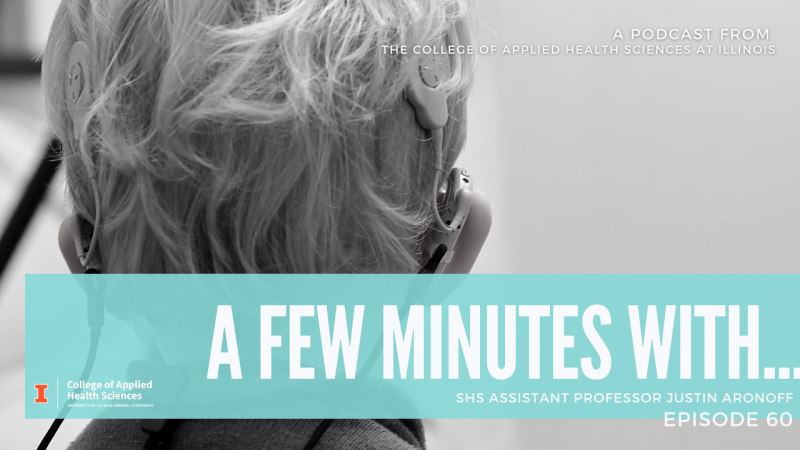
A Few Minutes With … Justin Aronoff


Transcript

VINCE LARA: Hi, and welcome to another edition of A Few Minutes With, the podcast that showcases Illinois College of Applied Health Sciences. I’m Vince Lara, and today I’m speaking with Justin Aronoff, an assistant professor in the Department of Speech and Hearing Science, about his research on the binaural auditory system as it relates to cochlear implants.

All right, Dr. Aronoff, thank you for joining me on this edition of the podcast. And commonly, I ask guests of the podcast about their inspirations for their research. So what made you look into auditory research? And you do primarily cochlear implants. So what made you look into that kind of research?

JUSTIN ARONOFF: So I kind of fell into this area. I was actually– I was having a bad experience at a postdoc. And there was another research position at the institute that I was at. And it was a hearing aid lab, primarily, that happened to have one cochlear implant project.

And I ended up on that project. So it’s a complete chance I ended up working a cochlear implant users at all. And I just fell in love with this field. I fell in love with the work. And it’s so rewarding to work with cochlear implant users.

One of the unique things about working with this patient population is that you tend to be individuals who come back to lab, you know, sometimes month after month for years. We’ll see them, and so we build up these relationships. It becomes very rewarding.

And it’s also a population that really values the research. So we do what is not necessarily the most exciting experiments to be in. We have people listen to beeps for five hours sometimes, which sounds very thrilling, I know. And I do sometimes ask them, look, I really appreciate that you’re coming in here and doing these incredibly boring experiments. I got to ask why, though. I appreciate it, but why are you doing it?

And what they often respond is they say, well, you know, I realize that what this device has done for me is a miracle. And I realize that the reason that it does what it does for me is because 20 years ago, there was someone sitting in a chair like this, listening to beeps for hours on end. And I really want to pay it forward. I really want to give to the next generation. And that type of sentiment is really kind of motivating to me, kept me really interested in continuing and working in this field.

VINCE LARA: Yeah, you kind of answered my next question, but I’ll ask it anyway. So you did your undergrad work in teaching, in the teaching of Spanish.

JUSTIN ARONOFF: Yes.

VINCE LARA: So then you followed with a masters in linguistics, which makes sense, right? You had these two– you had a pattern here. And then that led to Speech and Hearing Science. And that’s primarily because of how you felt about the population within that demographic, if you will?

JUSTIN ARONOFF: Well, I didn’t find cochlear implants until my postdoc.

VINCE LARA: OK.

JUSTIN ARONOFF: So my path was definitely fortuitous, to say the least. So when I was an undergrad here at U of I, in teaching Spanish, I did study abroad in Spain. And I took a linguistics course. And that got me very interested in linguistics.

And when I came back to campus, the only linguistics course that fit into my schedule was a neurolinguistic course by Molly Mack. And that really got me interested in the brain, and language, language acquisition. And so I went on and did my master’s in linguistics.

I was actually in the PhD program in linguistics at the University of Southern California. And as I got more and more interested into the neuro side of it, it felt like it didn’t quite fit into just the narrow range of neurologistics. I was interested in broader issues in neuroscience. And so I actually changed over into the neuroscience program to finish up my PhD.

And as I was doing that, I had the naive idea that, hey the auditory system seems like a fairly easy system to work with and to understand. But I was definitely a little naive at the time. And so that got me interested in working auditory work, and led to working at the House Ear Institute, and then eventually into doing postdoc there.

VINCE LARA: Mmhmm, now, Dr. Aronoff, for you listeners, recently received a seven-figure grant for a project that examines how the binary– binaural auditory system works. And so I’m curious, so the binaural system, for those of you who are uninitiated in this, is how the brain combines signals from our two ears. But I’m curious, why is that important?

JUSTIN ARONOFF: So having the ability to combine information from two ears can help in a lot of different situations. One of the big benefits is noisy environments. So typically, when you’re in a noisy environment– let’s say you’re at a restaurant– you’ve got the person you’re listening to is right in front of you but you’ve got all this background noise. You might have a table to side where those people are talking, you’re trying to tune them out.

The ability to basically attend to and separate out these spatially distinct sources of sound is dependent on the fact that you have two ears and that you can combine that information so it allows you to better focus on the person that you want to attend to, depending on wherever they are in space.

It’s also really important for localizing. So when you only have one ear, you really can’t tell if a sound is coming from the left or the right, especially if you don’t know what the volume is. There are some tricks you can use. But in general, most people are just very, very bad at being able to even tell the side that a sound is on when they only have one ear. Having two ears allows you to localize where the sound is.

You know, and also, patients also describe that having two ears makes the world seem fuller. It’s just this kind of qualitative sense to the world with two ears that you also don’t get having one ear alone.

VINCE LARA: Hmm. Your research is primarily focused on the importance of the study relative to cochlear implants. And–

JUSTIN ARONOFF: Yeah.

VINCE LARA: –the study states that you plan to maximize binaural benefits. And I wonder how you propose to do that.

JUSTIN ARONOFF: So one of the things that we found, my lab and other labs in this field, is that one of the big detriments in terms of getting those benefits from having two ears is when the information that you’re getting from the left and the right ear are mismatched.

And this can happen in a number of different ways. But the way that we see it happening with cochlear implants has to do with where the cochlear implant array is sitting, within the left or right cochlear, within the left and right ear, as well as what neurons are actually surviving in those two ears.

So it turns out that if you do not stimulate the same places, the same relative neurons in the left or the right ear, your ability to localize or ability to use these binaural cues and these cues that you get from having two ears decreases quite a lot.

Now, we know that there are potentially some mechanisms that can help you with that. There’s some ability to adapt. And our lab and other labs have looked at the ability to adapt to this mismatch between the two ears. It’s not clear how limited that is. We know you can do it in terms of the perception of what sounds like the same pitch in the two ears. Whether or not that translates to other things or not is not clear yet.

And really, what we’re trying to understand is how does that adaptation affect your ability? How do we need to change how we program these devices? When do we need to change? So if adaptation can handle a lot, maybe we can wait. If adaptation cannot handle a lot, then we need to start reprogramming very early on when you first get these devices.

And so we’re trying to look at kind of how do you manipulate where the stimulation is, how do you manipulate how similar the stimulation is in the two ears in order to improve those binaural benefits.

VINCE LARA: You helped develop a test that measures spectral resolution. And I’m wondering– two questions– what’s spectral resolution? And what’s the test?

JUSTIN ARONOFF: So spectral resolution is basically your ability to tell that two notes that you’re playing on the piano are not the same note. So people who have poor spectral resolution basically are not going to be able to tell that two notes that are roughly two notes apart are actually not the same note. And this is a common problem that we see with cochlear implant users.

And the reason that this is important is because it turns out that your ability to understand speech in a noisy environment really relates, in part, to your spectral resolution. And that’s something that we know that is a problem for cochlear implant users, as well as other patient populations.

So this is a test that I co-developed with David Landsberger when we were both at the House Ear Institute. And basically, this is a spectral-temporally modulated ripple test, or the SMRT. We’ve since modified it to create a version that can be used in the clinics as well, that’s the SMRT Lite for computeRless Measurement or SLRM. And basically what these measures are, they sound a lot like 1980s arcade sounds.

VINCE LARA: Hmm.

JUSTIN ARONOFF: And basically, it’s a fairly easy test. You just need to tell which sound is different, all right? And so you’ll hear three sounds that kind of sound– it’s kind of Space Invaders-y sound. And you’re trying to tell what’s [? different. ?] We’re manipulating, and there is some of the spectral properties, basically how close together these little ripples that we have across the spectrum, how close together they are and whether you can tell that one of them is closer than the other two.

VINCE LARA: Hmm.

JUSTIN ARONOFF: So it’s a fairly easy test for people to do. We’re not asking them to do anything but tell which one is different. And what’s nice about it is it turns out that it correlates well with speech perception in quiet as well as in noise. We’ve found that other labs around the world have found that as well.

So it turns out to be a nice kind of proxy test. Why the clinics have gotten interested in this is because one of the big problems that a lot of clinics have– I work with UIC in Chicago, for instance– is that they’ll often have patient populations that speak a wide range of languages, where English is not the native language. And when English is not your native language, testing someone on speech perception in English can be problematic because you don’t know if the problem is an auditory problem or if it’s a language problem.

VINCE LARA: Mmhmm.

JUSTIN ARONOFF: And so what’s nice about this test is that it’s a non-linguistic test. It doesn’t depend on languages. These are, like I said, kind of arcade-type sounds. There’s no linguistic content. But it does predict language performance.

VINCE LARA: Using your master’s in linguistics there, I would imagine.

JUSTIN ARONOFF: Yeah.

VINCE LARA: Yes. You know, you’re at an R1 university. And with that, your time is often dominated by research here at the University of Illinois. But teaching is a part of your responsibilities as well. And so I’m wondering what’s your favorite course to teach?

JUSTIN ARONOFF: That is a hard question. It’s hard to choose one, for sure. I really do enjoy teaching. And obviously, I got my degree in teaching. And I’m a licensed teacher in the state of Illinois. I come from a family of teachers. So it’s something I’m very passionate about.

If pressed, I would have to say it’s probably SHS280, Communication Neuroscience. It’s something that’s in that area where I got my PhD. I’m definitely very passionate about neuroscience. I really liked the large undergrad classes. I like those classes where this might be their first exposure to the area and you can really see the growth and the coming in really knowing next to nothing about the topic area, and then leaving. You can see kind of the growth of balance that they come out with.

So it’s a really rewarding class. And it’s just a fun class.

VINCE LARA: My thanks to Justin Aronoff. For more podcasts on Illinois College of Applied Health Sciences, search A Few Minutes With on iTunes, Spotify, iHeart Radio, radio.com, and other places you get your podcasts fix Thanks for listening, and see you next time.

Editor’s note:

To reach Vince Lara-Cinisomo, email vinlara@illinois.edu.
 

Share on social

Related news

I-Health student Cecilia Kattan discusses her internship


Cecilia Kattan, left, aspires to be a physician’s assistant

Q: Where did you complete your internship and what was your experience?

A: I completed my internship at the Champaign-Urbana Public Health Department in partnership with the maternal & child health department and community nutrition initiatives. My role at my internship was a hybrid of administration and observation. Some examples of projects I completed are: social media management, breastfeeding incentive program with the peer lactation consultant, coordinating with sponsors for the Mommy and Baby Expo, created an employer breastfeeding friendly certification toolkit, and led a grant proposal and presentation for the Carle HealthMaker Lab. I was also given the opportunity to shadow WIC consultations.

Q: How did you apply for the internship?

A: I applied via the C-UPHD internship website, followed by an interview with the director of the department, Valerie Koress.

Q: What did you learn from the internship?

A: I was given insight on how public health departments operate and allocate resources efficiently. In addition, I got an up-close look into the racial disparities experienced in our community and aided in the progression of initiatives to fill those healthcare gaps.

Q: What was your biggest takeaway from the experience?

A: My biggest takeaway was realizing the different levels of organizations that contribute to community health and the discrepancy in funding.

Q: Is this internship closely related to the field you are hoping to work in?

A: My internship gave me valuable experience working in maternal and child health, since women’s health is an interest of mine. As a future Physician Assistant I will be able to understand the value of non-clinical grassroots initiatives. In addition, community service is one of my intrinsic pillars. Therefore, I hope to participate in some of these initiatives in my future career.

Q: Would you like to share any other information that might be helpful for future I-Health students?

A: You get out what you put into your internship. My role was not clearly defined for me since I was the first intern since the arrival of the new director. Hence, I made it a point to do weekly check-ins with my preceptor, Valerie, to ensure I was being helpful. Remember to use your voice and advocate for yourself to ensure you have a valuable experience.

Share on social

Related news

Kinesiology student Jackie Buczkowski talks about her internship


Jackie Buczkowski demonstrates different exercises for patients.

Q: Where did you complete your internship and what was your experience?

A: I completed my internship at Active Rehab Clinics in Bucktown, a neighborhood in Chicago, Illinois. Initially, I began shadowing the head chiropractor of the clinic and his assistant. I observed the chiropractor while he worked hands-on with his patients and observed his assistant while he coached the patients through various exercises pertaining to their injury. After two to three months of observation, I began working with patients myself. I was taught the Burdenko Method which consists of a series of exercises used to treat patients on land and in water. Throughout the fall 2020 semester, I worked with patients at the clinic in Bucktown as well as out of Lutheran General Hospital in Park Ridge, Illinois.

Q: How did you apply for the internship?

A: Since I completed my internship during the summer and fall of COVID-19, I did not apply for this internship as a student conventionally would. My cousin is a patient of the chiropractor and asked if he was allowing students to shadow during this time. However, when I have shadowed previous physical therapists I would typically reach out through email. I have also dropped off my resume at a few different locations to see if they would allow me to shadow. More often than not they would agree! Since physical therapists understand shadowing is a requirement in order to apply to PT school, they are very understanding and willing to help.

Q: What did you learn from the internship?

A: This internship was the most fulfilling internship I’ve had so far. I learned to trust my judgment and to not be embarrassed of being incorrect or struggling to learn something new. I was often quizzed and asked questions before being told the answer. This style of teaching helped stimulate my brain which overall felt more interactive. I wasn’t simply watching passively but rather actively engaging in assessing a patient.

Q: What was your biggest takeaway from the experience?

A: My biggest takeaway from this experience is understanding that every patient is different. What might work for one patient may not work for the other. Although you’re taught to go by the book in some cases, you may need to think outside the box in other scenarios. It was fascinating for me to see the chiropractor and his assistant not only assess the part of the body that was injured or had pain but to go beyond that and see if another part of the body was actually causing that pain. For example, if a young athlete was having pain in her knee, they would rehab her hip and build strength there.

Q: Is this internship closely related to the field you are hoping to work in? 

A: This internship is closely related to the field I want to go into which is physical therapy. Although I shadowed a licensed chiropractor, he also specializes in rehabilitation. In my previous experiences I shadowed physical therapists at hospitals and chain outpatient clinics such as Athletico, however, this experience was different because it was a privately owned clinic. In many ways this faces its own challenges because billing and scheduling is in your control. I was able to see the “behind the scenes” of what owning your own business might look like.

Q: Would you like to share any other information that might be helpful for future Kinesiology students?

A: The advice I recommend to any Kinesiology student is to reach out to any company or any specific person you’d like to shadow or intern for! Internships are truly the best opportunity to figure out whether or not you really want to go into a certain field. I’ve shadowed many physical therapists and have learned something new from each of them. They inspire me to finish school and start doing what I believe to be the best career there is for me. With a bachelor’s in Kinesiology there are many career paths you can take and you want to find which fits you best!

Share on social

Related news

SHS rising junior Mia Mangialardi discusses her internship


Q: What was your experience with The Autism Program?

A: The Autism Program is a resource for individuals with autism and their families to gain support through networks of people. I worked in the resource room twice a week and also took a zoom class once a week that trained me to become a Registered Behavior Technician. At the resource room I would assist teachers, social workers and parents with any questions they had and directed them to specific books, pamphlets and hand outs. I also created devices for students on the spectrum to use such as Picture Exchange Communication Systems, personalized schedules and social stories.

Q: How did you apply for the internship?

A: After receiving an email from my advisor about a potential internship opportunity, I filled out an application that included my resume and letters of recommendation and emailed it to The Autism Program.

Q: What did you learn from the internship?

A: Through the years I have done a lot of hands on work with students with special needs. This internship really allowed me to work behind the scenes and see how the resources that aid communication are made and the purpose behind them.

Q: What was your biggest takeaway from the experience?

A: My biggest take away from this experience is that there is so much to learn from people who have Autism and their support systems. I had the amazing opportunity to get to know my supervisors, fellow interns, and different visitors that came in and each and every one of them gave me valuable information that I will be able to use in my career path.

Q: Is this internship closely related to the field you are hoping to work in?

A: My major is Speech and Hearing Sciences with a concentration in Speech Language Pathology. I have always wanted to work with individuals on the spectrum and this internship definitely taught me so much more about how to help and work with these individuals.

Q: Would you like to share any other information that might be helpful for future SHS students?

A: I suggest to try and get as much experience in different fields as possible! Just because a research, job or internship opportunity isn’t exactly what you will be doing in the future does not mean that it will not be beneficial in a multitude of ways.

Editor’s note:

To reach Vince Lara-Cinisomo, email vinlara@illinois.edu.
 

Share on social

Related news

SHS rising senior Jenna Pryor talks about her internship


Q: What was your experience with The Autism Program? 

A: I had many different experiences with The Autism Program, which is why I enjoyed it so much! We had observation hours watching an RBT interact with one of their clients. I also had hands-on experience working in the resource room making projects, communicating with other interns/clients, meeting new people, restocking the resource room and so much more! There was some slight research, we had to watch around 40 hours of training videos, those videos presented a great deal of information and expanded my knowledge for the internship and in general.

Q: How did you apply for the internship?

A: I initially heard about the internship through email from my consular. In the email, the application was attached. The instructions stated to fill out the application and then email it to the woman who conducts the interviews, Anne Hall. Later on I had an interview and then got offered the internship!

Q: What did you learn from the internship?

A: There are so many things that I have learned from this internship. I learned how to use different tools such as a laminator, different computer softwares, navigating a library database, answering phone calls, and creating books/stories. I also learned more about professionalism. Being in a resource room and interacting with different clients, interns, and coworkers in that setting gave me a better idea of how to behave as a professional. I also learned how amazing it is to step out of your comfort zone. I am not the most creative person, but I created and designed many different stories. It was great to work on my weaknesses and complete certain tasks that I do not have much experience on.

Q: What was your biggest take away from the experience?

A: My biggest takeaway from this experience is to give you all into everything that you do. I love helping and assisting others, and I got to use this strength of mine for many situations in this internship. It is important to give your all because not only are students/teachers/peers/parents/etc. using the resources that you make for them, a lot of individuals and families are counting on them. I’ve ran into situations where parents feel lost and need a sense of direction for their child. A diagnosis of autism for a parent who has a child with autism or the individual who has autism can be very overwhelming. I feel that The Autism Program helps ease the stress for these families. It is important to go above and beyond for all who come to us for resources/help.

Q: Is this internship closely related to the field you are hoping to work in? 

A: Yes, this internship is closely related to the field I am hoping to work with. I am a speech and hearing science student with a speech-language pathology concentration. When I saw the RBT interact with the child during my observation sessions, this is a similar situation I could be experiencing in the future. Children who have autism also tend to see speech-language pathologists, it was great to learn more about autism. It will help me for my future career getting to know more about different disorders, as they could be my potential future clients.

Q: Would you like to share any other information that might be helpful for future SHS students?

A: If you have any opportunity to apply to an internship or get hands-on experience, do it! These are eye-opening experiences that help you expand your knowledge greatly. It also builds character and puts you in different situations. I have grown academically and emotionally from my first internship. These are experiences that you don’t get from your courses! Be sure to get to know your professors and utilize office hours. Building a relationship with your professors is very important. Professors love when students reach out for help or when students want to get to know them.

Editor’s note:

To reach Vince Lara-Cinisomo, email vinlara@illinois.edu.
 

Share on social

Related news

College of Applied Health Sciences
110 Huff Hall
1206 South 4th Street
Champaign, IL 61820
(217) 333-2131