Postpartum depression linked to heightened pain perception in mothers’ brains
Sandraluz Lara-Cinisomo
Bringing a new baby into the world is often described as joyful, overwhelming, and exhausting all at once. But what’s less often talked about is how the postpartum body—and brain—handle pain, especially for mothers dealing with postpartum depression.
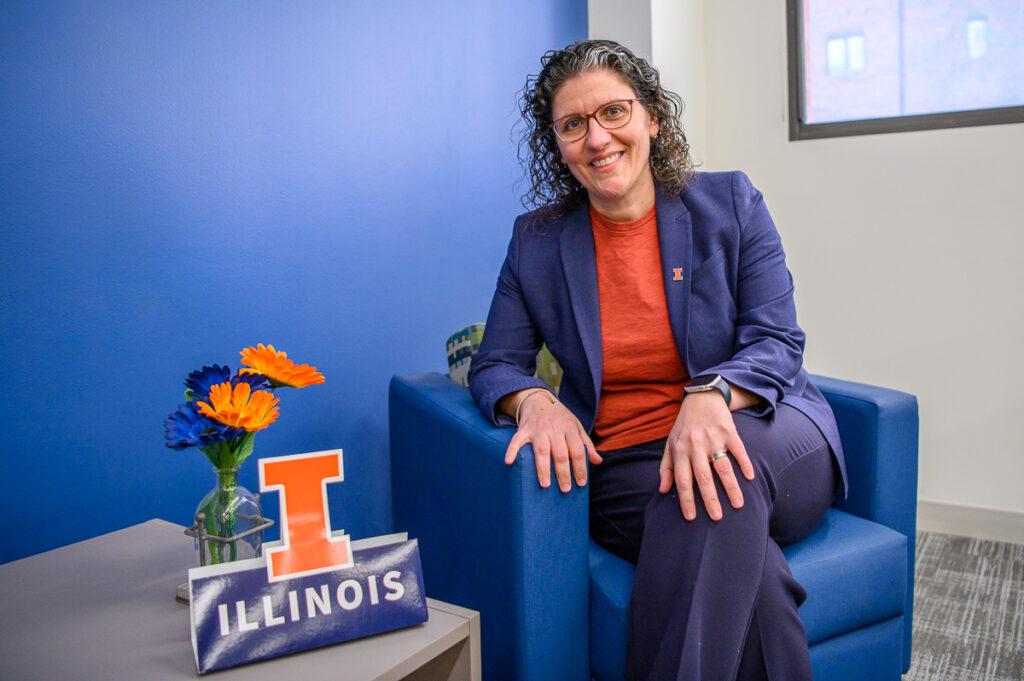
A team of researchers led by Sandraluz Lara-Cinisomo, an associate professor in the Department of Health and Kinesiology at Illinois, recently took a bold step to explore that question. Their study, published in Psychiatry Research: Neuroimaging, asked: Can we measure how new moms’ brains respond to pain using fMRI ? And would moms even be willing to do it?
It turns out the answer is yes.
The study focused on 13 women, 11 without depression and 2 with postpartum depression. The point was to see if the idea would work: Would new moms come into a lab, be willing to experience a controlled pain test while researchers measured their brain activity?
The “pain test” was simple but effective: participants were exposed to a cold-pain device while in the scanner, enough to be uncomfortable but not unsafe. The experiment was repeated five times, during which the women reported how intense and how unpleasant the pain felt.
“Although there is growing interest in the postpartum brain, including in the context of depression, the focus on postpartum pain has stalled,” Lara-Cinisomo said. “Birthing people experience changes that are not often observable. fMRI offers an opportunity to measure their minds process pain while creating a space for them to tell us how it feels to be in pain. This study is the first step toward unveiling how postpartum depression affects pain perception.”
The researchers then compared those reports to what was happening in their brains.
For the women without depression, the scans showed activation in the places you’d expect:
The amygdala (linked to the assessment of pain intensity)
The insula (a key hub for processing physical sensations of pain)
The anterior cingulate cortex, or ACC (involved in emotional components of pain)
When the researchers compared women with depression to those without, they found higher brain responses in the depressed group. Still, those differences were not significant, likely due to the small sample size.
Where things got interesting was in how the women described their pain.
Even though the numbers didn’t hit statistical significance, there was a clear pattern: women with higher depression symptoms tended to find the pain more unpleasant and intense. The depressed group also tended to report the onset of pain earlier in the experiment than the non-depressed group.
So, what is the takeaway from this study?
First, it proved the concept. Postpartum women were willing to take part and found the process acceptable. That matters because there’s often concern about asking new moms to volunteer for time-consuming or physically demanding studies.
Second, it showed that fMRI can capture real brain activity linked to pain in this group. That opens the door to larger-sample studies that could dig deeper into how PPD changes the pain experience—and maybe test which treatments (such as therapy, medication or support programs) improve mood and pain.
The study also adds to the growing recognition that postpartum health is complex. It’s not just about healing physically or adjusting emotionally—it’s about how those two processes interact in ways that can shape daily life for mothers.
Lara-Cinisomo and her co-authors are clear about what’s next: larger studies, with more women experiencing postpartum depression, and identifying interventions to help alleviate their physical and psychological discomfort. That way, they can track how the brain responds to pain might shift as symptoms improve.
How an RST alum became a Hollywood trainer to the stars
Dan Isaacson, center, served as executive director of the Governor’s Council under then-Gov. Pete Wilson. Before Arnold Schwarzenegger became governor, he chaired the council.
Transforming John Travolta. Becoming the first fitness editor for ABC’s “Good Morning America.” Marketing customized racketball racks for the Denver Broncos. Presenting the first wearable fitness device, the Polar Heart Rate Monitor. The list goes on.
“I dream of what could be and say why not? It’s the cornerstone of the creative entertainment community with visionary entrepreneurs like Walt Disney,” Dan Isaacson said. “I know I’m an entrepreneur, and I believe that that’s something I got from the University of Illinois.”
Isaacson, 75, grew up in Quincy, Illinois. His father owned John Isaacson & Sons Trucking and Isaacson remembers his early days as wonderfully rural, including farmhouse living, with no in-door running water or plumbing, one room schoolhouse for his first grade experience, church on Sundays, daily chores and sleigh rides in the winter. He said his background set a base for personal training and coaching others to achieve their goals in life.
“I believe we have a series of connecting dots in life that create a picture of who we are and our life’s story,” Isaacson said. “I grew up riding ponies at age 4, hiking, swimming, riding bikes, playing baseball, basketball, football and the tenor saxophone. It created a work/play lifestyle that developed my work values of discipline and responsibility balanced with unstructured play and the importance of being a person you could count on in life.”
Isaacson earned his B.S. from Western Illinois University in Recreation and Park Administration in 1971 and went on to earn his master’s in recreation, sport and tourism at the University of Illinois Urbana-Champaign.
His reason for choosing Illinois was simple: its historic and unparalleled history in the field recreation and leisure studies. Huff Hall had been graced with several “professors at that time, in the ‘60s and ‘70s, that were true pioneers in health, fitness and recreation education.”
Isaacson said Dr. Joseph Bannon and Dr. Chuck Pezoldt were his mentors. Bannon’s class on decision- making set a base for him that he still uses today, as well as being Pezoldt’s graduate assistant that provided him a guiding light on how to conduct his life personally and professionally.
“Everything to establish the professional importance and value of recreation activity was there,” Isaacson said. “When I got to Illinois, I saw the possibilities beyond just municipal recreation and parks including fitness specialized to improve performance and athletic facility development.”
His first professional role was as a manager of the Sheridan Swim Club in Quincy. Sheridan was also an early training ground for Olympic hopefuls. Nicole Kramer trained there before eventually competing in the 1976 Montreal Olympics for women’s swimming. During those Games, Isaacson was her spokesperson and reported live for the WGEM affiliate in Quincy.
“I got a call from a close friend living in Denver who said, ‘Dan, they’re opening several new athletic clubs in Denver,’ and sent me an article from The Denver Post.”
After that, he headed west.
He began working on programs at elite, full-service athletic clubs that were at the forefront of a new trend: real estate-driven fitness centers in cities like Denver, Las Vegas, Washington, D.C., and Newport Beach. Serving high-profile clients and specifically the baby boomer generation, these clubs helped spark what would become a nationwide fitness boom.
In the early ‘80s, Isaacson found massive success in training John Travolta for a role-specific physical transformation for the movie “Staying Alive.” Not only did he lay the groundwork for a science-based training program, he shifted the way Hollywood viewed strategic fitness as a means for elevating on-screen performance. Following the movie release, Isaacson and his wife opened their first personal training center by Warner Brothers called “Winning Results,” training many of the biggest stars, producers, directors and studio executives in Hollywood.
While Isaacson attributes much of his career success to his academics, he said there were other experiences outside of the classroom that shaped his worldview. He recalled a time when he was invited to play ice hockey with a friend’s friends.
When I got to Illinois, I saw the possibilities beyond just municipal recreation and parks including fitness specialized to improve performance and athletic facility development.
Dan Isaacson
RST alumnus
“Of course, they were hockey ice skaters,” Isaacson said. “I used to ice skate at home, but I only went one way, which was forwards. So, when the puck was passed to me and I had to skate backwards, they shouted, ‘What are you doing?’”
Despite the embarrassment, “it taught me a good lesson: know in life how to go forwards and backwards, right and left, and you’ll be fine,” Isaacson said. “You don’t want to be stuck – you want to have places to go.”
Isaacson said his next goal is to create a city-model to improve overall health and wellness in a community. Today with advanced technology, use of AI, holograms, robots, biohacking information, social media and new products, he said it’s time to develop and provide customized programs specific for cities.
“How do we create a healthy physical behavior pattern for a city in 90 days?” Isaacson said. “It’s a big goal and the next frontier in health, wellness and longevity.”
Even with all his accomplishments, there is one philosophy that Isaacson continues to champion.
“I just don’t want to look back on my life and say, ‘I wish I would have,’” Isaacson said. “It’s ‘Try, fail and sail.’”
John Preston had never been in an integrated environment until he came to the University of Illinois in 1967
John Preston, second from right, navigated an unfamiliar world when he came to Urbana-Champaign (Photo provided)
Arriving at the University of Illinois Urbana-Champaign in the 1970s, John Preston was among the few Black students and people with disabilities on campus. His journey through the university not only challenged him to navigate an unfamiliar world but also taught him the value of embracing life as it comes.
“If you understood what you’re going through, being Black, then what you go through being disabled is just a continuation of having that experience of being different,” Preston said.
In high school, a car accident left Preston paralyzed. The sudden change forced him to navigate a world that wasn’t built for people like him.
Having also grown up in the South, he said he had never been in an integrated environment until he came to U. of I. in 1967 to complete an undergraduate degree in business administration and marketing. It was the only university in the nation at that time that was accessible and accommodating to persons with disabilities.
“When I arrived, I went into my room and I met my roommate. Dwight was from Wisconsin and he was white,” Preston said. “This would be the first time I ever had lived with someone of a different race.”
Preston faced some discrimination in his dorm during the early weeks, but “I was used to it and I soon felt that discrimination melt away when we all got to know each other personally.” For him, the accessibility of the campus and sense of freedom was amazing.
“It was a campus that I could push all over,” Preston said. “I could go from one end to the other, and I could go anywhere in any building. I could get out of my chair and transfer into an accessible shower chair. It was absolutely fantastic.”
He had never lived in a place with accommodations like U. of I. Preston recalled that when he first applied to Illinois, he was missing course requirements like chemistry and algebra. Those classes in his high school were taught upstairs—a place inaccessible to him.
The first thing one has to do is accept, ‘This is who I am’
John Preston
Illinois alumnus
His wife, Lynn Preston, said the integration of people with disabilities isn’t just an opportunity for students with disabilities to have an accessible college program.
“U. of I. offered an opportunity for people who are able-bodied to have a realistic normalized opportunity to integrate with a population that happened to be disabled,” Lynn Preston said. “When we integrate with each other and know each other personally, we don’t see the disability or wheelchair first—we learn to see the person.”
At Illinois, Preston said it was a real treat to be in an environment where he felt comfortable, physically and mentally, as well as educationally.
“I was able to get in touch with a self that I had never been before,” Preston said. “I was able to start thinking about myself as someone who had an opportunity to become different in a world that I hadn’t traversed.”
That physical freedom opened the door to emotional freedom, too—a shift Preston didn’t fully understand until a study abroad trip to France offered and supported by Illinois as part of his master’s program in psychological social work.
A trip to France helped Preston, center, feel more emotional freedom. (Photo provided)
“As far as I can see, people were standing up staring at us—but I didn’t feel bad,” Preson said. “I was trying to figure out, ‘Why don’t I feel bad?’ And I realized that I cannot look inside their heads to see what they were thinking. Whatever negative impressions I was getting was from me—it wasn’t coming from people on the outside.”
It was at that moment, Preston said, that he began to feel OK about himself.
“That was the greatest sense of accomplishment because I came away knowing that my life was about learning how to be OK with me, not about trying to determine whether someone liked me or didn’t like me. It was more about me getting to like me.”
Another experience that defined Preston’s college career was his job as a bouncer at a bar.
“I determined who could come through the door, I was checking IDs at the door,” Preston said. “That was one of the things that really was the normalization process for me. I felt like everybody else because I was doing the same things everyone was doing. I’ll always appreciate the gentleman who gave me the job.”
Shortly after graduating with his B.S., Preston went back to earn his masters in social work. Once it was completed, he packed his car and drove to California, where he landed a job as a licensed psychotherapist for Stanford. His job was to provide sessions to staff and faculty who were having difficulties with their families, the university or any other issues.
“People just feel different sometimes in their environment. We try to get in touch with whom we are within a group of individuals,” Preston said.
He said being in social service helped him understand a lot about individuals and the therapeutic process, and that is intimately tied to my education and experiences at U. of I.
“My success as a psychotherapist was also a result of my coming to terms with myself and the quality of the education that I was getting,” Preston said. “It helped me become a better therapist and gave me the tremendous ability to change my awareness of life to see how I could grow and become the best that I could be.”
Preston said he’s gone on to have a fantastic life, with kids, grandchildren and a great-grandchild with another on the way.
“My life has been more than I could ever have thought it could be,” Preston said.
His philosophy that he has carried throughout his life can resonate with all audiences.
“The first thing one has to do is accept, ‘This is who I am,’” Preston said. “Then, you look at each situation that comes into your life as, ‘How can I be the best me in this situation?’ And you are always looking at life as an ability to grow and become who you are and feel OK about you.”
Tacoria Humphrey was recently named a Dike Eddleman Athlete of the Year, presented annually to the top Fighting Illini male and female athlete
Big Ten long jump champ Tacoria Humphrey has plans beyond her track and field competitions. (Photo courtesy of Fighting Illini)
She races down the rubberized runway, determination pumping through her arms, energy coursing across her strides and focus blazing in her eyes. With a mighty leap, she seems to sail through the air. Sand mushrooms under her shoes as she lands in the pit, the crowd roaring. That’s Tacoria Humphrey—champion of the 2025 Big Ten Long Jump.
Humphrey started track in middle school at Raymond Park Middle School on Indianapolis’ east side, where she broke two records in the high jump and 200 meter. Now, she’s well-decorated: she earned All-American honors in both indoor and outdoor seasons after winning back-to-back Big Ten long jump titles, placed fourth at the NCAA outdoor championships, recorded the third-longest indoor jump in NCAA history as national runner-up and earned a spot on The Bowerman Watch List. Humphrey said her success came from confidence.
“I feel like track is a mental sport,” Humphrey said. “If you believe you can do something, you’re most likely going to be able to do it, whereas if you’re scared or thinking about other people, that’s going to take over your mind and you’re not going to do well.”
Humphrey also attributed her many accomplishments to her training and her coach, Petros Kyprianou, the current director of Track & Field and Cross Country at the University of Illinois Urbana-Champaign.
“He has inspired me the most because he really believes in me, and when somebody just believes in you so much, you start to believe in yourself,” Humphrey said. “He’s just so thrilled to coach me, and he sees that I have a bright future and it just makes me want to accomplish everything to the highest level I can.”
She recalled a moment at the 2025 regionals for the NCAA Outdoor Championships. Competitors only had three jumps, and Humphrey’s weren’t up to the number she needed to qualify for nationals.
“After my second jump, he talked with me,” Humphrey said. “He was giving me that pep talk, like, ‘You got this. This is what you’ve been training for,’ and helping me calm down. I literally went from 15th place to fourth, and I qualified.”
Kyprianou was the one who encouraged Humphrey to switch her event from high jump to long jump her sophomore year of college.
“I definitely was like, ‘This is weird,’ but I love trying new things,” Humphrey said. “I never expected to change events and to do so good in that event, but I 100% don’t regret it.”
“I always love helping people. I’m a people person.
Tacoria Humphrey
Community Health major and Dike Eddleman Athlete of the Year
Outside of her national achievements, Humphrey was recently named a Dike Eddleman Athlete of the Year, presented annually to the top Fighting Illini male and female athlete. The University of Illinois Athlete of the Year was first awarded in 1940, and was named in honor of the 11-time UI letterman and Olympian Dwight “Dike” Eddleman in 1993, who is generally considered the greatest athlete in the history of Illinois Athletics.
Caitlin Clarke, a health and kinesiology teaching assistant professor and chair of the Academic Progress and Eligibility Committee, said that sport performance is typically not the only factor that goes into choosing the recipient of the Dike Eddleman award.
“This is part of the culture of Illinois Athletics—they’re not going to go for someone who’s just really good at their sport and doesn’t care about academics at all,” Clarke said. “We get some really phenomenal students who are both really good at their sport and also really good at their major.”
At Illinois, Humphrey is a community health major, with a concentration in health education and health planning and promotion.
“I always love helping people,” Humphrey said. “I’m a people person.”
This summer, she’s participating in the Health and Kinesiology 471 internship program and working with Wellness4Every1, an organization dedicated to ensuring equitable access to high-quality arts and wellness programs for students in diverse communities. Clarke, additionally a lead faculty for the community health internship program, said Humphrey is doing a great job stepping into the professional world.
“She’s future-thinking, because she knows that she wants to compete professionally for a while, but she isn’t just checking off a box with this internship,” Clarke said. “This experience really pushes students to learn how to communicate professionally, which is an important skill anywhere and can be difficult to navigate.”
Clarke said it’s important for all student athletes to also excel outside of their sport.
“Most of our student athletes are going to go on to careers that are not always directly related to sports, so you have to have a plan,” Clarke said. “You don’t want that plan to be, ‘Well, I just kind of did okay in my major.’ You want to be the rock star that gets into a successful career so that you can enjoy your life and do more to help other people around you.”
Currently, Humphrey is preparing to become a pro athlete. Her first pro meet was the USA Track and Field Championships at the end of July.
“I’ll be a little nervous, but not really, because I’ve been jumping big marks that are close to what pros jump,” Humphrey said. “I’m eager to have better competition, and that will definitely push me.”
For her, success means a gold medal, and with her trademark confidence, it’s not a matter of if—but when.
Sadie Braun, left, is working to develop more accurate and meaningful hearing assessments (Photo by Brian Stauffer)
Imagine sitting in a busy café, struggling to follow a conversation as voices and background clatter blend together. For many people with hearing loss, this is a daily challenge—yet traditional hearing tests, conducted in silent rooms with isolated tones, fail to reflect these real-world difficulties. At the University of Illinois, a team of researchers is working to bridge that gap by developing more accurate and meaningful hearing assessments that simulate everyday listening environments.
Sadie Braun, an audiologist and clinical assistant professor in the Department of Speech and Hearing Science in the College of Applied Health Sciences, is the team’s primary investigator and recently received a $30,000 pilot grant from the Center for Health, Aging, and Disability. She is working with Dan Fogerty, an SHS associate professor, on a project titled “Creation of Speech-in-Noise Profiles for Clinical Fitting of Hearing Technologies.”
The project has two goals, the first being to analyze and better understand speech-in-noise testing results from clinical environments.
“Instead of simply pressing a button when you hear a tone, we’re trying to get more out of tests that already exist which mirror real-world scenarios,” Braun said. “For example, it is fairly common now to play full sentences while background voices are talking at the same time—more like what someone might hear at a party or in a restaurant. We want to use these results to help understand the nuances in what causes understanding-in-noise difficulties on an individual basis.”
The second goal of the project goes a step further: not just measuring how many mistakes a person makes during a hearing test, but understanding what kind of mistakes—and why they happen.
“Right now, clinical hearing tests can tell you that someone misunderstood a sentence, but not how they misunderstood it,” Fogerty said. “Our approach focuses on the types of errors people make and the conditions under which those errors occur.”
By analyzing these mistakes—called error profiles—the team hopes to gain new insights into what’s actually causing the difficulty. For example, one person might confuse similar sounds, like saying “cat” instead of “cats,” which could suggest a problem with sound clarity. Another person might only repeat the second half of a sentence, pointing to a possible cognitive issue like memory or processing speed.
“We’re identifying patterns across different types of errors,” Braun said. “Then we compare those patterns with results from standard hearing tests to see if there are connections. That could help us predict which patients need which kinds of interventions.”
Data collection will begin in the fall and participants will come from patients who come to the Audiology & Speech-Language Pathology Clinic and have consented to their audio recordings being used for this study. Braun said the tests focus more on adults, primarily those in their 50s and upward.
With those error profiles, the team hopes to use those to improve hearing aid fittings and outcomes for patient satisfaction.
“Different types of errors can have different real-life consequences,” Fogerty said. “Identifying the reasons why someone misunderstands speech will help the clinician identify recommendations to address those specific difficulties.”
With support from CHAD, the pilot grant will allow Braun and Fogerty to gather foundational data, refine their testing protocols and begin developing detailed error profiles. Their ultimate goal is to translate this information into better hearing aid fittings, more accurate diagnoses and improved quality of life for patients.
Looking ahead, the team plans to apply for additional funding to expand the project and validate their findings across broader patient populations.
Braun emphasized the strength of the partnership at the core of this work.
“This is a true collaboration between research and clinical practice,” she said. “Dr. Fogerty brings deep expertise in auditory research, while I bring the day-to-day clinical experience. Together, we’re approaching the same problem from different angles—and that’s what gives this project real potential to move the field forward.”
The Chez Veterans Center showed an increase in military-connected student engagement in the first year after implementing a comprehensive case management model.
The Chez Veterans Center has refocused on more individualized care
The number of unique students Chez served increased by 25.89%, meaning that the center had expanded its reach to more students while focusing on more targeted, individualized care. Andy Bender, director of operations and services at Chez, said that the focus of this initiative was putting the person back into what they do.
“What do we need to do in order to connect with the students on a human level and show them that we care and we really are interested in their success?” Bender said.
The initiative was spearheaded by Ingrid Wheeler, Chez’s assistant director for behavioral health programs, who took the concept of the new model and made it into a practical application. Wheeler said that the shift began with questions like the one above, and evolved over time through the pandemic and as the Veteran population changed.
Her background in social work and case management helped her recognize that “a more individualized plan has to be in place to really support the ever-changing needs,” she said. “It’s about seeing it through a different lens that maybe we wouldn’t have if we weren’t seeing them as an individual.”
Cheryl Hanley-Maxwell, dean of College of Applied Health Sciences, was also part of conversations from the beginning, said Bender. She has been supportive of Chez’s mission shift and provided resources and knowledge about transition. Additionally, the Chez team said that student feedback, through their conversations with staff, was another part of shaping the new model.
Bender said that a September 2023 visit from Samuel Skinner, an alum and former White House chief of staff, had prompted the team to look more deeply into how Chez was caring for students. Previous to this shift, Bender said the way things were run wasn’t wrong, but that this mission change is a new approach to making a more powerful impact.
“A lot of our things were based on transactional services,” Bender said. “It was reliant on the student identifying that they have a problem and identifying a source for relief of that challenge. Often what would happen is the student would come in, they’d get the help, and then we’d never see the student again.”
Chez still provides those transactional services, such as assistance with Veteran benefits, resume writing and counseling, but now with an emphasis on continuing to check in with students. Chez documented 1,287 case management encounters this past year, ranging from quick check-ins to intensive support sessions.
Another aspect of the mission change was assessing what might be barriers for students and providing them with resources before they run into those barriers.
“Now we’re reaching out to students individually several times throughout the semester to really pull them in and have those conversations of ‘What’s brought you to campus? What are your goals?’” Wheeler said. “We can connect them to different resources, whether it be in the center or on campus, versus ‘Oh, you came to orientation—here’s a couple of pamphlets with everything on campus. Good luck!’”
What do we need to do in order to connect with the students on a human level and show them that we care and we really are interested in their success?
Andy Bender
Chez Veterans Center director of operations and services
She also said that Chez has been making sure that its own staff is equipped to answer the main areas that many students have questions about, such as resume review, so that students aren’t bounced around as much.
John Goeken is an electrical engineering undergraduate student and a former Marine and combat Veteran. Goeken’s first interaction with the Chez Veterans Center was through the Warrior’s Scholar Project, a “boot camp” started in 2022 for military-connected students to reacquaint themselves with the classroom environment.
“The hospitality that they had for us for that program for each student—they were willing to go out of their way and make sure we were accommodated,” Goeken said. “It was just above and beyond the reception you get as a Veteran anywhere else.”
Goeken recalled the first time that he spoke to Wheeler—he said he was just blowing off steam about difficulties adjusting during his first semester, including figuring out childcare.
“I’m just venting all this stuff, and she’s taking all these mental notes and literally follows up with me on an email that day an hour or two later with a list of resources for me to investigate,” Goeken said. “That was huge. I still have the list, too.”
Goeken said that he didn’t realize how much stress can compound, especially with the loss of structure and support that came with being in the military.
“But Chez helps fill that gap with knowledge, hospitality and resources,” Goeken said. “It hasn’t been any grand gesture, but it’s been all these little incremental things.”
Another student-Veteran, Jacob Means, is a social work student and a former Chez resident advisor. He said the biggest service Chez has done was connect him with the community.
“The biggest thing for me was the people,” Means said. “It’s hard to connect with people in class. With Chez, you’re immediately ingrained in this really welcoming community of people that are very excited to have you there and that understand you, which is super hard in college.”
Means also said that a benefit of living right above the CVC was the close access to all of Chez’s resources.
“It takes people like me, who were scared and alone and didn’t know what to do, and it empowers them and it gives them all this ability to feel able to say, OK, I can leave this housing and understand what’s going on now,’” Means said.
With the new model, the Chez team said its focus is to improve and develop what it is doing, which often means taking into account military-connected student feedback.
Goeken suggested more resources with specifics to different colleges, as well as Chez taking a more proactive role in encouraging Veterans to access the benefits available to them.
“There are so many resources out there, but Veterans like myself often don’t know what’s available, or how to stay informed,” Goeken said. “If Chez could expand its outreach or offer low-pressure education around available benefits, through peer support, onboarding, or regular updates, I think it could make a real and lasting impact.”
Even with the increase in quantitative data of this year’s engagement, Bender said success isn’t defined by numbers.
“I want the success to be more about how the student defines their success,” Bender said. “Again, every student is different and everyone has a different idea. If we’re going to put humans back at the center of all we do, then the numbers can’t be the most important—it has to be the feedback they give us on their success and if they feel like they’ve achieved their own goals.”
Paralympic multi-medalist Susan Hagel and the 2004 gold-medal-winning women’s wheelchair basketball team were among those selected for induction this summer into the U.S. Olympic & Paralympic Hall of Fame.
AHS alumna Susan Hagel (No. 31) was among those selected for induction into the USOPC Hall of Fame this summer (Photo courtesy of Susan Hagel and DRES)
The USOPC announced on Tuesday its Class of 2025 that brings together eight individual Olympic and Paralympic athletes, two teams, two legends, one coach and one special contributor.
Beside Hagel, an alumna of the College of Applied Health Sciences at Illinois, and the 2004 women’s team, which includes 10 Illinois alumni, the inductees include Steve Cash (sled hockey), Gabby Douglas (artistic gymnastics), Anita DeFrantz (legend: rowing), Allyson Felix (track and field), Flo Hyman (legend: indoor volleyball), Kerri Walsh Jennings (beach volleyball), Mike Krzyzewski (coach: basketball), Phil Knight (special contributor: Nike founder), Bode Miller (alpine skiing), Marla Runyan (Para track and field), Serena Williams (tennis) and the 2010 Four-man Bobsled Team.
“We’re proud to welcome the Class of 2025 into the U.S. Olympic & Paralympic Hall of Fame and to honor the extraordinary accomplishments they’ve made as representatives of Team USA,” said USOPC CEO Sarah Hirshland. “This induction celebrates not only their remarkable performances and lasting impact but also acknowledges the essential contributions of those who supported their journeys every step of the way. Earning a place in the Hall of Fame is no small feat—especially given the incredible talent across this year’s group of finalists.”
The Class of 2025 has represented the United States at a combined 42 Olympic and Paralympic Games, earning 51 medals, including 35 golds. This year also marks the introduction of three new sports or disciplines to the U.S. Olympic & Paralympic Hall of Fame: Para archery, represented by Hagel; women’s wheelchair basketball, through the 2004 U.S. women’s team; and women’s rowing, with Anita DeFrantz becoming the first female rower inducted.
The distinguished class of 2025 includes:
Susan Hagel (Paralympian: wheelchair basketball, Para archery, Para track and field – 1976, 1980, 1984, 1988, 1992, 1996)
Hagel is a trailblazer in adaptive sport, having competed in six Paralympic Games across three different sports where she earned four gold and two bronze medals. Over the course of her decorated career, she earned numerous honors, including the prestigious International Wheelchair Basketball Federation Triad Award in 1998. A 16-time All-Tournament Team selection, Hagel was a cornerstone of 14 U.S. national teams, representing her country at the Paralympic Games, Pan American Games and Gold Cup competitions. As a member of the NWBA Hall of Fame committee, Hagel continues to champion opportunities in sport for individuals with disabilities. A role model to women and junior girls in the National Wheelchair Basketball Association, she holds the distinction of having the longest playing career of any woman in her division. Hagel’s legacy is defined not only by her athletic achievements but also by her unwavering dedication to the growth and inclusivity of adaptive sport.
2004 Women’s Wheelchair Basketball Team (Paralympians: Susan Katz, Christina Ripp, Renee Tyree, Janna (Crawford) Mizens, Carlee Hoffman-Schwarz, Stephanie Wheeler, Teresa Lannon, Jennifer (Howitt) Browning, Jennifer Warkins, Emily Hoskins, Patty Cisneros Prevo, Jana (Stump) Shelfer)
The U.S. women’s wheelchair basketball team won its first gold medal in 22 years at the Athens 2004 Paralympic Games. Ten of the members (Jennifer Warkins, Janna (Crawford) Mizens, Patty Cisneros Prevo, Susan Katz, Teresa Lannon, Jana (Stump) Shelfer, Stephanie Wheeler, Carlee Hoffman-Schwarz, Emily Hoskins, Christina Ripp) are Illinois alumni. Christina (Ripp) Schwab and Stephanie Wheeler went on to coach future national teams, Wheeler in 2016 and 2020, and Schwab in 2024. Both are members of the National Wheelchair Basketball Association Hall of Fame. Six members of the 2004 team (Emily Hoskins, Patty Cisneros Prevo, Carlee Hoffman-Scwarz, Wheeler, Schwab and Jennifer Warkins) returned to win gold again at the Beijing 2008 Paralympic Games, marking the first back-to-back titles for the program. In 2004, the U.S. defeated five-time defending champion Canada in a tough semifinal and avenged a narrow group-stage loss to Australia with a 56–44 victory in the gold-medal game, setting the stage for continued success in future Paralympic Games.
May 22, 2025 | Laura Payne, Mike Raycraft, Kim Shinew and Monika Stodolska
Jack Kelly, a professor in the Department of Leisure Studies at Illinois for many years, died on Feb. 10, 2025, at the age of 94 (University archives)
Jack Kelly, a professor in the Department of Leisure Studies at Illinois for many years, died on Feb. 10, 2025, at the age of 94. Faculty members of the Department of Recreation, Sport and Tourism collaborated to write this remembrance of Kelly.
Professor Emeritus Jack Kelly was a trailblazer in the field of Leisure Studies and was instrumental in establishing the field of Leisure Studies. Kelly anticipated many societal issues and trends in the 1970s and early 1980s that advanced knowledge of healthy aging, the study of work and leisure, socialization and leisure and family leisure.
“We as a field owe Jack a great deal,” said retired RST faculty member Kim Shinew, who joined Kelly at the University of Illinois in 1993. “He catapulted us forward by making our research more relevant, and he increased our visibility to others outside the field.” Dr. Kelly’s research laid the theoretical foundations of the field through seminal works such as Leisure; Sociology of Leisure; Freedom to Be: A New Sociology of Leisure; and Leisure Identities and Interactions.
Kelly was one of the first leisure scholars to recognize that research advances were not keeping pace with societal trends and issues. He pushed the field to address the sociological and psychological aspects of leisure, which offered important advancements in leisure research and contributed to the development of professional best practices. A dynamic teacher, Kelly emphasized the connections between research and professional practice.
“I was fortunate to be a student in Dr. Kelly’s final LEIS 501 course in the early 1990s,” said RST faculty member Michael Raycraft. “He made it clear that an appreciation of leisure theory was critical for practitioners as it guided informed decisions and was the basis for effective RST programming. That was heavy stuff for a kid fresh out of business school. I am grateful to have learned from one of the best!”
Kelly’s pioneering research and dynamic teaching are stellar accomplishments in their own rite, but even more impressive since higher education was his second career.
Kelly grew up in Chicago and studied philosophy at Monmouth College and then earned an M.A. in Theology from Yale University to pursue a career as a congregational minister. Newly married to his beloved wife Ruth, the couple moved to rural Montana where Kelly served in two parishes that were so far apart, he flew his Cessna airplane back and forth between church services. In the 1960s, he decided to change careers and earned both master’s and doctoral degrees in sociology from the University of Oregon.
Kelly spent most of his career at Illinois as a professor in the Department of Leisure Studies and the Institute for Human Development. He was also the Director of the Gerontology and Aging Studies program. “He enjoyed mentoring young faculty and encouraging them to conduct creative and meaningful research,” Shinew said. “Over coffee on campus or dinner at his home, Jack stressed the importance of research to advance the field.”
Faculty member Monika Stodolska remembers meeting Kelly when she joined the faculty in 1999. “He mentored me in the first course I taught at UIUC. Jack taught Theories and Concepts of Leisure for a long time, and I began teaching the course when he retired from our faculty. I still use some of the classic texts that Jack put on the reading list. His legacy lives on.”
Jack’s life exemplified his knowledge of the importance of leisure throughout the lifespan. He practiced what he preached.
Kim Shinew
Retired RST faculty member
After retiring, Kelly remained active doing research, teaching and publishing journal articles and books. He returned to Illinois in 2001 for one semester to teach a graduate course on Sociology of Leisure and connect with faculty and students.
Faculty member Laura Payne recalled her first meeting with Dr. Kelly when she joined the department in 2001.
“Jack was so welcoming and tried to connect with me,” Payne said. “We got together and discussed our shared interests in trends and issues, especially about health and aging, and I learned a lot from our thought-provoking conversations.”
A prolific writer, Kelly authored 11 books, many of which were considered seminal, including the classic conceptual and theoretical texts already mentioned, and widely read books such as Leisure, Activity and Aging, Recreation Business, and Recreation Trends and Markets in the 21st Century, whom he co-authored with Dr. Rodney Warnick, a faculty member at the University of Massachusetts.
Kelly had a wide range of leisure interests. He enjoyed the arts, tennis, singing, reading, flying and the outdoors. After he retired, he and Ruth spent time at their homes on Beaver Island, Michigan and on Jekyll Island, Georgia where they enjoyed bicycling, tennis and other outdoor pursuits.
“Jack’s life exemplified his knowledge of the importance of leisure throughout the lifespan. He practiced what he preached,” Shinew said.
April 25, 2025 | Pamela Hadley, Charles and Kay Stenberg Professor and SHS Department Head
Pamela Hadley
Dear Students, Faculty, Alumni and Friends of the Department of Speech and Hearing Science,
As we step into the energy of spring 2025, I’m excited to share the latest updates from our department. It’s been a remarkable year, and we have so much to celebrate!
Our commitment to advancing the field of communication sciences and disorders continues to grow. In this edition, we highlight the inspiring achievements of our faculty, students and alumni. We have stories on a newly established aphasia group, multiple grants on understanding and improving hearing in noise, how our research translates to the lives of friends and family and an introduction to one of our new faculty members.
Take a moment to explore the stories in this newsletter and reflect on the incredible work in SHS. Together, we’re pushing boundaries, advancing new approaches to treatment, and improving lives of children and adults.
A heartfelt thank you to our dedicated faculty, staff and students—your passion and perseverance are the heart of our success.
Wishing you a vibrant and inspiring spring season!
Sincerely, Pamela Hadley, Ph.D. Charles and Kay Stenberg Professor and Head
A new weekly aphasia communication group is helping Illinois speech-language pathologists understand the condition
The weekly aphasia communication group is the ‘best hour’ of everyone’s week, one member said. (Photo by Ethan Simmons)
In the days following her stroke, all Mary Moore could remember was two phrases: her name, and Dec. 26, the day she was born.
A short five months later, Moore was in the Audiology and Speech-Language Pathology Clinic, leading a lively conversation with students at the University of Illinois Urbana-Champaign. She’s now a regular attendee of the Aphasia Weekly Communication Group, a brand new initiative in the Department of Speech and Hearing Science at Illinois.
“It’s very accommodating to people, and it’s just so, so much fun,” Moore said. “It helps your ability to socialize and get out there when you go back home afterwards.”
Now that Moore is living with aphasia, a language disorder that limits the comprehension and production of speech, she knows her conversational skills may never return to her pre-stroke fluency. But the camaraderie she experiences each week with the group provides a regular boost to her confidence.
The aphasia communication group brings master’s degree students studying to become speech-language pathologists together with adults with aphasia for hour-long chats.
The table topics at the clinic range from basic icebreakers (“Who’s your favorite celebrity? What’s a fun fact no one knows about you?”) to short word games and trivia contests. Each session challenges the participants on their recall of people, places and things, while the students gather valuable insights about how aphasia is experienced in the real world.
All the students are enrolled in a class, SHS 534 Aphasia and Related Disorders, taught by Teaching Assistant Professor Anna Pucilowksi. Department faculty have been hoping to add a real-life dimension to the class for years, and now, they finally have it.
Abby Franz, a longtime SLP and instructor at the Illinois clinic, has facilitated the weekly aphasia group since it kicked off in January.
“Our goal was to make sure the students understood this was an opportunity for the individuals who have aphasia to enhance their communication in a more informal social conversation because individuals who have aphasia often become isolated. They don’t get the same social experience just because of their language impairment,” Franz said.
“This is an opportunity for them to come together, socialize and interact with other individuals who have aphasia, which they really appreciate—I’m finding that to be very important to this group.”
A New Opportunity
According to the National Aphasia Association, at least 2 million people in the U.S. live with aphasia. The most common cause is from strokes: nearly one-third of the strokes that occur each year in this country, or roughly 225,000, result in aphasia.
For such a prevalent language disorder, SHS faculty felt their students needed more exposure to understand aphasia more fully.
“It was really obvious that our master’s students were not having real-life experience talking to people with aphasia,” Pucilowski said. “For previous cohorts of students, the course material just seemed really theoretical. I can show them videos, but they’re not actually learning what it’s like.”
Though this aphasia communication group is completely new for the Department of SHS at Illinois, similar conversation groups are common at hospitals and recovery centers across the country, Franz said. An aphasia communication group existed at Carle Hospital in Urbana, but it petered out prior to the COVID-19 pandemic.
At SHS, the need for more in-person interaction began bubbling further when the department yielded a larger-than-usual cohort of students. Then, the Audiology and Speech-Language Pathology Clinic became certified to accept Medicare clients last spring, bringing in more older adults to the clinic.
Pucilowski and Franz put together a proposal for the aphasia group in fall 2024, and the plan was quickly accepted. All that was left was to find participants.
To get the word out, they relied on word-of-mouth and some boots-on-the-ground flyer marketing, mainly in nearby health care facilities. In the first semester, around five regular participants have continued to show and chat with Franz and the students.
Aphasia manifests in a broad spectrum. On the severest end, clients with aphasia may struggle to communicate a single word or sound, or their comprehension could be significantly impaired. On the milder side, individuals with aphasia may speak quite fluently, Franz said, even if they misuse or mispronounce certain words, or halt as they try to recall the correct phrase.
This is an opportunity for them to come together, socialize and interact with other individuals who have aphasia, which they really appreciate—I’m finding that to be very important to this group.
Abby Franz
SLP and instructor at the Audiology and Speech-Language Pathology Clinic
In the current aphasia communication group, participants are all on the milder end of the spectrum. More importantly, they’ve gotten along swimmingly.
“The group’s really pretty fluent. The dynamic’s great,” Franz said. “They all are very unique and have a lot in common and are very interesting individuals. And that was just purely by luck.”
The ‘Best Hour’ of the Week
At their Wednesday session before spring break, students and participants in the aphasia communication group were asked to describe their experience with the group in one word.
Student Michaela Herwig chose the word “blessing.”
“It’s been really cool learning about them as people,” said Herwig, who’s training to become a clinical SLP. “Because before they had their strokes and before they had aphasia, they’ve lived very cool lives and they still do really cool things now, even though they might have to adapt them in different ways.”
As the weeks went on, new fascinating biography details kept leaking out from the participants. Many of the participants happen to be world travelers, for example, having spent years living overseas or learning different languages.
Within Herwig’s class of future speech-language pathologists, word about the aphasia group is starting to spread.
“We all describe this group as the best hour of our week,” she said. “Being in this group has solidified that this is a population I really want to work with when I graduate.”
For the students, each hour in the group is an opportunity to improve their clinical writing skills when working with individuals with aphasia and practice the right communication approach with these clients. In the first phase of the aphasia class, students complete a supported communication training where they learn strategies of how best to interact with patients with aphasia.
When a speaker with aphasia is working to get their point across, subtle nods and nonverbal cues in response go a long way. Sometimes, the students will rephrase a question to make sure everyone’s on the same page or ask the participant to write down the sentence they’re caught on.
“People who have a language disorder, they have full lives and they’re doing their best to recover and get through life,” said Tony Jacobs, a first-year SLP student who was placed in the group. “To see people with aphasia holistically and not just learning about it in class is one of the best parts of this group.”
In the second part of the aphasia class, students design their own eight-week aphasia intervention program—anything from a book club, to a volunteer group, exercise club or another socially driven way to engage participants. The aphasia communication group provides a hands-on learning experience of what these programs can look like.
“The way aphasia is getting treated nowadays, it’s with what’s called the ‘life participation’ approach to aphasia,” Pucilowksi said. “You don’t just come to a clinic and do some exercises and expect your language to change. You have to situate it in context, and language happens in groups and communities.”
The Road Ahead
What does recovery look like for a person with aphasia? With the most common cause being a stroke, the severity of the stroke and age of the patient are the main variables. Most patients can expect their fastest language recoveries in the first 3 to 6 months. A year out, progress typically levels off.
The class, instructors and participants want to keep this aphasia communication group going. (Photo by Ethan Simmons)
Communication groups target the isolation that comes with aphasia, improving the participants’ social health as much as their physical health.
“If we can improve their life, even if it’s just one of them, if they’re feeling more comfortable socially and we’re enhancing their life, then the goal is met, right?” Franz said.
With the first semester wrapping up smoothly, the class, instructors and participants want to keep this aphasia communication group going. There are undoubtedly more people in the Champaign-Urbana area with aphasia, and more students in the department eager to learn from the experience.
“If we can start offering these eight-week programs and groups, and more niche specialty groups, I think that would be great for the students and great fun for the participants,” Pucilowski said. “That would be my dream.”
From the time she walks into the sessions on Wednesday mornings, Mary Moore can hardly wipe the grin off her face. It’s hard to believe now, but months ago she was on the fence about joining the aphasia group at all. After understanding her diagnosis, she became determined to “do her homework.”
“I just had to get better. I had to get better,” Moore said. “I just decided I wanted to go, no matter whether it was in winter or whatever, that I wanted to go. So I did.”
Moore feels a weight lifted when she’s back in the room with Franz and the students. Gone are any airs of judgment when she stammers searching for the correct word, only patience and understanding.
Her advice to any adults with aphasia thinking about joining: “Go for it.”
“The students are wonderful, and they are very kind. They don’t talk about you, they listen to you and they care about you,” Moore said. “It’s just so good, it’s beyond belief.”
(Interested in joining the aphasia communication group, or want to learn more about the Audiology and Speech-Language Pathology Clinic? Contact shsclinic@illinois.edu or call 217-333-2205.)