The College of Applied Health Sciences featured students in its annual magazine, Moving Forward: Emmanuel Dubure, left, Byron Juma and Jemimah Bakare, right. (Photo by Michelle Hassel)
In its 2020-2025 strategic plan, the College of Applied Health Sciences makes a commitment to improving the access and affordability of its programs and reducing barriers that have historically limited individual opportunity.
For international students, the prospect of pursuing degrees in the United States can be both alluring and daunting. While the U.S. system of higher education is widely regarded as among the best in the world, the expense of moving overseas, securing required visas, learning a new language in some cases and adapting to a new culture can be overwhelming. One way to increase educational opportunities for both international and U.S.-based students is to offer degree programs and professional certificates online.
Currently, AHS offers a master’s degree and professional certificate in recreation, sport and tourism online, as well as a certificate of professional development in information accessibility design and policy. Efforts are underway to create two new online degree programs in the Department of Kinesiology and Community Health, the Master of Public Health and the Master of Health Administration. In addition, the online master’s degree in RST will be restructured into three specialized degrees. Each new program also will offer online certificates that focus on professional skills that are in demand. For example, non-degree students and other professionals can take advantage of the college’s expertise in public health and health administration by pursuing certificates in epidemiology, biostatistics, public health, physical activity and health, health promotion, health finance, healthcare quality and health informatics.
Cheryl Hanley-Maxwell, dean of AHS, said the college is always happy to welcome students to campus but recognizes the challenge residential learning poses for many.
“We have incredible, internationally renowned scholars on our faculty and degree and research programs that are exceptional and visionary,” she said. “We want to continue our leadership in health and health-related education by sharing our outstanding resources with a global audience.”
According to the Investment for Growth proposal submitted by the college, the online MPH program could begin enrolling students by year three of the process, while the MHA program is expected to enroll students by the fourth year. As far as the RST plan, following two years of redesign, the department plans to enroll students by year three.
In 2023, the College of Applied Health Sciences chose four AHS graduates to receive alumni awards. These awards serve as a testament to the unwavering dedication and great contributions of our graduates.
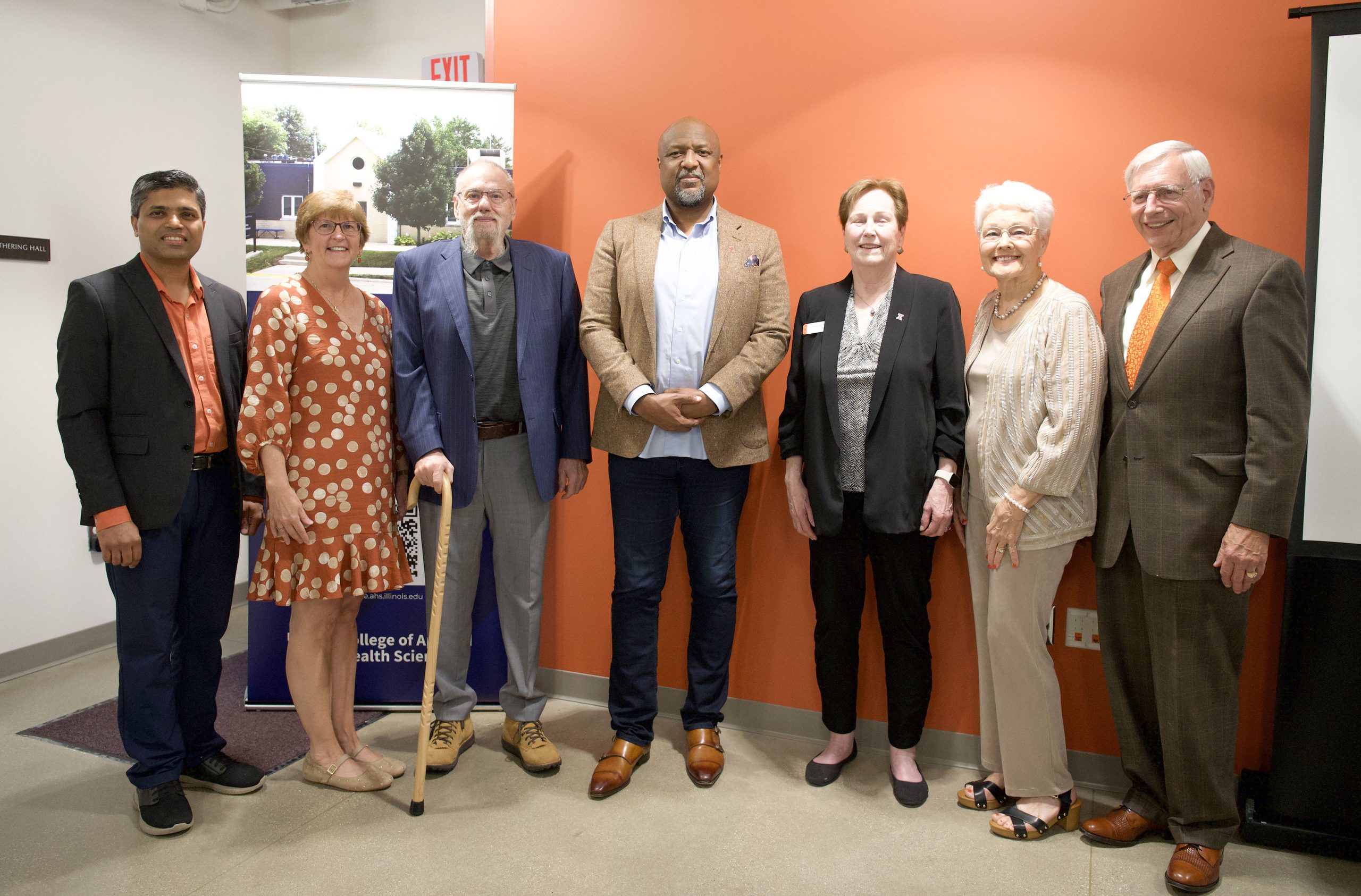
Dean Cheryl Hanley-Maxwell, left, stands with alumni award winners Michael Leach, Saul Morse and Walter Johnson. William Haskell was unable to attend the ceremony. (Photo by Jerry Thompson)
Young Alumni Award Michael Leach Recreation, Sport and Tourism
Michael Leach was appointed as the first-ever chief diversity and inclusion director for the White House in January of 2021. Leach, who earned his bachelor’s degree from RST in 2009, spent more than five years working for the National Football League on the NFL Management Council and later worked for the Chicago Bears and Miami Dolphins.
“I am truly humbled and honored to receive the 2023 Young Alumni Award from the University of Illinois at Urbana-Champaign,” Leach said. “My time in the College of Applied Health Sciences, and the institution more broadly, was nothing short of transformative.”
Harold Scharper Award Saul Morse Disability Resources and Educational Services
Saul Morse earned his bachelor’s degree (1969) and law degree (1972) at the University of Illinois and since has focused his practice on legislative matters, health law, insurance and municipal law. In 2010, with the passage of the Affordable Care Act, Morse was asked by the Illinois Department of Insurance to establish and manage an insurance pool for individuals with pre-existing health conditions.
“The Harold Scharper award is of great importance to me,” Morse said. “I came to the University of Illinois as a 17-year-old freshman. At the time, no other university in this country had a program which fully included students with a disability in all aspects of campus life, from academics to housing to activities. Most of what I have been able to do personally, professionally and within the broader community is due to the DRES program of the college.”
Distinguished Alumni Award William Haskell Kinesiology and Community Health
William Haskell is an internationally renowned researcher and emeritus professor of medicine at Stanford University. Haskell earned his Ph.D. in exercise physiology from the University of Illinois in 1966, and his work and achievements have clearly fulfilled the Illinois mission.
“It is truly an honor to receive the Distinguished Alumni award,” Haskell said. “Attending the University of Illinois at Urbana-Champaign offered me the opportunity to study and work with a large range of outstanding faculty and students, many of whom became exceptional leaders in exercise science research and teaching, as well as lifelong colleagues and friends.”
Walter Johnson Recreation, Sport and Tourism
Walt Johnson was born in Watseka, Ill., and graduated from the University of Illinois in 1958 with an undergraduate degree from the RST program. Later he entered the graduate program in RST and had the privilege of learning from both Professor Charles Brightbill and Dr. Alan Sapora. Upon graduation from the RST master’s program in 1962, Johnson moved immediately into a career in parks and recreation, where he served in a number of key leadership positions.
“The University of Illinois has always been the reason for my success and the lifestyle I live today,” Johnson said. “It gave me knowledge, hope and encouragement. Growing up on a farm and spending hours on a John Deere tractor since age 8, and milking cows, planting, cultivating and raising cattle and pigs, I determined I did not want to be a farmer.”
Anyone who has been fortunate enough to work with Kim Graber should be thankful she wasn’t a very good cook.
Kim Graber was appointed as the Shahid and Ann Carlson Khan Professor in AHS on April 22 (Photo by Craig Pessman)
Graber, the head of the Department of Health and Kinesiology in the College of Applied Health Sciences, was appointed as the Shahid and Ann Carlson Khan Professor in AHS on April 22.
In a heartfelt ceremony attended by university leadership, colleagues, students and alumni, Graber was recognized for her outstanding contributions to research, education and service over a career spanning more than three decades.
Graber, who grew up in Barrington, Illinois, said she did not think about becoming a professor because, at that time, “Career opportunities for women were limited, and girls were taught to dream about a career in teaching, nursing, or secretarial work.”
So, when she started college at Valparaiso University, she began as a student in home economics.
“That, however, lasted only a year because I didn’t enjoy cooking and wasn’t very good at it, as my family will attest,” she said during her investiture ceremony.
The event was opened by Cheryl Hanley-Maxwell, dean of the College of Applied Health Sciences, who highlighted the significance of an endowed professorship.
“Endowed professorships enable us to recognize, reward and retain outstanding scholars whose work brings renown not only to them but also to the college and the university,” Hanley-Maxwell said.
Hanley-Maxwell emphasized that such honors are reserved for faculty members at the pinnacle of their fields, affirming Graber’s well-deserved recognition.
The investiture ceremony also paid tribute to Shahid and Ann Carlson Khan, whose philanthropy made the professorship possible. Hanley-Maxwell recounted the Khans’ inspiring journey from their days as University of Illinois students to becoming leading entrepreneurs and philanthropists. Shad Khan’s story, from washing dishes for $1.20 an hour to leading a multi-billion-dollar global enterprise, was shared as a testament to resilience, innovation and community spirit.
Today, the Khans’ support extends across the university, including significant contributions to the Krannert Center for the Performing Arts, the College of Business, the College of Veterinary Medicine and the Khan Annex to Huff Hall.
Following remarks from University Provost John Coleman, the ceremony turned its focus to Graber’s achievements. After Valparaiso, she transferred to the University of Iowa to study physical education, setting her on her current path.
Graber’s academic journey took her to Columbia University for a master’s degree in movement sciences, an experience she describes as “the best year of my life.”
Graber embraced New York and would have continued for her doctorate at Columbia if not for the fact that the university didn’t offer teaching assistantships, and the accumulation of debt. So, she pursued her doctorate at the University of Massachusetts at Amherst, developing a passion for understanding how individuals learn and socialize into teaching professions.
“It’s where I learned to understand research, write like a scholar and think like an academic,” she said.
It’s where I learned to understand research, write like a scholar and think like an academic.
Kim Graber
Shahid and Ann Carlson Khan Professor
Graber’s research, grounded in teacher socialization theory, has significantly influenced how scholars and practitioners view learning and professional development in education, particularly within physical education.
Graber’s work has been widely published in leading journals such as Teaching and Teacher Education, Research Quarterly for Exercise and Sport, Quest, and Kinesiology Review. She has been a leading voice in examining how undergraduate education shapes future educators, and her later work has expanded to issues such as legislative policy in schools, children’s wellness, curriculum design, and the demographics of teacher educators.
Beyond her research, Graber is a well-recognized as an educator and mentor. Her devotion to undergraduate education has earned her prestigious awards, including the University of Illinois’ Distinguished Teacher/Scholar Award and the college’s Phyllis J. Hill Award for Exemplary Mentoring.
She emphasized the joy of teaching, saying, “To play a small role in preparing individuals to make a better future for others is very satisfying.”
Her service contributions are equally significant. As department head of Health and Kinesiology, Graber assumed leadership just as the COVID-19 pandemic unfolded. Undeterred by unprecedented challenges, she spearheaded efforts to revitalize the department through strategic planning, curriculum redesign and faculty expansion. Under her leadership, the department saw a substantial decrease in the student-to-faculty ratio, bolstering its academic standing.
In her speech, Graber expressed profound thanks to Shahid and Ann Carlson Khan for their support, to her mentors and collaborators such as Tom Templin and Amy Woods, and to her colleagues, students and family. She also shared touching stories of the relationships that sustained her through her academic life, including the pivotal support of her mother, now 95 years old, whose wisdom and encouragement made her achievements possible.
“She and my dad are the reason I attended college,” Graber said. “It was a family expectation that has served me well. As she will tell you, I’ve always been fiercely independent and determined, and she had the wisdom to set me free. That freedom has led to a very rich life and fulfilling career. Thanks, mom.”
In closing, Graber thanked for Khans for their “many contributions to the greatness of the University of Illinois.
“You are role models for sharing your success with others, and that is no small feat. Thank you from the bottom of my heart.”
Alicia Kraay’s study shows getting vaccine boosters and using non-pharmaceutical interventions can reduce cumulative deaths from COVID-19.
In a recent publication, Kinesiology and Community Health assistant professor Alicia Kraay and her collaborators write that combining boosters and non-pharmaceutical interventions results in a 30 percent decrease in cumulative deaths due to COVID-19, with potential for greater impacts if variant-adapted boosters are used.
Non-pharmaceutical interventions, or NPIs, include wearing a mask and social distancing, but also “surface decontamination and improved hygiene,” said Kraay.
According to Kraay’s publication, “The role of booster vaccination and ongoing viral evolution in seasonal circulation of SARS-CoV-2” in the journal The Royal Society, a rise in COVID-19 infection rates are expected this fall as the use of NPIs is relaxed.
“This year, we expect a fall surge, in part because we expect the transmission rate to be seasonal,” she said. “And we’ve also seen people have relaxed NPIs.”
Kraay attributed the decrease in NPIs in part to pandemic fatigue.
“Also, people’s different perception of safety now that vaccination is more widespread,” she said. “Some of the initial strategies that were proposed are simply not sustainable in the long term. It’s not really possible for elementary schools to do virtual learning only for the next 10 years. And there are issues with feasibility in certain contexts like elementary schools, with adequately distancing young children and getting perfect mask compliance.”
But Kraay wanted to emphasize that the important thing about NPIs is they’re not all or nothing.
“You don’t just tell people, ‘Oh, you need to stay at home now because cases might be increasing, and you should do nothing. That’s, I think, what happened at first early in the pandemic,” she said “You’re not going to get high compliance if you make recommendations like that. And it’s also not scientifically appropriate because not every type of interaction has the same level of risk. I think in order to get NPI compliant, it’s being clear about when NPIs are needed and when they’re not and what type is the most effective.”
Kraay, an infectious disease epidemiologist who did her undergraduate work at North Carolina-Chapel Hill and got her Ph.D. at Michigan, recommends wearing a mask in crowded situations you cannot avoid, and limiting appearances at large gatherings.
In terms of boosters, Kraay said ongoing safety studies will be important to ease concerns about vaccine safety, especially among parents.
“It’s going to be important to understand more about the impact of boosters,” she said. “In my paper, we assumed that boosters could reduce risk of infection. But the booster data hasn’t been fully analyzed yet. Seeing what happens with these variant-specific boosters and are there impacts in reducing transmission, and really quantifying how much it can help if you get boosted … at the population level, I think it could be useful.”
One thing Kraay remains uncertain about is whether the current pandemic has made the United States, and the world, for that matter, better prepared to handle the next global health crisis.
“I think we definitely have a better public health infrastructure, [but] I think there are still challenges from the health care access perspective. We know that there’s been a lot of new sources of funding that have been created to allow researchers to respond quickly to emergent priorities. We also know the way that vaccine development was streamlined is a major achievement.
“We have a better capacity to forecast infectious disease patterns over time. And we have new positions that have been created in pandemic preparedness at academic institutions throughout the country. There are challenges with health care access that I think still need to be worked out, [such as] health care access for marginalized populations. I do think we are in a better position just in terms of being able to respond from a public health and testing perspective, hopefully being able to respond more quickly from a vaccination perspective. The challenge still remaining of how to treat the people who do get sick is what I see going forward.”
And although President Biden declared the pandemic over in September 2022, Kraay isn’t as certain.
“COVID as we knew it in February and March 2020 is over,” she says. “I think that it’s true that our experience of COVID-19 has dramatically changed now. But I don’t think that we’re all the way to the point that it’s just in the background. It’s something that we definitely need to monitor. And we’re just not there yet.”
The 2022-23 academic year is off to a great start. We enrolled 396 first-year and transfer students in August, and added seven tenure-track and specialized professors to our faculty. Although the return of students to campus led to a spike in COVID cases, the University of Illinois’ revolutionary testing program and voluntary masking in classrooms helped us to bring the positivity rate back down. We will, of course, continue to follow best practices to keep our students, faculty, and staff safe throughout the year.
The KCH faculty continues to experience outstanding success in securing external funding for their research, and you’ll read about some of the most recent grants in this newsletter. Our scholars apply their research to the benefit of the community, as you’ll learn when you read about Dr. Laura Rice’s Illini Wheelchair and Scooter Clinic. You’ll also read about graduate students in our professional master’s degree program in health technology, who contribute to community organizations while gaining valuable experience through capstone projects.
I am so proud to lead this renowned and accomplished group of scholars, earnest and enthusiastic students, and dedicated and hard-working staff who come together to make the Department of Kinesiology and Community Health a truly vibrant and exciting place to be. It gives me great pleasure to report to you that KCH is thriving, thanks in no small part to your continued interest and support!
The University of Illinois is part of a consortium that has been awarded a five-year, $14.7 million grant from the National Institute on Aging (National Institutes of Health) for the Center for Research and Education on Aging and Technology Enhancement (CREATE).
University of Illinois Professor Wendy Rogers—of the Dept. of Kinesiology and Community Health within the College of Applied Health Sciences—is the principal investigator for the Illinois site. Co-investigators include Raksha Mudar of the Dept. of Speech and Hearing Science, Dan Llano of the Dept. of Molecular & Integrative Physiology, and Avinash Gupta and RS Sreenivas, both of the Dept. of Industrial & Enterprise Systems Engineering. “One of the most exciting aspects of the Illinois engagement is the breadth of our involvement, representing four departments across three colleges,” Dr. Rogers said. “Such interdisciplinarity is critical for advancement in technology designed to support older adults.”
Weill Cornell Medicine, Florida State University, and Illinois are the lead universities on CREATE, a multi-institutional, interdisciplinary center. The research will focus on employing emerging and existing technologies to promote wellbeing, quality of life and independence for diverse populations of older adults, and to provide support for older adults with cognitive impairments.
Initially funded in 1999, the goal of CREATE is to ensure that older adults can use and realize the benefits of technology for improving daily living. Through the four previous funding cycles of CREATE, the landscape of aging and technology has changed dramatically.
Given that age is a significant risk factor for cognitive impairments such as mild cognitive impairment (MCI) and Alzheimer’s Disease/Alzheimer’s Disease Related Dementias, CREATE V will expand its target populations to include older adults with MCI and involve three integrated cross-site projects. With a focus on enhancing cognitive health, social engagement and preventing cognitive impairment, the first study will look at how virtual reality technology can be used to foster cognitive and social engagement among aging adults.
It will be one of the largest randomized controlled trials of virtual reality in home settings. Preliminary development and testing will be conducted at the McKechnie Family LIFE Home on the Illinois campus.
Giving back to the institution that helped launch their careers makes all the sense to Julie and Rainer Martens
Julie and Rainer Martens pose at a recent reception at the College of Applied Health Sciences. (Photo by Jerry Thompson)
University of Illinois alums Rainer and Julie Martens are retired, but they can hardly stay still.
From their current home base of Ormond Beach, Florida, the pair have stayed busy building out Pictona, a $16 million pickleball facility in Holly Hill with more than 1,400 members that hosts major U.S. tournaments.
In their free time, the couple travels to remote locations across the globe together and documents their expeditions. In a recent visit to the Galapagos Islands, Rainer’s photography and Julie’s videography paired nicely.
“We make a pretty good team,” said Rainer, 81, who taught sports psychology in the Illinois Department of Physical Education for 16 years.
Through all their travels, the Martens say the University of Illinois has continued to hold a special place in their hearts. Giving back to the institution that helped launch their careers—now the Department of Kinesiology and Community Health at the College of Applied Health Sciences—made all the sense in the world.
Together, they’ve created the Rainer and Julie Martens Physical Activity Endowment Fund, a $2 million joint gift that will fund $80,000 in annual scholarships for KCH graduate students in perpetuity. The gift will convey to the department upon the Martens’ passing.
“Both of us were fortunate that when we finished our degree, we were not burdened by having to pay back loans,” said Julie, 74. “It makes life much easier. Then you can concentrate on what it is that your goal was and not have to worry about paying back a lot of money.”
The Martens’ message to future recipients: “simply, is ‘do good,’” Rainer said. They want new students to be able to afford the same scholarly path they once took.
“The difference this will make for some students is profound,” AHS Dean Cheryl Hanley-Maxwell said. “Both Rainer and Julie will live on in the students who are funded through their gift, they will continue to affect the health and wellness of communities and individuals in ways that are yet to be told.”
Illinois laid a foundation for much of their early career success. Julie arrived at Illinois after completing her master’s at the University of Washington and obtained her doctorate in sports psychology in 1977, with Rainer as her advisor. Rainer obtained his Ph.D. from the U. of I. in 1968 and began his tenure as a research professor in sports psychology.
Their lives both changed after Rainer founded the publishing company Human Kinetics in 1974 with his first wife, Marilyn, who passed away in 1991. Julie was the first employee of the publisher of books and journals in the physical activity field; Human Kinetics had swelled into a 300-person staff by the time she retired as its executive vice president in 2009.
“I was fortunate to make lots of connections around the world in our field and the related exercise sciences and kinesiology fields,” Rainer said. “It was those connections that really let us start Human Kinetics, and it’s been the success of Human Kinetics that has given us the wherewithal to make contributions to our universities.”
Their fondest memories in Champaign-Urbana start with the group of students they worked with. The strong cohort of kinesiology scholars was highly motivating for Rainer as a professor, and Julie as a doctoral student. They both made “lifelong friends” and collaborators working long days in the Applied Life Studies Library.
After each of them completed a day’s work, they’d make an afternoon visit to the Intramural Physical Education Building (IMPE)—the U. of I.’s previous campus recreation facility—where Rainer played handball and Julie played racquetball.
“It was a great way to end the day, I think, for the both of us,” Julie said.
A decision to give
No strangers to philanthropy, the Martens have used substantial sums to give back to the Champaign-Urbana community. It was their lead gift that helped build the $12 million Martens Center, a recreation community facility run by the Champaign Park District.
The difference this will make for some students is profound.
Cheryl Hanley-Maxwell
Dean, College of Applied Health Sciences
By last fall, the couple had made clear that they were set on helping the Department of Kinesiology and Community Health in some way. The College of AHS staff and advancement team made it “pleasant to do so,” Rainer said, including Jean Driscoll, who they called a “terrific representative” of the college and university.
“They made it very clear that they were totally open to whatever, however we wanted to structure the gift and didn’t ever try to direct us in a particular direction,” Julie said. The Martens are both lifelong athletes, and Julie—a former tennis player—caught the pickleball bug around 2011. Driscoll and Dean Hanley-Maxwell recently visited them in Florida and got a free pickleball lesson from the couple on one of their own Pictona courts. “They’ve got potential”, Rainer said.
Julie and Rainer visited campus earlier this month in a reception celebrating their estate gift, where they got to speak with faculty and graduate students whose shoes they were in decades ago.
“It has been a true pleasure to communicate with Rainer and Julie through the course of this agreement,” said KCH Department Head Kim Graber. “They are kind, intelligent, and captivating individuals, and they have left an indelible footprint on the history of our department.”
In the meantime, the couple is heading to Svalbard, an archipelago of Norway that’s one of the northernmost inhabited areas in the world. They plan to photograph polar bears and other wildlife there in the summer before making another trip to South Africa in September.
And they recently announced their plan to hand the reins of the Pictona pickleball facility to new leadership by the end of the year.
“One of the things that we’re really proud of here is having had a career in physical activity and made it part of our personal life as well is that here we get to witness, every day, people enjoying physical activity in the form of pickleball,” Rainer said.
“We’re looking at the future and trying to find the right personnel to replace us as we look at doing more travel, more photography, and actually getting to play pickleball more.”
Wendy Rogers said she always planned to get the Health Tech program established and build a strong foundation before passing it on
Wendy Rogers, center, says Shannon Mejia, left, is ready to lead the Health Tech program (Photo provided)
Health and Kinesiology Professor Wendy Rogers, the founding director of the Health Technology Education Program in 2017, stepped aside in the summer of 2024 and Shannon Mejía, an associate professor in HK, was named her successor.
Rogers had already had an illustrious academic career, primarily at Georgia Tech, before coming to the University of Illinois Urbana-Champaign in 2017. Together with her husband, Dan Fisk—also a Ph.D. in the field of experimental psychology, Rogers created the Human Factors & Aging Laboratory in 2003 at Georgia Tech. After Fisk retired in 2013, Rogers relocated the lab to Illinois—where Fisk got his doctorate—four years later.
Rogers’ arrival at Illinois coincided with an Investment for Growth proposal led by the College of Applied Health Sciences and The Grainger College of Engineering aimed at developing the Health Technology Education Program. Health and Kinesiology Professor Jeff Woods, who spearheaded the IFG with Kesh Kesavadas, a professor of Industrial and Enterprise Systems Engineering, knew who he wanted to lead the Health Tech program.
“Jeff asked me if I would be willing to lead the educational component and I agreed,” said Rogers, who is the Shahid & Ann Carlson Khan Professor of Applied Health Sciences.
“We hired Nicole Holtzclaw-Stone in January 2018 and the four of us (Jeff, Kesh, Nicole, and I) spent a lot of time together developing the Health Technology Education Program,” Rogers said. “We shepherded our Master of Science in Health Technology through department and college educational policy committees, the Graduate College, the Faculty Senate, the Board of Trustees, and finally the Illinois Board of Higher Education. In December 2019, Nicole and I drove to Chicago for the Illinois Board of Higher Education meeting in case there were any questions but there were none and we were officially approved. We welcomed our first cohort in August of 2020,” during the COVID-19 pandemic.
Rogers said she always planned to get the Health Tech program established and build a strong foundation before passing it on.
“The time was right to transition to a new director, but we want to continue to build on the trajectory we are on,” she said. “The mission is to advance health technology education for learners at all levels through our interdisciplinary undergraduate certificate and minor (joint with Industrial & Enterprise Systems Engineering), our Master of Science in Health Technology (in collaboration with Grainger College of Engineering), and our Health Technology Professional Education Program.”
Mejía praised her predecessor’s vision.
“She led the development and implementation of an innovative education program that provides cross training in user needs, human factors and user experience methodologies, and engineering principles to develop leaders who can speak the language of both health care and engineering,” Mejía said of Rogers. “To address the critical challenges facing health care today, it is essential to understand user needs and technological capabilities in order to assure that technological solutions truly support the well-being of individuals, families, organizations, and communities. We train students to fulfill this essential role. This program is one of a kind in the nation. And it is my privilege to take the program to its next level.”
Rogers said the move was eased by knowing Mejía was ready to step in.
“Dr. Mejía has been an active member of the Health Technology Education Program since its inception,” Rogers said. “She is the right person at the right time to take the program to the next level. She has a lot of energy and creative ideas. Together, with Dr. Katelyn Talbott as the assistant director, I know the program will continue to be successful and to grow.”
For her part, Talbott said Mejía “has great ideas for growth and increased recognition in the field.”
“As with any change in leadership, new leaders are able to bring their perspectives to the challenges and goals in front of them,” Talbott said. “Shannon will be no different. I look forward to working with Shannon as we work to grow all aspects of the Health Technology program.”
Rogers will continue in her roles as director of the McKechnie Family LIFE Home, program director of CHART: Collaborations in Health, Aging, Research, and Technology and director of Human Factors & Aging Laboratory. “I have plenty to keep me busy and I look forward to having more time to devote to these activities,” she said.
As a recognition of their continued support of the MS-HT program, Rogers and Fisk have endowed the Wendy A. Rogers Health Technology Travel Award. The award will provide master’s students with the opportunity to travel to conferences to share their own work, to learn from other researchers, and to participate in networking opportunities. Additional donations to the fund are welcome and will help to provide travel support for more students.
Donation instructions for mail or online gifts are on uif.uillinois.edu/how-to-give. For online donations, in the dropdown menu under Gift Designation, click on the “Other” box and enter Fund #777754 or “Wendy A. Rogers Health Technology Travel Award” or write this information on the memo line of your check.
“In August of 2024 we welcome our fifth cohort into the program,” Rogers said of the Health Tech program. “Alumni from our program are already out in the working world making a difference in health technology to improve quality of life for all of us.”
The University of Illinois at Urbana-Champaign’s College of Applied Health Sciences is proud to announce a significant milestone in its ongoing commitment to advancing health sciences education and research. Effective Aug. 16, the Department of Kinesiology and Community Health will officially change its name to the Department of Health and Kinesiology.
The new name better reflects significant changes in our disciplines, research interests, and educational mission. Health and Kinesiology allows for a broader, more inclusive representation of a department that focuses on multiple aspects of health and physical activity in a diverse society. It also honors our legacy as leaders in the field of health and kinesiology, while pointing the way forward to a future that is both dynamic and innovative.
The name change was a decision that was made based on goals highlighted in the KCH Strategic Plan and upon the recommendation of the KCH Restructuring Task Force. It was supported by multiple stakeholders and was recently approved by the College of Applied Health Sciences, UIUC Senate, and Board of Trustees.
Cheryl Hanley-Maxwell, dean of the College of Applied Health Sciences, expressed enthusiasm about the department’s name change, saying, “The renaming of our department to Health and Kinesiology aligns with our strategic vision of fostering interdisciplinary collaboration and addressing the multifaceted aspects of health and wellness. This change reflects our commitment to providing innovative education, conducting impactful research, and serving our communities.”
HK Department Head Kim Graber said, “As the department evolves to better reflect the dynamic landscape of health and movement sciences, we believe the change to Health and Kinesiology not only embraces our commitment to comprehensive wellness but also underscores our dedication to advancing research, education and outreach in these vital areas.”
The Department of Health and Kinesiology offers a wide range of undergraduate, graduate and doctoral programs aimed at preparing students for careers in health promotion, exercise science, public health, rehabilitation, and related fields. With world-class faculty and state-of-the-art facilities, the department equips students with the knowledge, skills, and practical experience needed to excel in diverse healthcare settings.
Six-time weightlifing champion Andy Askow is pursuing a Ph.D. at the University of Illinois (Photo provided)
To anyone who knows Andy Askow, the marrying of his personal interests and research interests is no surprise.
The Ph.D. candidate in the Department of Health and Kinesiology is a six-time national powerlifting champion. He’s also planning to defend his dissertation in the fall and graduate from the College of Applied Health Sciences at the University of Illinois Urbana-Champaign in December.
Askow’s dissertation is focused on a randomized controlled trial aiming to understand the role of dietary protein distribution throughout the day and dietary protein source on daily muscle protein synthetic rates throughout a nine-day intervention.
“We can’t look at nutrition without working with the exercise component as well,” said Askow, whose advisor is HK Associate Professor Nick Burd. “Certainly, it cradles a holistic approach to research and setting up to research and setting up the experiments.”
Askow came to Illinois in 2019 after completing his master’s degree in exercise physiology and sport science at Texas Christian University. Before that, he completed his bachelor’s degree in kinesiology and exercise science at University of Wisconsin-La Crosse.
While at TCU, Askow—a Wisconsin native—came to Illinois for the summer to work as a research associate. During that time, he found he wanted to return to the Midwest for his Ph.D., and found a perfect fit in Burd’s Nutrition and Exercise Performance Group.
“We have an interest in trying to identify innovative approaches to promote muscle health across the lifespan,” Askow said. “And every day is complete chaos. It’s really inconsistent, but it’s a fun inconsistent. It doesn’t get stale, because nothing’s ever the same.”
Burd agreed.
“It’s always exciting,” Burd said. “Andy and I were just sitting here for a few hours this morning, trying to figure out some data sets. And I literally told him, ‘This is where you earned your Ph.D.’ It’s fun, being a critical thinker, and being in the trenches in terms of answering the questions, generating that cutting edge information and then sharing it with other people.”
In addition to carrying his course load and his workouts, Askow has also made time for awards. He’s won four scholarships, most recently the Laura J. Huelster Award in spring 2024.
“Being a Ph.D. student, there aren’t a lot of opportunities for external confirmation that you’re doing things the right way. Winning these awards has been a nice reminder that hard work pays off and that I’m on the right path.”
As for future plans, Askow has been collaborating with Dr. Andrew Jagim, the director of Sports Medicine Research at the Mayo Clinic in Wisconsin, and hopes to return there after graduation.
As much mentorship as he offers, Burd knows that students, especially doctoral students, have to be self-starters.
“I’m just there to help them stay afloat and steer them in the right direction, but they’re really doing it on their own,” Burd said. “They’re just very self-driven. I’m there to help create a positive learning environment for him and help culture those passions and foster those passions.”
“The people that have been here have been some of my closest friends and collaborators,” Askow said. “I think you can’t get through a Ph.D. without having a good group around you or, it’s certainly not going to be very nice if you try.”