Transcript
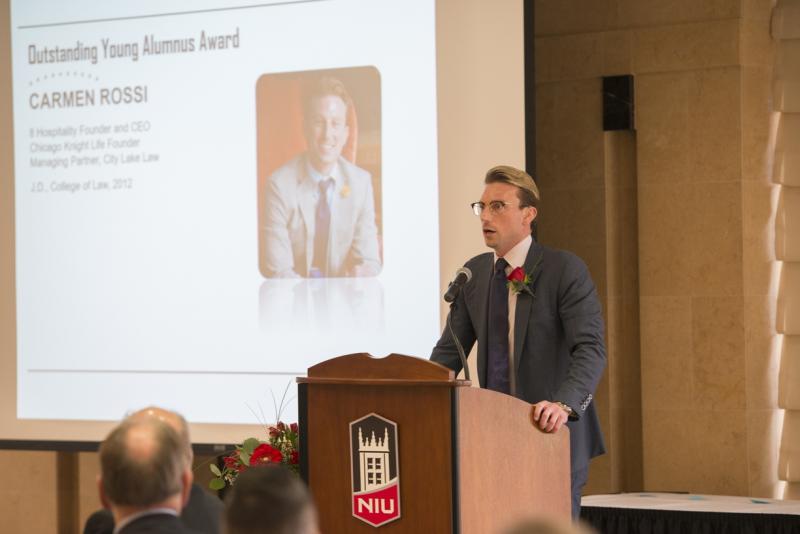
VINCE LARA: Hi, and welcome to another edition of A Few Minutes With, the podcast that showcases Illinois College of Applied Health Sciences. I’m Vince Lara and today, I’m speaking with Carmen Rossi, who is an RST alum, who’s an entrepreneur, real estate developer, and owner of the legendary KAM’s, about his academic career, his entrepreneurial spirit, and his contributions to RST. So Mr. Rossi, I really appreciate you taking the time out of your busy day to talk to me this morning. How are you, sir?
CARMEN ROSSI: Good morning. Good morning. Thank you. Thank you for the opportunity. Hello, and not only to you, Vince. And I think we’re going to have an enjoyable time speaking together. But certainly, the greater U of I community in the AHS alumni, faculty, staff, and students. This is really cool. So ready to kick it off.
VINCE LARA: Excellent. well, Carmen, I should tell our audience that you’re from Frankfort, Illinois. So as someone who grew up in the state, did you always plan to go to the University of Illinois?
CARMEN ROSSI: Well, not to give the Tom Cruise Risky Business reference a regard. But for me, personally, the University of Illinois is a highly competitive process and application and applicant pool. I’ve always had a steadfast desire to attend the community. And I think I honestly say that genuinely because I think I can very much recall the moment when I learned that I had been accepted. And I think it was with that sort of excitement was a channel for me to want to maximize my time. And that not only was during the time that I spent on campus, but that same scene reverberates today. I look at this as an opportunity to remain engaged on, as you will soon learn, very committed to the greater use of the University of Illinois community. And sort of look at it, the journey is not limited to just the years spent on campus, but my commitment beyond, which is as an alumni and as a active cheerleader to the community at large.
VINCE LARA: Now you are an English and political science major as an undergrad. Then you got your master’s degree in RST, Recreation, Sport, and Tourism. And then you got a law degree. And I’m wondering what spurred you to pursue such diverse academic avenues? Was it something that your parents encouraged or was something within you?
CARMEN ROSSI: Well, I think the greatest contributor to the idea of continued education, which given the diversity of my business ventures, contribute as a nod to the experience in college. But my pursuit of higher education and continued education was. The driving force was the U of I experience, most definitely. I had such a positive experience as an undergraduate, whether it was intimate class sizes and the opportunity to engage with professors before and after class.
Certainly, my classmates, with, as you’ve mentioned, those concentrations of studies are diverse, which puts you with a very different set of students and topics and themes. And so it was easy for me to remain committed and committed to the going pursuit of education, so long as it was at the University of Illinois.
And really, I was, also. I mean, those are– not to try to be a romantic here. But those are important development years. I can’t say that my goal, at all, as an 18-year-old or as an undergraduate was to pursue the many ventures that I’m in now. I had to develop individually, but also academically, and then professionally. And it was my exposure to those varied disciplines and paths that I think most contributed to my confidence, right?
So being an entrepreneur requires a element of patience and risk. And I think the academic journey itself, which is to say, deadlines and grades papers and a balanced curriculum. I think those were all little mini tests and mini milestones, which ultimately contributed to my abilities in venturing out into the professional world.
VINCE LARA: Now you passed the BAR in 2012. And you worked at a law firm in 2013. And then you opened a hospitality company. So I’m wondering, did that indicate that a pivot from the law? Or did you always envision pursuing an entrepreneurial career, even after getting your law degree?
CARMEN ROSSI: So the experience was such that I had, as an undergrad, started a couple of small businesses. And it really is a testament to the caliber of students that were my peers because going into Champaign as a freshman, I didn’t really know many people coming from a smaller town, like Frankfurt. And in class, made new friends. And we came up with a couple of companies. And I’m only smiling because I want to use the word, that corporate word, gingerly. But we started a painting company, for example. We started, with a classmate that I met in a Greek organization, with another classmate I met in political science. I started a furniture and loft building company. And again, I had not known these folks before school. And throughout the years, I would start little companies, maybe employee sizes. Maybe it was just two or three of us, the biggest probably being 20. And my undergraduate, with dual disciplines, was five years. My graduate was two. And my law was three. So I did more time than Van Wilder.
There’s the pop culture reference. But yeah, during those 10 years, I probably had eight or nine small businesses that really were just trial and error. I mean, if I were to reference, previously, the painting company or the furniture and loft building company, I don’t mean to indict the great work we did. But I had never painted or used a hammer in my life. So literally, it was those are true learning experiences, through trial and error and probably testaments to our commitment to one another, but our commitment to the customers, if nothing else.
But when I graduated to get back to your original question. When I graduated, I did work for a civil litigation firm out of Joliet, Illinois. I had clerked for the state’s attorney’s office and was actually assigned to one of the most high profile criminal murder cases, as just a clerk. But it was really exciting and cool at the time. And I had such an appreciation for the law. When you go into advanced academics, which I would describe as law, medicine, accounting, engineering– you’re really, to me, the elements and knowledge, specifically, is secondary to the discipline, which is the way of thinking and process of how you approach situations and that repetitive training.
And so I was very excited eager determined to have a career in law that would champion advocacy. So the idea of a hospitality company really didn’t show itself until the nature of my work allowed me the freedom to explore. So imagine I am actually assigned to drafting appellate court briefs for a firm, which is might sound fancy. But it’s incredibly monotonous and boring exercise of writing.
But you have to respond within some statutory time, 28 to 35 days later. And all you need is the internet because you’re just writing. So going the other way of seeing that is I was not confined to a courtroom or an office. I was merely required to have an internet and abide by deadlines. So I started spending time in Chicago. Being from a small town, how incredibly powerful and impactful the city serves those tall buildings, those busy streets. And I very quickly fell in love with the landscape and the potential, the capacity.
So I had money, some money saved up. You can only spend so much on ramen and cheap beer in college, as an undergrad. So whatever dollars I saved from those small ventures, I decided to open up a restaurant, pour all my money in. And not to take away from the the capacity and size of starting a new company. But I was at least aware of the reality of failed business and the reality of my lack of experience and the reality of my youth.
But I knew that I had a good degree. And I knew that I had a network of friends. And I knew that I was still young and that failure is sometimes a very necessary part of life’s lessons and journey. And for any students out there who are frustrated with themselves and any parents who are equally frustrated or kicking themselves in the butt, I am one of those who lived with my parents until I was 27 years old, God bless them. And I am super grateful that they allowed me that roof because it took off so many of the pressures and allowed me the time to develop.
So yeah, I wish I had a more explosive answer. But that’s the truth. That’s how I got there. And I describe as very– I describe academically and very seriously, the elements of success in preparation and research and due diligence.
But almost as importantly, timing and luck. That can be a very not necessarily chilling or humbling, but it can be a very necessary component to any venture or life decision. It needs to be made at the right time. And to get over that hump, you just got to catch a little bit of luck. And so in my opinion. And so I was at the right time for city politics, for city, for where we were in the economy. And I could have easily gone the other way because I was way in over my head. But that was where luck, then, played its part. And yeah, I just kept going.
VINCE LARA: Working in hospitality and opening an industry opening a business in hospitality, it really takes a specific mindset. You have to be patient. Something you referenced earlier, humble. And you have to have a willingness to serve. And so is that what drew you to hospitality?
CARMEN ROSSI: Well, right. That’s a great point. And again, highlights my lack of experience. So right, I had no professional background in hospitality, cooking. I’ve certainly never worked in a kitchen or cooked. But also, wasn’t a mixologist. I was never a server in the steps of service and the art of setting the plate or managing the customer. But I did have a–I have always had a fundamental understanding of making someone feel good and understanding that they are here to have an experience.
And I don’t limit that simply to hospitality. It can be in development, construction, it can be in client engagement, a first client interview, whether a lawyer or a doctor or a pre-call interview, as a journalist. You are tapping into the emotions and expectations of the person on the other line.
And with hospitality, maybe it’s a first date, a birthday, a corporate meeting. And understanding what that person’s expectations are, what they’re looking for from the experience, whether it is sustenance, whether I’m here just to have a bite or a drink and move on or creating a memory, like a wedding, engagement party, or otherwise.
So I knew that if I could surround myself with the skills and people who had the expertise, that’s probably my job today. I wish it was. I wish I was more developed on the intricacies of the many steps. But I put together teams. My ability to participate in so many varied industries. And most recently, if this interview is ever time stamped, in 2021, 2022, in the state of Illinois, you’ve had two massive industries emerge that had never previously existed or existed, legally, I should say. And that is cannabis and gaming.
And those are two industries that I am very deeply involved. But that comes with new regulation. That comes with your– it’s not simply the process of the operation, but rather education, dialogue with elected officials. And it is recruitment, as far as for me, London, of skilled, people who have worked in the industries and have that bandwidth.
So my job is similar to that of a general manager of a sports team. I have to field a team that can perform, but at so many different positions, in so many different skill sets. And the success of our team are, our goal of making the playoffs and playing in the championship, is through the journey of everyone having to perform at the highest degree, but not always at the same task.
So yeah, and boiling back down, I think you’ll be able to see now, as we’ve explored together throughout our talk this morning. I think you see how that’s sort of roadmap has been established. It was at Champaign. It was with very diverse students and curriculum and just learning throughout the process, not knowing where I was going.
I mean, isn’t that a reflection of the American curriculum, as it relates to college. Not everyone knows exactly where they’re going to land in the next four years or what they’re interested in. I mean, I have a law firm today. And our concentration is mostly regulatory, government lobbying. But that was not at all what I had ever envisioned, even while I was in law school. And I think it is a contributor to a larger footprint, a larger vision.
And if you were to say, well, what is the proverbial, where do you see yourself in five years? Well, I hope my head is still above water. I couldn’t necessarily or absolutely describe what the next five years look like or that I wouldn’t get involved in other industries that today I have no idea about.
But the confidence in that patience that you referenced is really just borne from the fact that we’ve been here before, even from the very first day, we stepped on campus, we didn’t know where we were going. But we knew that this is a good community. We’re going to do good work. We’re going to listen. We’re going to network. So long as we make great relationships and friendships.
And so long as people pick up the phone when you call because you’re a valued asset to their Rolodex. Then we’ll be OK. And not to say that there isn’t chaos and problems. But if you boil it down to those very, very simple life lessons and sort of, I wish there was a more algorithmic formula that I could share with everyone, so to say, that I could say, here’s the secret. Don’t tell anyone.
But it’s not. I love keeping it simple. James Carville maybe, KISS, Keep it Simple, Stupid. During Bill Clinton’s campaign. Yeah, I love that. It allows you to breathe a little easier when the pressure is mounting or when you feel like you’re behind, if you just remind yourself of all the little things that you’ve done, all the great relationships that you’ve managed to bring in and cultivate them. It’ll be OK. You just got to weather the storm.
So yeah, that is definitely patience. And it is patience and understanding of that, ultimately, leads to vision. But those are the nation elements.
VINCE LARA: One of the many impressive things I found out about you in doing my research is that there is always a charitable side to your endeavors. And I’m wondering what inspired that in you.
CARMEN ROSSI: Well, that is fundamental. Probably central theme, if we had to create a bubble chart with singular themed words of this conversation, one of the words might be, community. And as I referenced, the network and the friends and the family and the new relationships and ventures, really, those are all fall into community and if you and if you believe that, and you make that a central tenet of your mission statement, then giving back is not, probably, a preferred way of framing. I don’t think– that might come off as obligatory.
I live in the community. And the community has been amazing. I’m so absolutely fortunate for being able to have experienced the degree of success as a product of the community. And the community is representative of so many different cogs in so many different organizations. Therefore, charity is a daily commitment. I can make this point, anecdotally. I had five or six restaurants within let’s say, two to three years of starting this company, which means I’m two to three years into learning about hospitality.
But I had quickly opened up. It was six. But let’s, as many as I have fingers on one hand, we had 150 employees, 200 employees. And I said, I am learning so much about Chicago because I’m not from there. And I’m meeting people who are coming into the restaurants as customers, who work in the neighborhood, that work for such a variety of businesses and organizations. And a lot of nonprofits, especially in Chicago. There’s so many awesome organizations that directly serve the community, but from such a– whether it’s children services, whether it’s educational, whether it’s support, human support. And I have an addictive personality. And I’m a people pleaser and quite frankly, a lover. The idea of hearing more about their organization was a internal trigger to just want to get involved. But I would share it. I would share. I’m in my 20s. And so many of my employees are like me, in their 20s. And I would, these are friends. And I would say, hey, let’s– I just met this person. And they have this organization. And I’m volunteering to serve food. We’re going to make the food. We’re going to go over there. We’re going to serve the food.
And then there was a support system, another organization that was for abused women. And we were there Just to sit and talk, to serve coffee and pastries, and just to hang out. And people in the service industry in their 20s are energetic. We’re jovial. If you have a desire to work in hospitality, you probably have a personality that is pretty electric. And you likely enjoy human conversation because that’s so much a part of the job.
So we just all started signing up. I would just put up sign up sheets throughout the business and our businesses and just say, hey, I’m going to show up here at this time. And if you want to, as well, great. If not, sounds good. And those sign up sheets were never empty. I mean, every single day. And sometimes, they were too full, which is to say we had more help than we needed. And it sort of got out that we were an organization that sort of really enjoyed getting involved. And it just grew from there. So I decided to formalize it and really, it was twofold to formalize it as an opportunity and channel for employees, but also as an opportunity and channel for organizations to hear about us and reach out to us and know that we would, whatever the task, if we’re capable, we’re in. And that was in 2014, 2015. And we’re still engaged 365 now.
VINCE LARA: Speaking of charitable works, part of the reason that we’re chatting today, a small part of it anyway, is that you are giving a gift to RST to support RST 180, which is Mike Raycraft’s Hall of Fame tour, a wonderful program that takes two dozen students around to see various landmarks across the country. So I’m wondering, why did you want to be involved with RST? And specifically, why RST 180?
CARMEN ROSSI: So the curriculum for RST is a lot of what I’ve talked about today. You’re working intimately with people with communities, municipalities, governments, charities, organizations related to kids, students, and development of new organizations. RST, it’s got a very vast base and that touches on a lot of foundations, whether it is organizations of recreation or tourism. Those are massive industries.
So, of course, you’re talking about marketing advertising. You’re talking about operational logistics. You’re talking– I loved it. I had such a– and when you talk about political science in English, and then you go, RST has disciplines that are much– they’re hands on, boots on the ground. And the best way to learn is to engage. Not to take away from the academic curriculum, specifically. But there is a practical application that will best serve you for success. And that practical application is showing up, is getting involved, is trying it out. Not only as the service intends, but as a service to yourself. I enjoy this, OK. There’s only so much a textbook or course tech can teach and educate.
So it requires the students to sort of get out into the community and work, whether it’s an event, whether it’s behind the scenes, organizationally. So I see in these students, probably, a role that I can play is certainly one of opportunity for internships, certainly one of opportunity in education, whether it’s education of philosophy and sort of the steps of service or participate in the practical application through anecdotes, stories, life lessons.
And then there’s the opportunity of establishing scholarships, establishing financial commitments that can lead to students being allowed to participate. Or I think there’s a–I think there’s a designation of funds that’s going toward I would describe as an extended road trip. But a field trip of getting exactly into what we’re talking about, getting into the thick of things, and going and learning and experiencing what you might have discussed, ad nauseum, in the classroom. But now you get to see it in action for events. So yeah, I’m excited to see where this goes. And I’m not hardly done. And the community, again, from Champaign to Chicago, has been an absolute blessing. And I think about that every day. And that I convert that into a commitment of staying involved. And as long as you’ll have me, as long as the AHS family and community will have me, I’m committed to staying involved and excited to see where our journey together will go next.
Again, this was an idea. Shout out to Mike Raycraft I hope there are smiling faces. There has to be many when I say that name because he’s had a significant impact on my experience at the University of Illinois and certainly, in the vast community. So he came up with this idea of getting involved in creating a program that would afford students to participate with financial resources that I could extend in a program that came out of nowhere. And so I’m excited to find out. I’m excited to participate in our next idea together.
VINCE LARA: Yeah, and that’s a fantastic way to end. I appreciate your time, Mr. Rossi. And thank you for all you do for AHS. And I appreciate the time you spent with us today.
CARMEN ROSSI: I thank you, really. This was a cool opportunity. And I again, thank you very, very much.
VINCE LARA: My thanks to Carmen Rossi. For more podcasts on Illinois’ College of Applied Health Sciences, search A Few Minutes With on iTunes, Spotify, iHeartRadio, Radio.com, and other places you get your podcasts fix. Thanks for listening, and see you next time.