Global opportunities


Jemimah Bakare, right, Emmanuel Dubure and Byron Juma, left, are parts of a growing contingent of Illinois students from Africa (Photo by Michelle Hassel)

The Republic of Ghana has the second-largest population in West Africa. Until recently, Emmanuel Dubure was one of its more than 32 million inhabitants. He said the part of the country where he grew up faces many health challenges, and he wanted to develop the expertise to make a difference. He chose to study in the United States, he said, because “the U.S. has the best educational system at the graduate level and is a hub for research and experts in many fields.”

Dubure aspires to work at the community level to improve health back home. He learned of Illinois on LinkedIn and liked the idea of obtaining his master’s degree in community health from a well-ranked Research 1 university. 

“Most importantly, I chose to come here because the College of Applied Health Sciences had faculty doing good research in my area of interest, which is the use of nutrition education to improve health, particularly in relation to chronic conditions,” he said.

Dubure described his experience at Illinois as “amazing” and said he would strongly recommend it to other international students.

“I have met a lot of wonderful people, both students and professors. The environment here is very stimulating and supportive of learning,” he said. “AHS is very multicultural, which gives you an opportunity to learn about different cultures. It also helps you feel at home because you meet other people from your home country.”

A common sense of humanity

The University of Illinois Urbana-Champaign boasts one of the largest international student populations among public institutions in the United States. According to the university’s Vision 2030 Global Strategy document, the first international students arrived on campus just four years after the university was founded. In 1907, the University of Illinois Urbana-Champaign became the first university in the nation to create the position of international student advisor, an early recognition of the benefits of worldwide perspectives in education and scholarship. 

Marta Schneider, associate director for global communication at Illinois International, said the university’s global strategy puts a high priority on intentional engagement in Global South countries. 

“The number of students from the African continent have indeed been increasing, with Nigeria being among the top 10 represented countries at Illinois in 2021 and 2022,” she said. “The university also is committing resources to increasing ties with Latin America and underrepresented parts of Asia.”

Bill Stewart, interim head of the Department of Recreation, Sport and Tourism, thinks encouraging international enrollments is a good idea.

“A world-class university needs a world-class student body to prepare future professionals for careers that will involve advancing relationships across international and cultural boundaries,” he said. “International students elevate class discussions and activities and research programs by sharing insights and cultural values.”

As a result, he adds, domestic students often better understand cultural differences and similarities and reflect on their own cultural heritage. International students can increase understanding of a common sense of humanity.

This has certainly been the case for Sandraluz Lara-Cinisomo, associate professor of kinesiology and community health. Her research addresses disparities in the mental health of women and mothers in different racial, ethnic and immigrant groups and the military. In her Laboratory for Emotion and Stress Assessment, she has graduate students from Nigeria, Ethiopia and The Republic of The Gambia. She said the insights that international students provide on perinatal mental health disparities are critical for addressing the diverse needs of mothers not only globally but also within the United States.

The University of Illinois Urbana-Champaign is a prestigious institution, and I am extremely proud of being a student here. I wouldn’t want other international students to miss out on these crucial opportunities.

MaryEllen Mendy

Doctoral candidate, Community Health

“International students have lived experiences that are valuable when considering risk factors for perinatal mental health, barriers to care and innovative strategies that respect diverse communities’ cultural and linguistic needs,” Lara-Cinisomo said. 

Domestic students also benefit from learning, she added, that while public health crises abroad may appear identical to ones in the United States, they may actually involve layers of complex cultural and political systems that aren’t observed here.

One of Lara-Cinisomo’s mentees, Mary Ellen Mendy, hails from the smallest country within mainland Africa, the Republic of The Gambia. Women in The Gambia face many challenges to their physical and mental health. After completing her Ph.D. in community health, Mendy hopes to apply all that she has learned from this program and her Master of Public Health program at the University of Illinois Springfield to making a difference back home.

“The skills I am developing are already paving the way for my future career as a researcher,” Mendy said. “I have received so much training in the Laboratory for Emotion and Stress Assessment lab, which I greatly value.”

Mendy said she already has recommended the program to friends back in The Gambia: “The University of Illinois Urbana-Champaign is a prestigious institution, and I am extremely proud of being a student here. I wouldn’t want other international students to miss out on these crucial opportunities.”

A wholehearted recommendation

Like their domestic colleagues, international students also benefit from the exposure to different cultures. Kenyan student Byron Juma said he has seen the months fly by as he’s grown “leaps and bounds” from his interactions with students from different parts of the world.

“I have taken classes from different departments and appreciated the opportunities to interact with students from diverse academic and social backgrounds and nationalities,” he said. “Such interactions have enriched my academic life and allowed me to view my research from different perspectives. Furthermore, these interactions have allowed me to learn and appreciate other cultures, thus building my emotional and social intelligence.”

Juma, who is pursuing a Ph.D. in recreation, sport and tourism, has researched doping in sport in Africa and Europe. The unique closed-league system and heavy commercialization of sport in the United States offered an exciting new perspective for his research. The possibility of studying with RST Assistant Professor Julian Woolf, one of the world’s leading scholars on the topic, was also enticing. 

“I firmly believe that AHS has some of the best faculty in the country,” Juma said. “Getting a degree in the college counts as a prestigious achievement.” 

Juma also noted that the outstanding diversity of the student body in AHS, where 33 percent of the students belong to historically underrepresented racial and ethnic groups and 149 students are from other countries, makes it easy to feel at home.
Nigerian student Jemimah Bakare, who is pursuing a master’s degree in community health, agrees.

“The campus’ commitment to diversity and inclusion makes it an attractive choice for an international student,” she said. “The sense of belonging and the opportunities for cultural exchange are enriching aspects of the university experience that I believe are essential for personal growth and academic success.”

Bakare’s interests focus on the management of type 2 diabetes and chronic kidney disease in older adults. She was drawn to the strong academic and research reputation of the campus and the college as well as the student body diversity. 

“The academic rigor and quality of instruction have exceeded my expectations,” she said. “Furthermore, the university’s emphasis on research and practical application of knowledge has provided me with valuable hands-on experiences that will undoubtedly contribute to my future career in community health.”

Because of this combination of academic excellence, diversity and translational research opportunities, Bakare would “wholeheartedly” recommend the University of Illinois Urbana-Champaign and the College of Applied Health Sciences to other Nigerian students. In addition, she said, the support services and resources available to international students at the university help to ensure a smooth transition to life in the United States.

Related news

AHS honors four outstanding alumni


Dean Cheryl Hanley-Maxwell, left, stands with alumni award winners Michael Leach, Saul Morse and Walter Johnson. William Haskell was unable to attend the ceremony. (Photo by Jerry Thompson)

Young Alumni Award
Michael Leach
Recreation, Sport and Tourism

Michael Leach was appointed as the first-ever chief diversity and inclusion director for the White House in January of 2021. Leach, who earned his bachelor’s degree from RST in 2009, spent more than five years working for the National Football League on the NFL Management Council and later worked for the Chicago Bears and Miami Dolphins.

“I am truly humbled and honored to receive the 2023 Young Alumni Award from the University of Illinois at Urbana-Champaign,” Leach said. “My time in the College of Applied Health Sciences, and the institution more broadly, was nothing short of transformative.”

Harold Scharper Award
Saul Morse
Disability Resources and Educational Services

Saul Morse earned his bachelor’s degree (1969) and law degree (1972) at the University of Illinois and since has focused his practice on legislative matters, health law, insurance and municipal law. In 2010, with the passage of the Affordable Care Act, Morse was asked by the Illinois Department of Insurance to establish and manage an insurance pool for individuals with pre-existing health conditions.

“The Harold Scharper award is of great importance to me,” Morse said. “I came to the University of Illinois as a 17-year-old freshman. At the time, no other university in this country had a program which fully included students with a disability in all aspects of campus life, from academics to housing to activities. Most of what I have been able to do personally, professionally and within the broader community is due to the DRES program of the college.”

Distinguished Alumni Award
William Haskell
Kinesiology and Community Health

William Haskell is an internationally renowned researcher and emeritus professor of medicine at Stanford University. Haskell earned his Ph.D. in exercise physiology from the University of Illinois in 1966, and his work and achievements have clearly fulfilled the Illinois mission.

“It is truly an honor to receive the Distinguished Alumni award,” Haskell said. “Attending the University of Illinois at Urbana-Champaign offered me the opportunity to study and work with a large range of outstanding faculty and students, many of whom became exceptional leaders in exercise science research and teaching, as well as lifelong colleagues and friends.”

Walter Johnson
Recreation, Sport and Tourism

Walt Johnson was born in Watseka, Ill., and graduated from the University of Illinois in 1958 with an undergraduate degree from the RST program. Later he entered the graduate program in RST and had the privilege of learning from both Professor Charles Brightbill and Dr. Alan Sapora. Upon graduation from the RST master’s program in 1962, Johnson moved immediately into a career in parks and recreation, where he served in a number of key leadership positions.

“The University of Illinois has always been the reason for my success and the lifestyle I live today,” Johnson said. “It gave me knowledge, hope and encouragement. Growing up on a farm and spending hours on a John Deere tractor since age 8, and milking cows, planting, cultivating and raising cattle and pigs, I determined I did not want to be a farmer.”

Editor’s note:

To reach Vince Lara-Cinisomo, email vinlara@illinois.edu.
 

Related news
Pritzker to RST students: Stay in Illinois


J.B. Pritzker was the invited speaker at the kickoff to the 2024 Sapora Symposium (Photo provided)

If there is one thing Illinois Gov. J.B. Pritzker knows about, it’s hospitality.

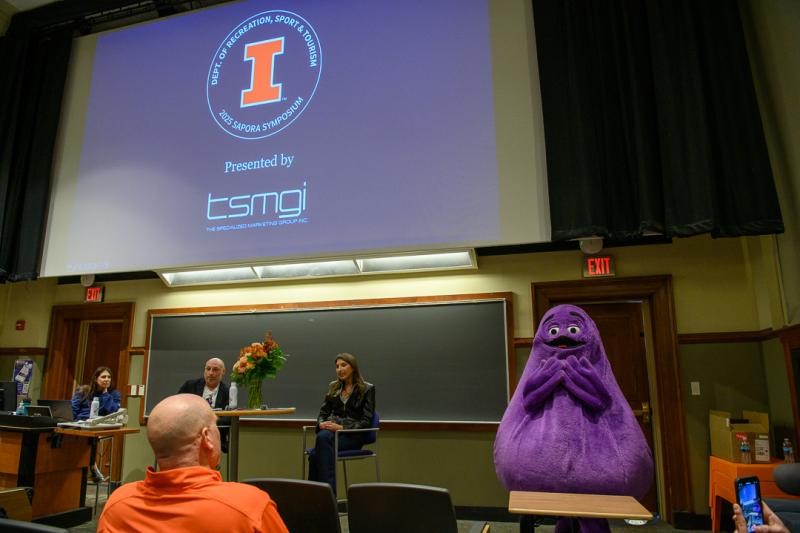
A member of the family that owns the Hyatt hotel chain, Pritzker on Jan. 25 gave the opening remarks for the Sapora Symposium—organized by the Department of Recreation, Sport and Tourism at the University of Illinois Urbana Champaign—and implored students to “stay in Illinois.”

“My advice is stay in the state of Illinois because a lot is happening here that is going to be good for your careers,” said the 59-year-old Pritzker. “It’s not just the governor trying to convince you to do something that you don’t want to do. It’s the governor telling you that I have seen a real change in the way this state thinks of itself and the opportunity that exists, particularly in travel and tourism and recreation.”

Pritzker was the invited speaker at the recent kickoff to the Sapora Symposium, a semester-long class that features alumni and other professionals who share insight on current issues in recreation, sport and tourism. This year’s theme, according to instructor Michael Raycraft, a teaching associate professor, is the “important roles for recreation, sport, and tourism agencies in the revival of the economic, social, and environmental dimensions of Chicagoland in the post-pandemic era.”

Among the topics that came up during the discussion with Pritzker—moderated by Raycraft and RST alumni and adjunct faculty member Carmen Rossi—were contemporary issues in parks, tourism and sport and their importance to Illinois’ future. 

“Not just because I come from a family that’s been involved in tourism and the hospitality industry, but from a state perspective, it is one of the easiest ways to boost revenues,” Pritzker said.

Pritzker—a Democrat—touted his administration’s recent success in the tourism sphere, primarily securing the Democratic National Convention, slated for Aug. 19-22 at the United Center. 

“It is my job to get major conventions to come to the state,” he said. “In politics, it’s like the Super Bowl every four years. It brings 50,000 people, and they’re going to spend weeks on end beforehand, setting up and bringing people in. The delegations are going to fill all the hotels here.

“We won it for a couple of reasons. There are politics involved. But  … what mattered most was when (the DNC committee) came here, they were blown away. Because our hotels are in close proximity to one another. Hotels are close to all the places that the convention will take place. And everybody knows summer in Chicago is one of the best things in the world.”

Pritzker ended his remarks by saying the state’s “tourism economy is booming coming out of Covid.”

“My advice to you all is, stay in Illinois because we’re headed in the right direction if you want to be in this economy, in this tourism and recreation world.”

Editor’s note:

To reach Vince Lara-Cinisomo, email vinlara@illinois.edu.
 

Related news

RST Ph.D. student helps student-athletes find belonging, in and out of his research


Solomon Siskind is leading a double life at the U. of I: While researching diversity and inclusion for student-athletes, he leads Illinois Athletics development program for them. (Photo by Ethan Simmons)

Solomon Siskind is living a double life at the University of Illinois Urbana-Champaign—two lives that are finely intertwined. 

While the Recreation, Sport and Tourism doctoral student researches diversity, inclusion and belonging for college athletes, he’s also applying those concepts as the Coordinator for Illini Way Student-Athlete Development in Illinois’ Division of Intercollegiate Athletics. 

“The research that I’m doing is what I’m doing in my every day,” Siskind said. “Who I’m advocating for, and who I’m empowering.” 

“No one day is the same” for Siskind in DIA. He’s laser-focused on preparing student-athletes for their transition to life after sport, whenever the ball stops bouncing or the track runs out for them. 

A Midwest transplant from the East Coast, Siskind’s own experiences—as a former college athlete himself on the University of Massachusetts Amherst football team—inform his new day-to-day as a young scholar-practitioner in the sports industry. 

Now, he’ll be studying these issues with his first grant-funded research project, entitled “Do we belong here? Examining Black student-athlete affinity groups as spaces for belonging at historically white institutions,” with a $7,500 grant from the NCAA. He spent the first year of his doctoral program ideating the project with his advisor, RST Assistant Professor Yannick Kluch. In his second year, he has started the research.

As one of five graduate students selected to receive the competitive grant, Siskind will conduct semi-structured interviews with Black student-athletes in NCAA Division I, predominantly white colleges across the country to better understand their experiences. Namely, what it’s like to be a Black student-athlete at a predominantly white institution and how being part of a racial affinity group affects their life on campus. 

The topic dovetails with Siskind’s professional and personal experiences. He was part of an affinity group for student-athletes of color at UMass Amherst, and he advises its equivalent at Illinois, called “EMPOWER.” 

“I’m interested in, what’s the impact going to be? How am I going to be able to take the findings from this research and provide recommendations to different institutions so they can better serve our Black student-athletes?” Siskind said. 

Kluch is excited for Siskind’s project getting off the ground on this “much-needed topic,” and grow his horizons in the field. 

“Solomon, in many ways, embodies many of the qualities I look for in doctoral students seeking to be advised by me. I care a lot about doing good work, doing rigorous research, knowing your expertise, but also applying that to industry contexts,” Kluch said. “With Solomon, he gets it. He has lived it. He lives it every day here at Illinois.” 

From the playing field to the classroom

From Brockton, Massachusetts, Siskind grew up in New England and stayed there for his undergraduate work, walking on to the UMass Amherst football team as a freshman. 
Even with sports in the foreground, Siskind was dead set on obtaining an advanced degree like his older brother and sister before him. 

“I’m a first-generation college student. My mother placed a big emphasis on higher education with me and my siblings from the beginning. She had both of my siblings in high school and as a single mother, her dream of going to college was no longer an option,” he said. 

Siskind had to confront his own athletic mortality far earlier than he would’ve liked. Multiple knee injuries and surgeries derailed his playing time at tight end for the UMass Minutemen.

“I’ve had a lot of time down off the field, I’ve had space to think about this, because I knew ‘I’m not going professional,’” Siskind said. 

It’s a concept he now talks about with his students at Illini Way: student-athlete identity foreclosure. What comes next after organized sports? Even the greats confront it eventually: Tom Brady is a football broadcaster now after 23 years in the NFL; Derek Jeter started preparing for the transition 10 years before his MLB career ceased; track and field star Allyson Felix started up her own lifestyle brand for women prior to retirement, Siskind recalled.

As an upperclassman, Siskind began to wrap his head around these concepts academically. In his junior year, he attended the Black Student-Athlete Summit in Austin, Texas, where presentations on student-athlete development and diversity, equity and inclusion in college sports lined the conference. 

“That was my first time seeing that type of research and the type of conversations I wanted to have,” Siskind said. “From that moment on, I was like, ‘I want to do that.’”  

For his first bite of research, he partnered with fellow college athlete Desiree Oliver of the UMass women’s basketball team to analyze the experiences of student-athletes of color at their university. 

The study aimed to better understand how their experiences as student-athletes were shaped by being at a predominantly white institution, or PWI. The data showed, among other trends, that student-athletes of color were three times as likely to report experiencing “culture shock,” and half reported feeling depressed or isolated at their institution.  

While obtaining his master’s, he learned under one of the top scholars in the diversity, equity and inclusion field as research assistant for Nefertiti Walker, now Senior Vice President for Academic Affairs, Student Affairs, and Equity for the UMass system.

“I knew this is what I wanted to do,” he said. 

Perfect timing, perfect opportunity

If you’d asked Siskind if he wanted to stay in the Midwest two years ago, he would’ve “thought you were absolutely out of your mind.” 

A postgraduate internship at the NCAA’s Office of Inclusion brought him from the East Coast to Indianapolis, Indiana, where he supported the office’s inclusion initiatives for a broad swath of student identities. 

Outreach from a familiar face, Elizabeth Hamlet, opened his eyes to the university two hours to his west, in Urbana-Champaign. Hamlet was the Senior Assistant Director of Academic Success at UMass while Siskind attended, but now she serves as the Assistant Director of Academic Services for Illinois Athletics. They discussed a new opening in the athletic department in student-athlete development.   

“Liz had been a mentor for me at UMass, and was someone who helped me develop off the field,” Siskind said. 

The opportunity was attractive. At the same time, another connection was making the move to Urbana: Kluch had applied for a tenure-track professorship at RST. The two got offered and accepted their Illinois positions at the same time. 

“When I thought about which Ph.D. programs I wanted to go into, he was the person I wanted to work with,” Siskind said. “I knew our research, our works and passions already aligned with one another.” 

“It was really perfect timing.” 

Siskind and Kluch had been acquainted for some time, following each other on social media platforms because they shared a research area. Their scholarly interest in diversity, equity and inclusion overlapped perfectly. 

“The professionals who care about these things in the sports industry, it’s a pretty small and tight-knit group,” Kluch said. 

Kluch had caught wind of Siskind’s social justice leadership on the UMass campus during his time as a student-athlete: “He was very big on elevating the athlete voice, promoting racial justice, social justice, DEI within those contexts.”  

What further connects them, Kluch said, is their shared philosophy as “scholar practitioners,” aiming to extend the impact of their research beyond the classrooms or academic journals and into the real world. When he learned Siskind wanted to pursue graduate school, Kluch hit the recruiting trail to bring him to Illinois’ RST program. 

“It’s so fun to work with him because a lot of grad students struggle with finding the connection between the theory, the theoretical, and the practical. And he walks that line seamlessly,” Kluch said. 

An advisor who’s “been in their shoes” 

Mary Long started at Illinois Athletics just a month after Siskind, and they’ve been crossing paths ever since. 

Long, a second-year Diversity, Equity, Inclusion and Belonging Fellow at DIA, coordinates cultural events for student-athletes, facilitates diversity training for staff, leads a mentorship program for students and advises Illini Allies, the LGBTQIA+ affinity group for Illinois athletes. She complimented Siskind’s ability to build rapport with student-athletes and quickly link them to scholarships or leadership opportunities. 

“He takes the time to connect with them on a personal level—he’s warm, friendly, and genuinely interested in each student-athlete. Once he’s in your corner, he’s all in,” Long said. “His biggest strength as a student-athlete development coordinator is that he has firsthand experience as a former student-athlete. He’s been in their shoes, so he gets the unique challenges they face.” 

He takes the time to connect with them on a personal level—he’s warm, friendly, and genuinely interested in each student-athlete.

Mary Long

Division of Intercollegiate Athletics

Siskind’s schedule is packed these days, balancing his part-time doctorate program with a full-time student support role. He leads sessions of RST 118: Transition to College for first-year student-athletes and helps them with major selection and grad school applications, resumes, leadership development and the like. 

On top of that, he heads Illini Way’s community outreach efforts and co-advises the Student-Athlete Advisory Committee (SAAC), which provides insights to athletics administration and leadership development for more than 40 Illinois student-athletes across each athletic team, all while advising EMPOWER’s student leaders. 

“I view student-athlete development as a part of DEI, because the work that we do has real implications in the lives of our students. whether it is through creating inclusive spaces, developing life skills, or growing civically and community engaged leaders, it all matters,” Siskind said. “The transition to life after sport is a very hard transition. I also think being able to help our student-athletes understand who they are as individuals, as leaders, and prepare them for life itself is super important.”

The job is fulfilling, but the opportunity to study in the Department of Recreation, Sport and Tourism was a huge draw. Siskind has particularly enjoyed taking “Theory and Methods of Leisure” as a student of Associate Professor Liza Berdychevsky this fall. 

“The number of things I’ve learned in the last few class sessions, it blows my mind. It’s not just sport management in RST—I’m excited to continue learning from all the faculty here,” he said.  

(Siskind’s study on racial affinity groups for student-athletes is actively recruiting. Visit the following link to complete the survey and see if you qualify for participation.) 

Editor’s note:

To reach Ethan Simmons, email ecsimmon@illinois.edu.
 

Related news

Fredericks: How Black American Distance Runners Shaped the Sport From the Shadows


Ted Corbitt (bib #999) runs in the 1952 Olympic marathon in Helsinki, Finland. Retrieved from the International Olympic Committee database.

The world of competitive long-distance running took off in the 1970s. But stories of the sport’s Black architects and pioneers who laid its foundation have been largely untold for decades. 

Teaching Assistant Professor Jake Fredericks in the Department of Recreation, Sport and Tourism at the University of Illinois has dedicated a significant part of his research to uncovering the legacies of successful Black long-distance runners who grew the sport “from the shadows” while challenging enduring racial stereotypes. 

“The explosion of running in the 1970s could not have happened without the efforts of the earlier generation, in the ‘50s and ‘60s, to lay the groundwork for the races in the first place,” Fredericks said. “These are the men who established the marathon courses or put the structures in place for organizations that could support bigger and bigger races.” 

This Memorial Day Weekend, he’ll co-lead a panel presentation on Black running history to an academic audience at a conference for the North American Society for Sport History (NASSH). Fredericks will present papers alongside Gary Corbitt, an archivist and son of legendary long-distance competitor Ted Corbitt, and Suzuko Morikawa, associate professor of History and Africana Studies at Chicago State University. 

Dave Wiggins, the former NASSH president and professor emeritus from George Mason University, will co-moderate the discussion. 

Fredericks’ paper, titled “When is it Okay to Run Around Your Neighborhood in Shorts?: Representations of Black Running at the National Marathon Championship,” examines the country’s perceptions of race and long-distance running through the prism of the AAU National Championship in Yonkers, New York, the nation’s second-oldest marathon.

From 1938 until 1966, Yonkers was the site of the country’s preeminent championship marathon race, and several Black American runners—such as Louis White, Ted Corbitt and Harold Harris—posted some of its best times, more than a decade before long-distance running grew beyond its niche, community-driven status.  

While Black American athletes such as basketball’s Bill Russell, baseball’s Jackie Robinson and tennis’s Althea Gibson received significant coverage in the newspapers of the day, “marathoning was on the margins,” Fredericks said. 

In 1952, Corbitt became the first Black American to represent the United States in the Olympic marathon. Two years later, Corbitt was crowned champion in the 1954 National Marathon Championship. 

“That victory is so sparsely covered across the newspapers in the United States, that he’s mostly forgotten. Ted Corbitt is not a name that we often say alongside Jackie Robinson, even though they’re competing at the same time and had similar levels of success,” Fredericks said. “My research looks at how these Black Americans really shaped the sport, even from the shadows.” 

Chicago’s Harris posted his best performance in the 1964 Yonkers Marathon, finishing fourth—just one spot removed from a bid to compete in that year’s Summer Olympics. 

Compared to the more “glamorous” track and field events such as sprints and jumps, long-distance running lacked institutional support, Fredericks said. So, in 1958, many of the sport’s top competitors formed the Road Runners Club of America, opening chapters with running enthusiasts in major American cities. 

Harris became one of the founding members of the Midwest Road Runners branch based in Chicago, which fostered a multiracial community of runners in the city, Fredericks said. Meanwhile, based in New York City, Corbitt pioneered techniques to measure more accurately the 26.2-mile marathon races.

Back when Harris competed, marathons were lucky to run 100 participants, Fredericks said. The “marathon boom” of the 1970s changed all of that. 

A confluence of factors led to marathoning, and running writ large, to hit the mainstream. Medical science backing the health benefits of exercise had steadily grown while Cold War-era pressures to increase Americans’ fitness continued. Then, in 1972, Frank Shorter won the marathon at the Munich Games, scoring the United States’ first gold medal in the event since 1908, and first medal since 1924. 

Shorter’s success was lionized in the media, and his profile—a white, educated American man—suddenly became the prototypical image of the long-distance runner. 

“We lose the image of Ted Corbitt, who could have just as easily been the image of running, or somebody like Harold Harris, in Chicago, could have been the image of running,” Fredericks said. Those kinds of pioneering figures get replaced throughout the ‘70s, by a Frank Shorter-esque, well-to-do upper middle-class person.” 

The lack of recognition these Black American pioneers faced also played into athletic racial stereotypes. Fredericks’ dissertation, “Great Speed and Great Stamina,” in part challenged the lasting notion that Black athletes were “built” for explosive, powerful feats but couldn’t win in tests of endurance. 

The stereotype seemed to build from the sport of boxing, where analysts alleged that Black fighters couldn’t “go the distance” in the ring. Jesse Owens’ prodigious success in the sprints and long jump Olympic events of the 1930s shattered racial barriers in the sporting world but reinforced some of the same athletic stereotypes that dogged Black American athletes of the day. 

These Black runners’ success, however, “disproves these stereotypes that, unfortunately, have lasted 100 years. They’ve just been so hard to remove in the minds of the public,” Fredericks said. 

Part of the mission of Fredericks’ research, along with Gary Corbitt’s new Ted Corbitt Institute for Running History Research, is to document the history of the sport’s development more accurately and recognize the oft-forgotten figures who laid its framework. 

What stands out to Fredericks is many of these early organizers’ foresight: “They knew that road running had this potential to engage the masses,” he said. Even when races were lucky to field a dozen runners, they kept pushing to host events and spread the word. 

“Black Americans are a huge part of the story of long-distance running. Today, we reap the benefits of their efforts to establish and grow the sport of running, yet that part of the history often gets left out.” 

Related news

Pritzker connects tourism, recreation to state’s economic boom


If there is one thing Illinois Gov. J.B. Pritzker knows about, it’s hospitality.

A member of the family that owns the Hyatt hotel chain, Pritzker on Jan. 25 gave the opening remarks for the Sapora Symposium—organized by the Department of Recreation, Sport and Tourism at the University of Illinois Urbana-Champaign—and implored students to “stay in Illinois.”

“My advice is stay in the state of Illinois because a lot is happening here that is going to be good for your careers,” said the 59-year-old Pritzker. “It’s not just the governor trying to convince you to do something that you don’t want to do. It’s the governor telling you that I have seen a real change in the way this state thinks of itself and the opportunity that exists, particularly in travel and tourism and recreation.”

Pritzker was the invited speaker at the recent kickoff to the Sapora Symposium, a semester-long class that features alumni and other professionals who share insight on current issues in recreation, sport and tourism. This year’s theme, according to instructor Michael Raycraft, a teaching associate professor, is the “important roles for recreation, sport, and tourism agencies in the revival of the economic, social, and environmental dimensions of Chicagoland in the post-pandemic era.”

Among the topics that came up during the discussion with Pritzker—moderated by Raycraft and RST alumni and adjunct faculty member Carmen Rossi—were contemporary issues in parks, tourism and sport and their importance to Illinois’ future. 

“Not just because I come from a family that’s been involved in tourism and the hospitality industry, but from a state perspective, it is one of the easiest ways to boost revenues,” Pritzker said.

Pritzker—who is in his second term as governor—touted his administration’s recent success in the tourism sphere, primarily securing the Democratic National Convention, slated for Aug. 19-22 at the United Center. 

“It is my job to get major conventions to come to the state,” he said. “In politics, it’s like the Super Bowl every four years. It brings 50,000 people, and they’re going to spend weeks on end beforehand, setting up and bringing people in. The delegations are going to fill all the hotels here.

“We won it for a couple of reasons. There are politics involved. But  … what mattered most was when (the DNC committee) came here, they were blown away. Because our hotels are in close proximity to one another. Hotels are close to all the places that the convention will take place. And everybody knows summer in Chicago is one of the best things in the world.”

Pritzker ended his remarks by saying the state’s “tourism economy is booming coming out of Covid.”

“My advice to you all is, stay in Illinois because we’re headed in the right direction if you want to be in this economy, in this tourism and recreation world.”

Related news

Outdoor Recreation Consortium: An RST trip to the Smokies—for class credit


Kiara Frausto thinks she might’ve been “kind of spoiled” in her first visit to a national park. 

That’s because the University of Illinois junior was treated to a week full of hands-dirty field research at the Great Smoky Mountains Institute—where students banded birds, caught salamanders and listened to Appalachian folk stories—and it all counted for course credit. 

“It’s probably going to be hard to beat this one,” Frausto said. “Now I want to see all the other national parks.” 

Buses full of students from seven universities rolled into the Great Smoky Mountains Institute at Tremont in Tennessee just after spring break, ready for a week of experiential learning in the country’s most visited national park. 

For the first time in more than a decade, University of Illinois students got to join the group, known as the Outdoor Recreation Consortium. The roster of involved universities has shifted over the years; Illinois dropped out years ago without a faculty member to run the trip. 

But now, with second-year Recreation, Sport and Tourism Assistant Professor Nick Pitas at the helm, Illinois has returned to the fold. 

This year, nine students took the eight-week RST 199 course: Outdoor Recreation Consortium, which culminated in a six-day stayaway visit to the Smokies. 

Students and faculty from six other schools took part this year, including Penn State University, North Carolina State, East Carolina, University of Missouri, Texas A&M and Western Illinois.

Pitas is well-traveled alumnus of the course, which has been around in some form for 46 years. He enrolled and visited the Smokies while he was a student at Penn State, then rejoined the trip as a teaching assistant—twice—before eventually teaching it as a faculty member. 

“This was my fifth time going,” Pitas said. “But first time as a faculty here at Illinois.” 

What kept him returning to the trip were the rich, hands-on experiences that embodied all the concepts the course had prepared them for. Once in the Smokies, students hear from real National Park Service rangers and administrators, natural resource scientists and community partners, all while assisting them with field research data collection. 

At Illinois, RST 199’s eight week were spent introducing students to the operations of a national park, through its history and cultural context, the wide biodiversity in the region, and the management of the park’s record visitor numbers. Students also broke off into “committees” to help organize the trip, from transportation logistics all the way to morale-boosting exercises. 

“From a professional standpoint, I think it opens their eyes, hopefully, to the breadth of opportunities that are available in the outdoor recreation, natural resource, and tourism space,” Pitas said. “But the bulk of the learning is when we’re there. It’s like going to summer camp except with an extra learning component baked into it.” 

Michela Ossola, a senior in natural resources and environmental sciences at ACES, helped map the ideal driving route to the Tremont Institute in Blount County, Tennessee. Once there, daily trips to the forest and engaging learning sessions kept the time flying by.

“It’s a week detox of being off your phone, and every evening we’d have people come by, folk storytellers, folk music, a bear caller. A lot of those things you don’t get for free these days,” Ossola said. “It’s definitely a highlight in the four years I’ve gone to U of I.” 

Many of the students this year, like Ossola and Frausto, came from the College of ACES. Undergrad students in the college are required to complete a field experience before they graduate. 

But Pitas would like to grow the number of Applied Health Sciences students who come through the class, like Genna Peters, a junior in RST who’s interested in pursuing an outdoor recreation career post-graduation. 

Peters loved getting to know the professionals from the Appalachia area, like a park ranger who was enrolled in the Western Cherokee tribe and mingling with students from all the other universities. 

“The biggest experience for me being around all these other people my age who shared in the same interest and wanted to go into the same field as me,” she said. “It was really cool to know this park has this giant history of all these different people who work there, but they also really truly treasure the culture and history of the park itself.” 

As much as the field knowledge broadens horizons for the students who go, Pitas knows the relationships they build are just as important. 

“It’s not always the case that an adult has a chance to have a camp experience and just go and be with people they know and people they don’t know, and have that of connection and experience together,” Pitas said. 

“I feel very lucky to have the chance to do it, would be my overarching feeling this semester. This is awesome. Can’t believe I get to do this for work.” 

Related news

A new fellowship for a groundbreaking leisure researcher


RST Associate Professor Liza Berdychevsky has been named a TALS Fellow for her continued contributions to leisure sciences. 

As a graduate student, Liza Berdychevsky didn’t expect much fanfare when she first visited a Leisure Research Symposium as a “future scholar,” on behalf of The Academy of Leisure Sciences (TALS). In 2008, she was completing her master’s program and searching for a university to complete her doctorate. 

Yet when she began to meet the academy’s cadre of experienced leisure scientists, Berdychevsky felt seen, welcomed and valued, “almost like a celebrity,” she said. 

Seventeen years later, Berdychevsky—now an associate professor of Recreation, Sport and Tourism at Illinois—has been named a TALS Fellow for her continued contributions to leisure sciences. 

“It’s one of the biggest honors there is in our field,” Berdychevsky said. “I certainly didn’t expect it to happen so early. I’m very grateful to my colleagues’ recognition of my work, and the fact that they felt that it’s time.” 

Berdychevsky arrived at the Urbana-Champaign campus in 2013, after completing her doctorate at the University of Florida. She quickly made her mark studying risky leisure behaviors, such as sexual risk taking, violence, and delinquent practices, along with sexual leisure and positive sexuality across gender and lifespan. 

Her work often focuses on vulnerable populations, including older adults facing ageist stereotypes around their sexuality, transgender people, high-risk young travelers and people affected by the COVID-19 pandemic. 

Her name will join the TALS Fellows alongside a select group of scholars, including many of the same researchers she looked up to as a budding academic. 

She’ll share the mantle with several of her colleagues from RST at Illinois. Previous fellows include Professor Monika Stodolska, a frequent collaborator; Professor Laura Payne, director of the Office of Recreation and Park Resources; Associate Professors Toni Liechty and Julie Son; and Professor and current RST Department Head Carla Santos. 

Santos said a TALS fellowship provides “global recognition for your research,” which can lead to keynote speaking opportunities and bolster recruitment of top graduate students. 

“Her work offers direction and examples that influence practices on how to advance positive sexuality, including sex as leisure in later life, and is informed by theory and empirical evidence,” Santos said. “Dr. Berdychevsky is undoubtedly pushing the boundaries of what leisure scholarship can, and should, become.”

Berdychevsky is a frequent contributor to prominent leisure, tourism, sexual health, and aging journals, including Leisure Sciences, Leisure Studies, Tourism Management, Annals of Tourism Research, Journal of Sex Research, Archives of Sexual Behavior, The Gerontologist, and Innovation in Aging. She has also published two books co-edited with University of Otago Professor Neil Carr: “Sex in Tourism: Exploring the Light and the Dark” (2021) and “Innovation and Impact of Sex as Leisure in Research and Practice (2022). Her third book, “Sex in Hospitality: The Good, the Bad, and the Ugly” is under contract. 

“If you look at the mission of TALS, it’s an organization for scholars who are focused on the fundamental value of leisure and how we can promote it through scholarship, education, advocacy, and service,” Berdychevsky said. “They were pivotal to most of my choices throughout my career. Many of them feel like a family to me.” 

Berdychevsky will accept her fellowship at the 2025 TALS Research and Teaching Conference, hosted March 5-7 in Pittsburgh. 

The Academy of Leisure Sciences (TALS) was founded in 1980 by former leaders of the Society of Park and Recreation Educators, including Allen Sapora, a pioneer in recreation education and research at Illinois and former RST department head. 

(To learn more about Associate Professor Berdychevsky’s work, visit her faculty page here.)  

Editor’s note:

To reach Ethan Simmons, email ecsimmon@illinois.edu.
 

Share on social

Related news

RST internship: Jonathan Oliveira


Jonathan Oliveira worked as a stadium competition analyst for Copa América at Allegiant Stadium in Las Vegas (Photo provided)


In his role, Jonathan was responsible for implementing and monitoring operations activities directly related to matches, press conferences, and stadium familiarization of all the national soccer teams who played at the stadium. In addition, he coordinated overlapping activities in areas inclduing transportation, protocol, and marketing. Further responsibilities included managing match equipment, locker rooms, ceremony rehearsals, organizing volunteers, and more.

On the highlights of his summer, Jonathan said, “I had the opportunity to interact with some of the most famous soccer players, coaches, and staff in the world and learn about the behind-the-scenes of match-day operations. I could connect and learn from several brilliant professionals with vast experiences in the sports events industry. This experience at Copa América was a dream accomplished!”

Share on social

Related news

Beebe hopes to make MLB his future home


Nate Beebe holds a glove used by Rita Meyer Moellering of the Peoria Redwings, a team from the All-American Girls Professional Baseball League in the 1940s. (Photo provided)

For someone who wants to work in baseball in the future, Nate Beebe had a dream internship this summer.

Beebe, now a senior in the Department of Recreation, Sport and Tourism, spent his summer interning at the National Baseball Hall of Fame and Museum in Cooperstown, New York.

Beebe was one of 16 students chosen for the 2024 Frank and Peggy Steele Internship Program for Youth Leadership Development. The program, which hosted its 24th class, offers interns the opportunity to learn from Hall of Fame employees, senior leadership staff and Steele Internship alumni through various seminars and career development events.

Beebe said the idea to apply for the internship came from RST Teaching Associate Professor Mike Raycraft. Beebe’s role involved compiling reports for leadership and developing new queries for specialized searches, building his skills as a data analyst. Additionally, he had the opportunity to create a 10-minute presentation for museum guests about artifacts not currently on display.

“I worked very closely with Kimberly Adler (manager of Data Analytics) and Jason Schiellack (director of Membership and Annual Giving),” he said. “Kimberly was who I did all of my day-to-day tasks with, and she helped me become acclimated to the systems that were being used and the practices in place at the Hall.”

Beebe said he enjoyed his time in upstate New York, working at what many regard as the best of the four major sports’ Halls of Fame.

“The feeling that I had is probably best described as excitement,” he said. “There’s just so much history in Cooperstown, and I couldn’t believe that I was going to get to work there every day for 10 weeks.”

While interning, Beebe lived about 30 minutes south of Cooperstown in Oneonta. The nearby State University of New York campus has a relationship with the Hall of Fame and directs interns to stay in the college’s dorms, he said. He took advantage of the location by taking day trips to Philadelphia and New York City for baseball games.

Those trips could be viewed as scouting for future work opportunities.

“I would like to work in baseball after graduation,” Beebe said. “I’m not sure if I want to pursue that immediately after school or try to work in a corporate environment first and develop some skills, but, eventually, I would like to work in some type of data analytics role with a baseball team.”

Share on social

Related news

College of Applied Health Sciences
110 Huff Hall
1206 South 4th Street
Champaign, IL 61820
(217) 333-2131