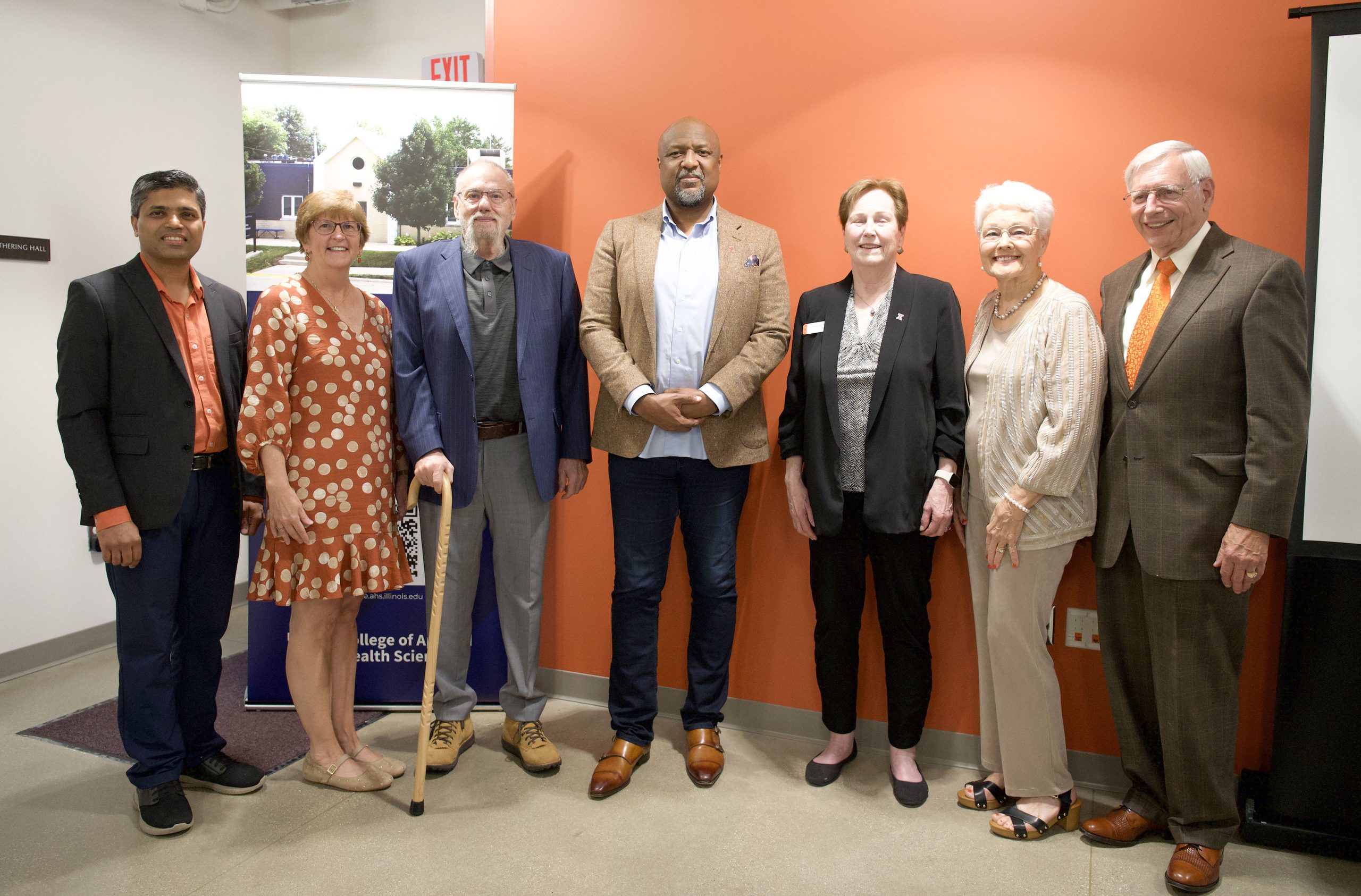
The AHS Class of 2027 gathered in Huff Hall for the first time.
Welcome Week at the University of Illinois Urbana-Champaign capped off with individual college celebrations scattered across campus.
The College of Applied Health Sciences brought first-year students to Huff Hall for a spirited welcome and resource-sharing session. A few members of the newest freshman class offered their thoughts on why they chose AHS and what they’re looking forward to in the new academic year.
Mustafa Siddique, hailing from Naperville, Ill., had a lot of fun with the “festive” atmosphere of University of Illinois Welcome Week, where it felt like everyone was there to lend a helping hand.
Mustafa is studying interdisciplinary health sciences on the pre-medical school track. The College of Applied Health Sciences won out in his school choice for its real-world usefulness.
“It kind of gives you a perspective into the specific field that you’re going into instead of just science as a whole. So I thought AHS was a good choice,” he said.
Arely Soto, from Aurora, Ill., was exposed to a wide range of therapists through her mother, who’s a social worker. After speaking with a speech pathologist and learning about her career, Arely decided speech and hearing science was the path she wanted to follow.
Experiencing Illinois Sights and Sounds, the capstone Welcome Week event that teaches new students Illinois traditions, was an early highlight for her. Especially taking a huge picture with her class packed into a “Block I” on the Memorial Stadium field.
“I’m really excited for RSOs to start, to get involved and see what the schools offer in general.”
Dallas Miles, from South Holland in the Chicago suburbs, said his family always encouraged him to do something in the health field.
“I’m glad I’m here now,” said Miles, who’ll be studying interdisciplinary health sciences in his freshman year. After Welcome Week, he’s got plenty of Illini merchandise—shirts and stickers galore.
Dallas’ vision for his career vision orbits around health technology, “making stuff like hearing aids and heart monitors” to help patients day-to-day, he said.
Allison Pines is from Highlands Ranch, Colo., but she’s a “religious Cubs fan” through and through. In fact, she declared for recreation sport and tourism with a concentration in sports management in the hopes of becoming an analyst for a Major League Baseball team.
“I was really impressed with the prestige that the concentration in sports management held, it’s something that I’ve been dreaming of for a very long time. The fact that I found a prestigious program at a school I’m passionate about drove me to Applied Health Sciences,” she said.
“Sports management is my declared major but I may get involved in kinesiology or other opportunities this college has to offer.”
Illinois freshmen Sam Rausenberger from Carterville and Mihir Patel from Vandalia share an interest in the human body and how it works. Majoring in kinesiology at AHS seemed an easy choice for both of them.
“I like sports and fitness and I like helping people,” Patel said. “Physical therapy spoke to me, basically, I feel like that’s something I can do.”
Both freshmen are interested in the physical therapy path, specifically in the world of athletics.
“I took a health class my freshman year which was required and I loved learning about the skeleton and muscles and all the movement,” Rausenberger said. “I didn’t take another class like that until anatomy in my senior year, we did the bones and learned in-depth how muscles move and how they work. I was super interested in that and knew this is what I want to do.”
After putting their names in for student organizations at the AHS Student Welcome—and in Patel’s case, catching a prized Illini shirt thrown into the crowd at Sights and Sounds—both are excited to explore the U. of I.’s opportunities.
“I’m definitely looking forward to getting to know more people and knowing the campus, what I’ve seen so far. It’s a beautiful campus. I just don’t know my way around yet,” Rausenberger said.
Greetings friends and alumni of the Department of Recreation, Sport and Tourism,
Welcome to the 2024 spring edition of the RST newsletter. This publication features research endeavors from our faculty, notable student accomplishments and the ongoing engagement of our esteemed alumni.
We were delighted this semester by a visit from Gov. J.B. Pritzker and saddened by the loss of a dear former colleague and mentor. We take great pride in showcasing the achievements of our students, and we shine a spotlight on faculty members, underscoring how their research endeavors propel our department forward as a trailblazer in advancing knowledge and shaping policy and practice. Whether you are an alum, a current student, or a member of our esteemed faculty, we trust that you will find these narratives both enlightening and enriching.
As I reflect on the past academic year serving as interim head, I am deeply appreciative of the rich legacy of leadership within our faculty and alumni. Your enduring goodwill and assistance have contributed to the strategic growth of our department, evident in the expansion of our educational offerings and the increased visibility of our scholarly endeavors.
Warm regards,
Bill Stewart Interim Head Department of Recreation, Sport and Tourism
The Speech Accessibility Project aims to amass a database of audio recordings from people with disabilities that affect their speech. (Getty Images)
Speech recognition software such as Alexa, Google Assistant, Amazon Echo, Cortana and Siri allow anyone to access information and use smart home technologies through spoken questions and commands. At least, that’s what they’re supposed to do. Unfortunately, these devices typically don’t recognize speech that is affected by a disability.
Mark Hasegawa-Johnson, professor of electrical and computer engineering at Illinois, wants to change that. He launched the Speech Accessibility Project (SAP), which aims to amass a database of audio recordings from people with disabilities that affect their speech. Volunteers with Parkinson’s disease, amyotrophic lateral sclerosis (ALS), stroke-related disabilities, cerebral palsy and Down syndrome record responses to three different types of prompts to capture commands, phonetically diverse speech such as one might produce when reading aloud, and conversational speech.
SHS Associate Professors Laura Mattie and Marie Moore Channell are leading the Illinois Down Syndrome Team. “People with Down syndrome have intelligibility issues so it’s common for them to not be understood at all or to be misunderstood by voice recognition systems,” Mattie said. And it’s not just that it’s the hot new thing, as Channell observed. “These systems are among the strategies we put into place to make life easier for people with disabilities,” she said. One can imagine the frustration that results from being unable to use technologies that are supposed to improve your life.
Mattie said she and Channell put a lot of effort into developing the prompts for the recordings “…to make them representative of the kinds of things for which individuals would be using the software.” Added Channell, “It’s about making sure on the front end that the recordings are valuable and representative so that what goes into the database is relevant.”
The Speech Accessibility Project database initially will be available to the consortium of technology companies that are funding the project, including Amazon, Apple, Google, Meta and Microsoft, before becoming widely available to the public.
RST alumna Julie Simmons has joined AHS’ Board of Visitors (Photo provided)
Pivotal. That is how Julie Simmons, chief operating officer and co-founder of Paragon Marketing Group, described her experience earning a master’s degree in Recreation, Sport and Tourism at the University of Illinois Urbana-Champaign. The experience not only influenced her successful career in sports marketing, but also led her to where she is now, continually offering her generosity to the community that fostered her professional growth.
“When you truly learn and you really take to heart the lessons from your college experiences, I think you naturally want to give back to and support the institution that shaped you,” Simmons said.
Simmons has spent much of her career giving back to her alma mater, opening Paragon’s doors to current students in the form of mentorship and scholarships. The company sponsors four scholarships—one within Illinois’ own RST program as well as at Northern Illinois University, Illinois State University and DePaul University.
For years, Paragon has also facilitated a number of internships with students in RST, as well as from other area universities.
“We strive for diversity in our recruitment, but supporting institutions within Illinois is particularly important to us,” Simmons said. “And because many of these applicants are local, it reduces the financial burden of internships and makes these opportunities more accessible.”
Internships at Paragon offer hands-on experience with sports marketing, priming students to work on a wide variety of client projects. According to Simmons, interns are exposed to different areas of the business including strategy, event logistics and planning, providing them with a broad understanding of the industry.
“For us, it’s about providing interns with a positive, real-world experience that equips them with the knowledge they need to pursue a career in sports marketing,” she said.
But Simmons didn’t want to stop at simply providing internships and scholarships. She is now part of the College of Applied Health Sciences’ Board of Visitors, an advisory board of volunteer alumni who aim to assist and advocate for the college’s goals. Simmons was nominated to the board in January of 2024 by Jean Driscoll, the assistant dean for advancement, who said “her [Simmons’] experience, leadership, and passion for service make her a wonderful addition to the board. Her accomplishments are too numerous to name, and the BOV will be a beneficiary of her talents and ideas.”
“I’m truly excited and honored that Jean nominated me for this position,” Simmons said. “For me, this is another way to give back to a place where I experienced tremendous growth.”
Simmons not only has her own professional expertise and experience on the corporate side of scholarships to offer the board, but also her unique experience as a woman owner in a male-dominated industry.
“When I started out, I was often the only woman in a room full of men, and that’s still often the case,” she said. “One of the most important things I learned was the value of finding advocates for myself and other women. Building that support network is crucial. When I worked at the University of Illinois in the athletic environment, I was the only woman on the promotions team for quite a while. Despite that, everyone was welcoming and open, showing me that you can coexist and support each other.”
Those experiences of positive mentorship are a large part of Simmons’ motivation to join the Board of Visitors, but she has yet another personal connection that draws her toward supporting an institution of learning. Simmons, being the first person in her family to go to college, has a particular appreciation for the privilege of higher education, especially for going on to receive her master’s degree from Illinois.
“If I didn’t have others helping me along the way, great mentors to guide me and people encouraging me to expand my horizons, I wouldn’t be where I am today. That’s what I want to do, as well. I want to provide others with the information they need, whether it’s about the sports industry, being a woman business owner or the importance of education. It’s all about paying it forward.”
Simmons reflected on the impact of a positive learning environment on her career and how it has influenced her and her peers to continue working with the university, recalling her time working with Michael Raycraft, a clinical associate professor in RST, and Stephen Staples, a member of the board.
“That’s why it was pivotal for me, and that’s why I feel very passionate about trying to give something back to something that really helped me.”
When it comes to her future on the board, Simmons expressed her excitement to join the Nominating and Governance Committee.
“I’m excited to be able to bring my background and experience,” she said. “I look forward to contributing substance and value to our initiatives. I’m excited to get some more meat on the bones.”
Our College of Applied Health Sciences college awards.
The College of Applied Health Sciences has awarded eleven faculty, staff, and students college awards for excellence. Three individuals received campus-level awards. All recipients will be honored at the Spring College Meeting in May.
AHS Excellence in Undergraduate Teaching Award: Faculty Campus Award for Excellence in Undergraduate Teaching Associate Professor Andiara Schwingel, Department of Kinesiology and Community Health Since joining KCH as a visiting scholar in 2008, Dr. Schwingel has taught more than 40 courses and appears regularly on the List of Teachers Ranked as Excellent. She founded START, Student Aging Researchers in Training, which places undergraduates in labs across the college, and has mentored more than 30 START scholars in the Aging and Diversity Lab. She is the current Associate Head for Undergraduate Studies in Community Health. She also received this award in 2018, and in 2013 was awarded the Phyllis J. Hill Award for Exemplary Mentoring in the Edmund J. James Scholar Program.
AHS Excellence in Undergraduate Teaching Award: Teaching Assistant Allyson Box, Ph.D. student, Department of Kinesiology and Community Health Allyson is a Graduate Research Assistant in Dr. Steve Petruzzello’s Exercise Psychophysiology Lab and a Teaching Assistant for his undergraduate class on the social and psychological aspects of physical activity. She has been named to the List of Teachers Ranked as Excellent every semester since the fall of 2017. Students described Allyson as “approachable,” “passionate,” “an exemplary teacher,” and “an exceptional communicator.” One said, “She encourages us to share our ideas and asks us thought-provoking questions, which has allowed me to gain confidence and develop my critical thinking skills.”
AHS Excellence in Online & Distance Teaching Professor Monika Stodolska, Department of Recreation, Sport and Tourism Dr. Stodolska played an instrumental role in developing and implementing RST’s online master’s program in 2012. She created the first RST course offered online, Theories and Concepts of Leisure, which she recently revised by developing new content and engagement activities that foster meaningful student interaction, and recording more than 40 video lectures. The AHS e-Learning team regularly shares her lectures with other faculty as outstanding examples of online content. She also converted the campus-based undergraduate course on diversity in recreation, sport, and tourism into an online course that enrolled more than 450 students in the fall of 2021.
AHS Excellence in Graduate and Professional Teaching Award Campus Award for Excellence in Graduate and Professional Teaching Associate Professor Toni Liechty, Department of Recreation, Sport and Tourism Dr. Liechty has taught courses for both the on-campus and online master’s degree programs in RST, and developed a course on legal aspects of RST that she has taught in both programs. She also teaches classes for the doctoral program. Dr. Liechty is deeply committed to diversity and takes steps not only to ensure that all students in her classes are able to make meaningful contributions, but also to make all of her students aware of the value of the diversity of perspectives. She often adjusts course syllabi to accommodate students’ various research interests.
AHS Excellence in Graduate Student Mentoring Award Associate Professor Raksha Mudar, Department of Speech and Hearing Science Dr. Mudar has guided the work of three Ph.D. students and several M.A. students in the Aging and Neurocognition Lab. All three Ph.D. students published research papers under her mentorship. Her two current doctoral students have received highly competitive 2021-2022 national scholarships from the American Speech-Language-Hearing Foundation. One also received a prestigious Dissertation Completion Fellowship from the University of Illinois Urbana-Champaign Graduate College. As the Director of Graduate Studies in SHS, Dr. Mudar ensures that more than 100 graduate students meet program milestones and provides support to faculty for graduate mentoring and advising.
Phyllis J. Hill James Scholar Award for Exemplary Mentoring Professor Steven Petruzzello, Department of Kinesiology and Community Health Dr. Petruzzello also received this award in 2018. Since that time, he has mentored almost 40 additional students enrolled in the James Scholar Program. He works with each student to help them identify their area of research interest and how best to pursue it, guides them through relevant literature reviews, and provides them with regular feedback as they complete their projects. Students describe him as enthusiastic, caring, and passionate. He has been called “one of the most impactful faculty members that I have worked with” and students greatly appreciate his commitment to their success and well-being.
Campus Award for Excellence in Undergraduate Advising Amy O’Neill, Department of Kinesiology and Community Health Since joining KCH as an Academic Advisor for kinesiology in 2003, Amy has shepherded thousands of undergraduate students through their studies. In addition to her one-on-one advising duties, she teaches the introductory kinesiology course to new first-year and transfer students. She developed a kinesiology advising website to share important resources with students and sends out a weekly email message to make them aware of opportunities for involvement in the department, college, and campus. She also has played significant roles on departmental, college, and campus committees related to student registration, honors and awards, and scholarships.
AHS Academic Professional Staff Excellence Award Ann Fredricksen, Division of Disability Resources and Educational Services After starting with DRES captioning videos in 2008, Ann has become the Coordinator of DRES’s Accessible Media Services. She oversees the captioning of videos, trains and manages student workers, develops captioning and audio description standards for the campus, and creates and administers educational outreach activities related to captioning and accessibility. Since the COVID pandemic began in late March 2020, she has been responsible for the captioning of more than 1000 hours of video material. She has created Math and Science Captioning Standards and Best Practices for STEM fields and co-developed an online captioning certification course.
AHS Custom Class Staff Excellence Award Heidi Krahling, Center on Health, Aging, and Disability Heidi has been providing outstanding support to faculty, staff, and students before and during the grant submission process as CHAD’s Grant Specialist since 2018. She brings her commitment to the advancement of science, keen eye for detail, and dedication to submitting grants error free and on time to bear on each proposal, and played a critical role in the college’s success in receiving its greatest amount of external research funding ever in 2020, more than $18 million. Grant seekers appreciate that Heidi’s skills enable them to focus on the scientific content of their proposals.
AHS Staff Excellence Awards Sally Marshall, Dean’s Office Sally brings strong organizational, communication, and multitasking skills to her work as the Office Administrator in the AHS Dean’s Office. She has provided support to the Senior Assistant Dean for Undergraduate Recruitment, Advising, and Enrichment, and is the primary support person for the Associate Dean for Academic Affairs. She assists with planning major events such as Ph.D. Recruitment Day and the AHS Distinguished Lecturer Series, serves as the liaison between the Associate Dean and departmental directors of undergraduate and graduate studies, and supports the Associate Dean in his role as Interim Director of the Chez Veterans Center.
Kathy Saathoff, Office of Advancement As the Office Administrator, Kathy supports the Assistant Dean for Advancement, two Major Gift Officers, and the Associate Director for External Engagement. She manages the execution of the critical gift acknowledgement process, handles multiple requests for research and reports, plans donor visits, and helps to complete donor fund agreements. Advancement personnel across campus regard Kathy as a friendly resource with deep institutional knowledge, developed during both her current position and her previous position with the University of Illinois Foundation. Colleagues describe her as “an exceptional teammate” who is always able to see the big picture.
Diego Acosta, a senior in the Department of Recreation, Sport and Tourism in the College of Applied Health Sciences, is aware of the well-worn axiom, “Find something you love to do and you’ll never have to work a day in your life.”
RST senior Diego Acosta spent the summer as an intern for Prep Baseball Report
The Skokie, Ill., native worked this summer as an intern for Prep Baseball Report (PBR), one of the top independent baseball scouting services in the country. Acosta plans to go to graduate school after he graduates in the fall, but he aspires to work in the baseball operations department for an MLB team.
Like many scouts you might have seen on TV while watching a baseball game, Acosta carried the tools of the trade—a stopwatch and a radar gun—and loved every minute of it.
“I obviously have a passion,” Acosta said about baseball. “And if I have a passion for it—we were learning (that it is) statistically proven that workers that have the biggest passion for what they do will move up higher and faster than anyone else that doesn’t have a passion for what they do.”
Acosta’s love for baseball began when he started playing the sport at four years old.
“I just kept (playing) until I blew my knees out. And when I was looking to go to school, I wanted to play baseball. I knew that I wanted to keep it as a part of my future someway, somehow.”
Acosta was recruited by Cornell University to play baseball before he hurt his knees but felt a natural inclination to the University of Illinois.
“I have a long lineage of Illinois alums,” he said. “My parents went there, my uncles went there, my aunts. I’ve been going (to UIUC) since I was a very young kid, and I just wanted to keep it in. So I decided to just go to school and see what I can do with the baseball team there.”
Thanks to his connections to Illinois, Acosta caught on as a bullpen catcher for the Illini baseball team, which fed his fire to stay in the sport. And, Acosta said, the courses offered in RST are a perfect springboard to a career in sports. He particularly enjoyed Clinical Associate Professor Mike Raycraft’s RST130 (Foundations of Sport Management) course, RST354 (Legal Aspects of Sport), and RST199 (Sport Brand Management), taught by RST Assistant Professor Jules Woolf.
“I feel like when it comes to the business side … there’s definitely times where I’m just like, ‘I remember talking about this in this class, but I’m seeing it here with the whole PBR thing. The Future Games is a perfect example. I remember thinking to myself, ‘Well, this is exactly– we talked about the brand and everything with Dr. Jules Woolf.’ And it’s genius. You bring everybody. You have every single state bring the entire country to one place, and you put on an event in one place across the entire country. It’s absolutely genius.”
For many RST students, a career in the sports industry is the ultimate goal. Some aspire to the customer-service side, some to the hospitality section, and others to the management sector. After all, who doesn’t want to be general manager of the Cubs? But while Acosta definitely dreams of being in a big league front office some day, he is ready to pay his dues first as a baseball scout, an often-grueling job with long hours, low pay and not much notoriety.
“I have a long lineage of Illinois alums,” he said. “My parents went there, my uncles went there, my aunts. I’ve been going (to UIUC) since I was a very young kid, and I just wanted to keep it in. So I decided to just go to school and see what I can do with the baseball team there.”
Diego Acosta
Student, Recreation, Sport and Tourism
“You’ve got to start at the bottom,” he said. “That’s the very first thing I figured out working with PBR, is there’s going to be some really, really, really long days. I was at a tournament in Rantoul from 8 in the morning until midnight. And I get back home, and the Cubs were playing. And I was staying at my apartment with a couple of my buddies that were there for the summer in Champaign. I was like, ‘Put the Cubs game on for me, please.’ And then they were like, ‘Uh, you just watched almost 13 hours of baseball. How do you want to watch the Cubs game?’ I was like, ‘I just want to watch the Cubs game.’ ‘They were like, you’re crazy.”’
Acosta is realistic, knowing how competitive working in the sports industry can be. That’s why he plans to pursue graduate school, possibly law school, upon graduation this fall.
“I have, basically, a plan B,” he said. “And my plan B would be some type of lawyer. I mean, my mom and dad have always joked, ‘Why do you argue so much with everything? Just go be a lawyer.’ I’m like, ‘Honestly, I might.’”
As much as he loves the game, Acosta wants to work in baseball for a reason larger than his appreciation for the sport.
“I’m Mexican-Colombian … and I grew up playing in Humboldt Park, which is like all Puerto Ricans and inner city kids, and then Homer Park. So I have a lot of friends from all different backgrounds,” he said. “And if I can do anything for kids like that, especially in other countries, because I’ve been there. Especially in Colombia, I’ve seen the slums. I’ve seen kids playing with rocks and sticks in the street. And if I could really help them get to their ultimate goal, I feel like that would be really cool for me to do. So that’s why I sort of want to be in professional scouting.”
Students in the College of Applied Health Sciences have the opportunity to do their internships in a variety of fields. Today, we speak with Jackie Buczkowski, a student in the Department of Kinesiology and Community Health, about her internship.
Jackie Buczkowski demonstrates different exercises for patients.
Q: Where did you complete your internship and what was your experience?
A: I completed my internship at Active Rehab Clinics in Bucktown, a neighborhood in Chicago, Illinois. Initially, I began shadowing the head chiropractor of the clinic and his assistant. I observed the chiropractor while he worked hands-on with his patients and observed his assistant while he coached the patients through various exercises pertaining to their injury. After two to three months of observation, I began working with patients myself. I was taught the Burdenko Method which consists of a series of exercises used to treat patients on land and in water. Throughout the fall 2020 semester, I worked with patients at the clinic in Bucktown as well as out of Lutheran General Hospital in Park Ridge, Illinois.
Q: How did you apply for the internship?
A: Since I completed my internship during the summer and fall of COVID-19, I did not apply for this internship as a student conventionally would. My cousin is a patient of the chiropractor and asked if he was allowing students to shadow during this time. However, when I have shadowed previous physical therapists I would typically reach out through email. I have also dropped off my resume at a few different locations to see if they would allow me to shadow. More often than not they would agree! Since physical therapists understand shadowing is a requirement in order to apply to PT school, they are very understanding and willing to help.
Q: What did you learn from the internship?
A: This internship was the most fulfilling internship I’ve had so far. I learned to trust my judgment and to not be embarrassed of being incorrect or struggling to learn something new. I was often quizzed and asked questions before being told the answer. This style of teaching helped stimulate my brain which overall felt more interactive. I wasn’t simply watching passively but rather actively engaging in assessing a patient.
Q: What was your biggest takeaway from the experience?
A: My biggest takeaway from this experience is understanding that every patient is different. What might work for one patient may not work for the other. Although you’re taught to go by the book in some cases, you may need to think outside the box in other scenarios. It was fascinating for me to see the chiropractor and his assistant not only assess the part of the body that was injured or had pain but to go beyond that and see if another part of the body was actually causing that pain. For example, if a young athlete was having pain in her knee, they would rehab her hip and build strength there.
Q: Is this internship closely related to the field you are hoping to work in?
A: This internship is closely related to the field I want to go into which is physical therapy. Although I shadowed a licensed chiropractor, he also specializes in rehabilitation. In my previous experiences I shadowed physical therapists at hospitals and chain outpatient clinics such as Athletico, however, this experience was different because it was a privately owned clinic. In many ways this faces its own challenges because billing and scheduling is in your control. I was able to see the “behind the scenes” of what owning your own business might look like.
Q: Would you like to share any other information that might be helpful for future Kinesiology students?
A: The advice I recommend to any Kinesiology student is to reach out to any company or any specific person you’d like to shadow or intern for! Internships are truly the best opportunity to figure out whether or not you really want to go into a certain field. I’ve shadowed many physical therapists and have learned something new from each of them. They inspire me to finish school and start doing what I believe to be the best career there is for me. With a bachelor’s in Kinesiology there are many career paths you can take and you want to find which fits you best!
Andrea Paceley is ‘indispensable,’ according to nominators. (Photo by Jerry Thompson)
The Graduate College in February announced that Andrea Paceley (Office Manager, Speech and Hearing Science) was named a winner of the 2024 Graduate College Excellence Award for Graduate Contacts. The award is given annually as part of the Graduate College’s Annual Workshop for Directors of Graduate Study and Graduate Contacts. It recognizes staff members whose service has exceeded expectations in enhancing graduate students’ experiences and has positively impacted their graduate program or department’s operations.
Paceley has served as the Office Manager in Speech and Hearing Science for more than eight years. Nominators named her an “indispensable” part of the department for her streamlining of processes, commitment to transparency and “contagious cheerfulness.” One nominator said that Andrea “has demonstrated sustained excellence in support of our graduate programs, students, and faculty.” A graduate student in Speech and Hearing Science added that “her skills, kindness, and ability to navigate challenges with grace set her apart as a truly exceptional graduate secretary.”
Graduate Contacts are essential to the success of our graduate students. They welcome students into our campus community, provide valuable support through both the good and challenging times, and celebrate students’ accomplishments. The care and compassion that Graduate Contacts demonstrate every day are an invaluable contribution to the university and its community of students, faculty, and staff. The Graduate College extends its thanks to all of our Graduate Contacts for their work in our campus community.
Students are attending college in a unique environment, and that includes students in the College of Applied Health Sciences at the University of Illinois. The AHS communications staff spoke with AHS seniors about online classes, truncated courses and how COVID-19 changed their expectations. Today, we speak with Sam Tinaglia, a Recreation, Sport and Tourism major with a concentration in sport. Sam will graduate as a Bronze Tablet Scholar this month.
Sam Tinaglia
Q: Why did you pick RST?
A: When I first came to UIUC, I started as a journalism major, but then was recruited to go on Dr. Michael Raycraft’s RST 180 Hall of Fame Class Trip. I enjoyed the trip and meeting other RST students and faculty so much that I eventually transferred into the RST program my sophomore year. I have always loved sports and knew I wanted to work in the sports industry and I felt RST was the major that could help me reach my goals. As I finish my undergraduate degree, I feel I made the right choice as the RST curriculum has thought me many valuable skills for the future.
Q: Which professors had the most impact on you?
A: Dr. Kim Shinew, Dr. Michael Raycraft, Dr. Sharon Zou, Dr. Bill Stewart, Robyn Deterding, and Don Hardin have left a lasting impact on me from my time in RST.
Q: What course did you most enjoy?
A: RST 180 with Dr. Raycraft was my favorite course as that class is one of a kind. As a group of about 20 individuals, we jumped on a big orange Illinois coach bus and traveled to recreation, sports, and tourism destinations in Ohio, New York, Pennsylvania, and Indiana. We saw the Major League Baseball Hall of Fame in Cooperstown, the Lake Placid Olympic facilities, the Woodstock Concert Grounds and Museum, the National Football League Hall of Fame, and the Indianapolis Motor Speedway, which were just a few of our many fantastic stops. This class was like no other I’ve ever taken in my years of schooling and I would take it again in a heartbeat.
Q: Did you enter RST knowing your career path, or did RST help you decide?
A: I entered RST knowing I wanted to work in sports, so I went the sports concentration route. But as I was taking classes in RST, I learned to love the recreation and tourism concentrations too. I think the parts of R, S, and T can be intermixed, and after finishing the course work, I can say I would love to work in any of the RST fields.
Q: What do you hope to do after you graduate?
A: After I graduate I hope to start up my online master’s degree with RST and get more experience in the RST field as I intern with the Niles Park District in Athletics.
Q: What was your favorite on-campus experience?
A: My favorite on-campus experience at Illinois was working with the Fighting Illini Marketing Team within the athletic department. For that opportunity, we handed out promotional materials before athletic events at UIUC and helped with in-game promotions too. Being able to work in person at various Illini sporting events was a fantastic experience and I’ll miss it when I graduate.
Q: What do you miss most because of the pandemic?
A: I have been schooling from home since March of 2020, so ever since the pandemic started. The thing I miss most is going in person to classes and interacting with other students and professors. You don’t realize something was so great until you can’t experience it anymore, and that was me at Illinois. I really enjoyed school and, sadly, it’s (technically) over.
Q: What are the biggest changes on campus, pre- and during COVID?
A: (I) haven’t been back since March 2020, I wouldn’t know.
Q: What would you say to recommend RST to a prospective student?
A: If you love and want to work in recreational activities, sports, and/or the tourism industry, RST is the place for you. Also, if you just want to get a good, well-rounded college experience in a smaller tight-knit college within a large university, RST would be a great home for you.
Students in the Department of Recreation, Sport and Tourism in the College of Applied Health Sciences at the University of Illinois have had to adjust their internships because of the ongoing COVID-19 pandemic. Periodically, we will speak with them about how those changes have affected their summer plans and potentially career paths. Javier Maldonado expected to work at a field house in Chicago, but instead was part of the inaugural Illini RST Undergraduate Consulting (IRUC) program, created by RST department head Carla Santos and clinical assistant professor Mike Raycraft. He talked to AHS communications about his experience working for The Specialized Marketing Group and the NBA’s Oklahoma City Thunder.
Q: How are your experiences different from what you expected?
A: My experiences are very different from what I had expected from my internship; I expected something where I would be hands-on and not behind a computer screen.
Q: Are you doing something different for your internship than what you originally planned?
A: No, not from when I found out about this internship and what it would be like. Since it’s begun, I don’t believe I have done anything different then what was originally planned.
Q: Does your internship lead you to think about a different career path?
A: It doesn’t necessarily drive to a different path, but it does open up my eyes to different fields within my major.
Q: What happened to your original internship?
A: I was waiting to hear back from a field house in Chicago but because of COVID-19, they didn’t know how many people they would actually need. Unfortunately, because of time, they weren’t able to give me an answer.
Q: Has anything been frustrating about your change in internship status?
A: The only frustrating part is being at home and having to work from home.
Q: What are you missing out on because of the pandemic, in terms of working face-to-face with people?
A: I feel like face-to-face is the biggest thing I am missing out on; I am a very hands-on learner and would have liked to learn from a professional face to face.
Q: What advice do you have for future students who might have disrupted internships?
A: The advice I have is to try and maintain a positive view on things. It’s going to be hard when things don’t go the way you expect but making the best out of situations goes a long way.
Q: What other ways has COVID-19 affected you? Have you traveled? Have you been able to go home, see family?
A: COVID-19 has just been a bummer and being stuck at home all the time hasn’t been fun, either.