Eight students in the Master of Science in Health Technology program showcased their capstone presentations on Aug. 4 at the I-Hotel in Champaign.
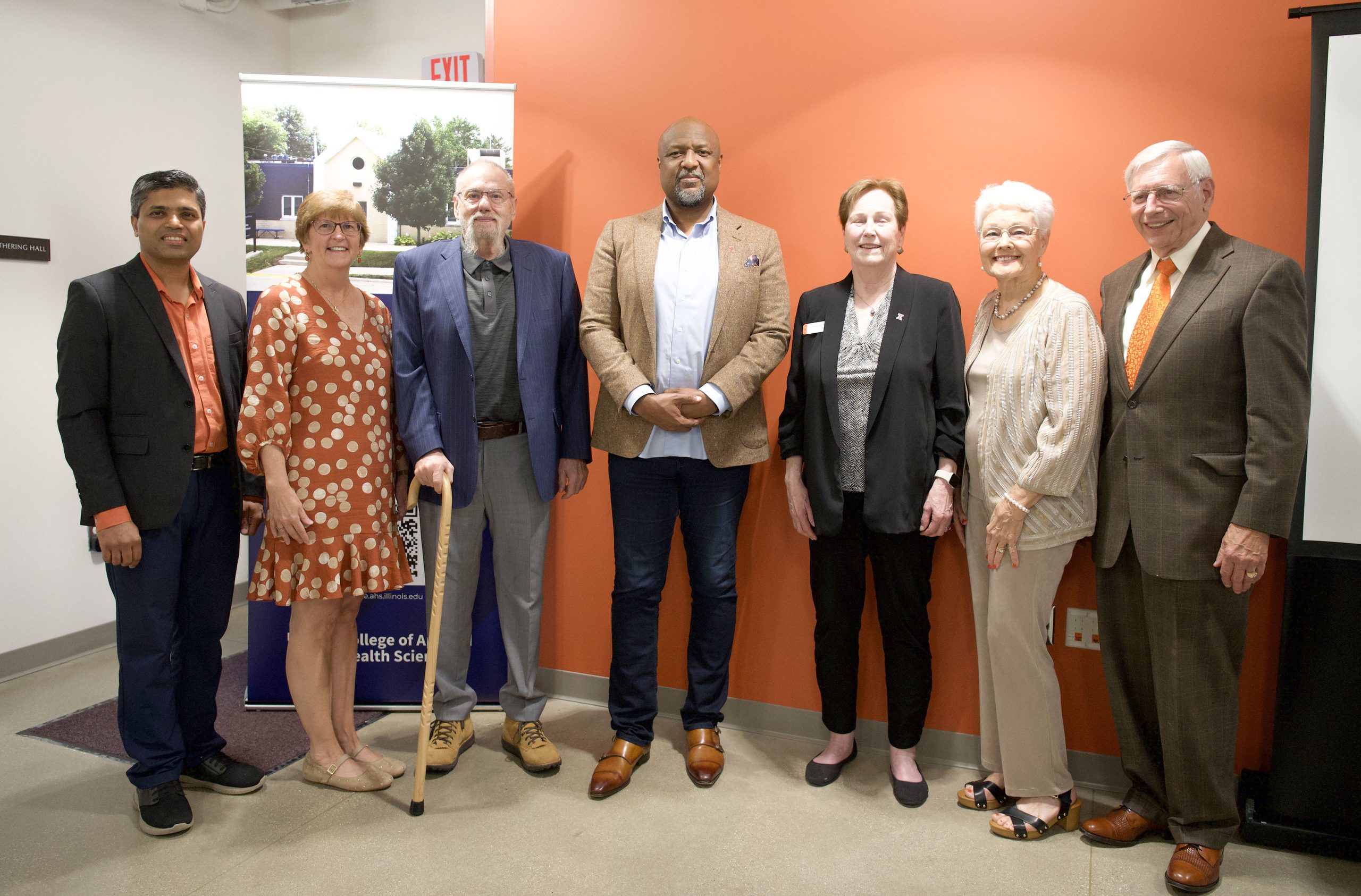
The capstone is the final presentation for the students’ Master of Science degrees. Invited guests included faculty members and capstone sponsors as well as friends and family of the students. Special guests included Illinois alumni and donors Michael Vitoux and Jim and Karen McKechnie.
Falguni Deshpande was selected to receive the Michael Vitoux Capstone Excellence Award, which included a $2,000 prize. Deshpande’s capstone was entitled “Inclusion of Minority Patients in Alzheimer Disease and Related Dementias (ADRD) Clinical Trials through Care Partner Engagement” and was supervised by Kinesiology and Community Health Assistant Professor Mina Raj in the Aging, Caregiving and Technology Laboratory.
Lauren Komrska received honorable mention in the same category, which includes a $1,000 award. Komrska’s capstone in the Disability, Participation, and Quality of Life Laboratory with KCH Associate Professor Laura Rice was entitled “Development and Validation of a Fall Detection Device for Older Adults who use Wheelchairs or Scooters”.
Vitoux was present for the award presentations and said he was impressed by the students’ work. The recipients were selected by the awards committee based on presentations and assignments about their capstone projects throughout the academic year.
Dr. and Mrs. McKechnie celebrated all of the MS-HT students’ accomplishments at the luncheon and poster session. They were especially proud of the work of Deshpande and Komrska, who were recipients of the 2021-2022 James and Karen McKechnie Fellowship in Applied Health Sciences.
I hope this message finds you all in good health and high spirits as we embark on a new academic year at the College of Applied Health Sciences. As the dean of our esteemed college, I am thrilled to welcome you to the fall 2023 semester and share some updates.
This edition of the newsletter is a testament to our relentless commitment to excellence, innovation and community engagement. In the past year, our college has made remarkable strides in research, education and outreach. In this newsletter, we celebrate these accomplishments and highlight the incredible individuals who have made them possible.
Our faculty members continue to shine as leaders in their respective fields, producing groundbreaking research that contributes to the advancement of health sciences. Our students, the heart of our community, have continued to excel academically and demonstrate their passion for making a positive impact in the world of healthcare. Moreover, our alumni network continues to grow and thrive, with our graduates making waves in various sectors of the healthcare industry.
I encourage all of you to actively engage with the newsletter by reading and sharing. This publication is a reflection of our shared journey, and your input is invaluable in making it a meaningful resource for our community.
Thank you for your dedication to the College of Applied Health Sciences. Together, we will continue to empower excellence and drive positive change in the field of health sciences.
Students visited many noted tourism sites during the RST180 course this summer (Photo provided)
The Hall of Fame tour that serves as the essence of the Recreation, Sport and Tourism 180 experiential course has been the subject of much discussion since it was introduced in 2016.
The 12-day excursion component of the course—led by RST Clinical Associate Professor Mike Raycraft—spans more than 2,000 miles and has drawn attention from local news channels, magazines and newspapers over the years. Students visit notable tourism sites including the Rock and Roll Hall of Fame, the Baseball Hall of Fame and the NFL Hall of Fame as well as historic destinations in Ohio, New York, Pennsylvania and New Jersey.
But what makes the course so beloved by its participants? Students who took the course and went on the spring 2024 trip along with a few RST professionals who lead tours on the trip weighed in.
For Axel Mueller, a sophomore studying sport management, getting to know other students was what made RST 180 truly special.
“I was able to meet so many other people within the RST department and get a better understanding of the recreation and tourism side, because at school, I don’t ever see those people much.”
Mueller recalled one of the trip’s hiccups where the lift on their charter bus broke down during a rainy day in New York. The group had stopped for lunch at the famed Anchor Bar, the birthplace of Buffalo chicken wings, and on the way out the lift that was supposed to help Kendall Speaks, an RST major and wheelchair basketball team member, get onto the bus broke, leaving the group stuck in a parking lot for more than an hour.
“I had to squat down, have her wrap her arms around my neck, pick her up, and then carry her to her seat on the bus,” Mueller said. “Of course, Dr. Raycraft was able to arrange another bus that day.”
It was that type of attitude, from Mueller and others in the group, that turned what could have been a deeply frustrating situation into a humorous anecdote, and the tour continued without major issues after that point.
Another aspect of the course Mueller appreciated was getting the opportunity to talk to experts in his prospective field of sports management.
“It definitely opened my eyes a little bit—there’s so many things I can do with a sport management major,” he said. “I would say it broadened my perspective rather than narrowed it.”
Carter Blount, another sophomore in RST, put his perspective on the tour plainly:
“Professor Raycraft makes the trip,” he said. “ He’s done this for so long. He knows all these people and has crazy connections, and he definitely makes it enjoyable.”
Blount went on Raycraft’s spring break study abroad course to London, and despite the exhausting overnight flight and packed schedule, he enjoyed it and was influenced to enroll in the RST 180 course for the second half of the semester. Blount wasn’t alone in this; he said around 20 students who went to London that spring also enrolled in RST 180 this year.
A few fond memories for Blount included cramming into one hotel room with everyone to watch the NBA playoffs, walking the Princeton campus at night where he coincidentally met a student who had gone to the same high school as he did, and watching the sun set over the lake in Cooperstown, New York.
“I can’t think of a single night where I wasn’t in someone else’s room,” Blount said, referring to the close-knit evenings the group spent together after the day’s tours were done.
“It reaffirms my perspective that there are Illinois people everywhere, but also in places you would never think of,” Marshall said. “It’s a reminder to just keep my eyes open and look for connections wherever I can find them.
Todd Marshall
RST student
Blount spoke about the positive experiences the group had with their hosts, with the students who were able to ask questions about internships, careers and their own experiences breaking into the industry. He also discussed how the class itself enhances the trip, saying “you spent eight weeks studying the places you’re going to visit, so it’s cool to go see them all at the end.”
Todd Marshall, an RST graduate student at the University of Illinois, had a slightly different experience than the other students on the trip. As a graduate student working closely with Raycraft, he got an inside look at what it takes to organize and deliver experiential learning opportunities that will serve him well as he enters the field. Marshall was heartened by the large number of alumni they connected with at the locations they visited, taking the opportunity to learn from people not much older than him who successfully made it in the sport management industry.
“It reaffirms my perspective that there are Illinois people everywhere, but also in places you would never think of,” Marshall said. “It’s a reminder to just keep my eyes open and look for connections wherever I can find them.”
Chris Willis first met Raycraft in 2019, while he was doing research for his book on Red Grange, an Illinois alum who played for the Chicago Bears from 1929 to 1934 and is one of the most famous NFL players of the 20th century. When they met, Raycraft mentioned the tour, leading Willis to offer his expertise as head archivist at NFL Films in New Jersey. Despite the COVID-19 pandemic preventing the addition to the tour for a few years, eventually students were able to visit the studio, libraries and research facilities at the headquarters.
“We provided an overview and general information about what NFL Films does, and the facility is a big part of that,” Willis said. “We have everything under one roof.”
Willis is no stranger to hosting tours at the facility, saying they have around five or six per year, usually with friends or family of employees or groups of students like the ones from the Department of Recreation, Sport and Tourism. Willis confessed he enjoys leading student tours the most, saying he prefers “talking to a younger crowd.”
“Some of the subjects we study are between 50 and 100 years old, so it’s fun to interact with younger students or fans and show them what we do or talk to them about NFL history or the history of NFL films,” he said.
The highlight of the tour was the studio, according to Willis. Many students, sports fans themselves, recognized the place where many of the NFL’s talk shows are filmed and enjoyed seeing the back end of their favorite sports productions.
Mark Thomas found his love for working at parks while working at a summer camp in Rockford as a teen. After graduating from the department of Parks and Recreation (now RST) in 1975, he managed the grounds of a college campus for seven years until it closed. For a long time, Thomas found jobs outside of the industry, doing work in consulting, retail and politics before he was able to work his way back into parks, where he was asked to host RST 180 at Niagara Falls in 2016. At that point, he had been serving as the western regional director of state parks in New York since 2007, with a main office in Niagara Falls.
“I have a tremendous amount of experience,” Thomas said. “The students have a lot of great questions about the park, and so I’m able to elaborate on that for them.”
When the RST 180 students first arrived at Niagara Falls at night, the lights (a $4 million system whose installation Thomas took part in overseeing) shined orange and blue to welcome the tour, an experience cited by many students who went on the trip. They saw the natural landscape and participated in the Maid of the Mist boat tour offered by the American side of the park. Thomas said the students were curious and engaged with the tour, regarding both the history of the falls and the logistics behind managing them.
“They love the tourist experience—who wouldn’t, right? It’s a great experience, but they also embrace the learning aspect of the visit as well.”
Grace Burns, a senior majoring in statistics and minoring in RST with hopes to go into sports analytics post-graduation, was excited by the prospect of the course but admitted to feeling anxious about going on a long trip with complete strangers. Her worries ended up being unfounded.
“Going into it not knowing anyone, I was definitely really nervous,” she said. “I was like ‘Oh my gosh, what did I get myself into?’ But I met so many people. I’m almost glad I didn’t go with my friends because it allowed me to branch out more.”
Burns’ favorite memories from the trip include a night she and several other members of the tour went out for karaoke in Albany, and listening to a panel at the NCAA headquarters where she was able to speak to someone with a career in sports analytics and recordkeeping.
“That’s what initially got me into sports analytics,” she said. “I love all the records in sports, especially baseball—there seems to be a stat for everything. So, it was really neat to hear from him.”
RST 180 exemplifies the passion for educating, events and entertainment, and accommodating all who travel, whether they are sports fans, history buffs, or national park enthusiasts. The class and tour provide a unique experience for students that puts them on both sides of this transaction.
“I would encourage everyone to look into the class even if you’re not RST affiliated and even if you don’t know anyone,” Burns said. “It sounds clichéd, but it was really awesome, even if you’re not into sports.”
Marni Boppart, second from right, poses with husband Stephen, left, her daughters, and Chancellor Robert Jones, center. (Photo by Darrell Hoemann)
Marni Boppart’s trajectory to named professorship at the University of Illinois Urbana-Champaign began as a kid playing in the Pine Barrens of New Jersey.
Boppart, a professor in the Department of Health and Kinesiology in the College of Applied Health Sciences, was named the Saul J. Morse and Anne B. Morgan Professor at an investiture ceremony on Sept. 6.
But long before her illustrious career studying cellular biomechanics and muscle began, Boppart’s interests were taking roots in the woods.
“I would describe myself as a very active kid growing up,” she said at the investiture. “All our recreational time was spent outdoors playing baseball, basketball, kickball, riding my bike and jumping over ramps and doing crazy things that my mom still doesn’t know about. I grew up in in the Pine Barrens of New Jersey, and the woods were our playground. I mention this because it really influenced my decision to pursue my first degree in biology at the University of New Hampshire. This provided the opportunity to continue to explore the great outdoors, hiking, rock climbing, skiing, and even trying my hand at hang gliding—without hurting myself.”
As a biology major, Boppart was required to take a course in immunology and was assigned to write a paper on the effects of exercise on immune function.
“I thought, ‘Well, this was a really odd topic. What would exercise have anything to do with immune cells in the body? If you recall, the 80’s were defined by the fitness craze,” she said. “I think I still have my ThighMaster and Jane Fonda tapes sitting in a closet somewhere. The idea that exercise could be beneficial for health and prevent disease was still relatively new. What started as a simple class assignment grew into a life-long obsession with wanting to understand how exercise or the process of muscle contraction could benefit not only muscle, but all organ systems and whole body health.”
Boppart spent time in the Air Force as an aerospace physiologist, then decided to pursue a Ph.D. in Applied Anatomy and Physiology at Boston University. Working with two “powerhouse investigators” in the field of exercise science—Roger Fielding at BU and Laurie Goodyear at Harvard Medical School—the trio was able to document some of the first observations of molecular changes occurring in human muscle as a result of exercise.
“Like most researchers, I had more questions than answers at the end of my doctoral program: How does exercise, or the process of contraction stimulate molecular changes in muscle, what do these changes really mean for structure and function, and going back to my original interest, what is released by muscle into the circulation that might influence whole body health?,” she said.
For Boppart, those question led to what is now a 30-year career studying muscle.
Using transgenic mice, Boppart and her lab partners were able to determine that the integrin complex not only controlled molecular signaling in muscle, but also contributed to skeletal muscle remodeling and growth in response to exercise.
“But then everything changed in 2013,” she said.
That year, Boppart said, she and her lab mates were the first to report that exercise can result in the accumulation of perivascular stem cells in muscle.
“We found that these cells secrete beneficial factors that not only influence muscle remodeling and growth, but structures outside of muscle as well, including vessels and the brain. And so we started to wonder … could these stem cells be used to treat a disease or condition?”
Boppart’s interest in healthy aging led to a study of whether stem cells could be used to address age-related disabilities, particularly slowing the progression of muscle loss. While she found that stem cells were not effective in slowing the progression of muscle loss or regrowing muscle after disuse, she did find if she isolated nanoparticles (or extracellular vesicles or exosomes) from the stem cells first and then injected them into the aged mice, they could successfully recover muscle growth, which is the first step in preventing disability. That discovery led to new sources of funding, including funding from NASA and private foundations such as the Allen Institute.
Cheryl Hanley-Maxwell, dean of the College of Applied Health Sciences, praised Boppart and her work.
“Being named to an endowed position is a singular honor for faculty members,” Hanley-Maxwell said. “Those who hold named professorships are at the top of their fields, and that is certainly true of our honoree today. When I think of Marni, I think of unwavering integrity, deep intellectual curiosity, unconditional dedication to her students, and absolute passion for her work. And humility.”
The named professorship is endowed by Saul Morse and Anne Morgan. Morse earned two degrees at the University of Illinois, including a law degree and is an alumnus of AHS’s Disability Resources and Educational Services. He retired in 2023 after a 50-year career in law. Morgan is a clinical psychologist who retired after more than 30 years of practice in health psychology.
“I would like to thank our donors, Saul and Anne, for their generous contributions to the University of Illinois and the College of Applied Health Sciences,” Boppart said. “I am deeply honored and humbled by this recognition. And I am humbled because, as I look around the room, I see many experts in the fields of health, aging, and disability. To know that several of you nominated me for this award is a bit overwhelming. Thank you for this opportunity. I will remember tonight always.”
Boppart thanked her mentors, HK Department Head Kim Graber and Professor Jeff Woods, as well as her collaborators and colleagues.
Turning toward her future plans, Boppart is energized about what’s next.
“We would like to use our funding and this professorship to translate our EV therapy to humans. I’m confident we can do this,” she said. “Not only because clinical trials with stem cell-derived EVs are already occurring in the U.S. in places like the Mayo Clinic, but also because I have an amazing interdisciplinary research team to help make it possible.”
Camille Hobby’s life has always revolved around sports. She grew up moving from city to city as her father, Marion—currently the defensive line coach for the NFL’s Cincinnati Bengals—coached at various colleges and in the NFL, but her personal passion was always for basketball. Now, at 23, graduating with two degrees, three ACC tournament wins and a Women’s Basketball Invitation Tournament championship under her belt, the 6-foot-3-inch center is ready to start a new chapter in her basketball career.
Camille Hobby ultimately wants to be a coach. (Photo by Fighting Illini)
“I think it was kind of just a natural progression,” Hobby said. “I’ve been around sports my whole entire life. I definitely want to stay in sports—college athletics, professional, whatever the case is, so in the future I want to be a coach. I want to get into coaching, and I thought it was the best idea for me to go into (the Department of Recreation, Sport and Tourism).”
Hobby graduated from the University of Illinois Urbana-Champaign with a master’s degree in recreation, sport and tourism in May 2024 after spending her fifth year of eligibility with the Fighting Illini women’s basketball team. Hobby earned a bachelor’s degree in sport management from North Carolina State University, where she would have played all four years, had COVID-19 not taken a season away.
“I had one year [of eligibility] due to COVID, so I transferred primarily because of basketball, because of having that extra year. But then I wanted to continue that sports management realm of study, so that’s how I ventured my way to the RST department.”
In deciding where to spend her last year of eligibility, a few key aspects drew Hobby to choose Illinois. She said the school’s reputation was one factor in her decision, giving a nod to the iconic “Block I” impact on a resume.
“Everyone sees the I. Everyone knows the logo, you know, and that’s extremely important, especially when you’re going into jobs and looking for future places of work.”
She also highlighted the university’s emphasis on community and academics that impacted her decision.
“It’s a tight-knit community—definitely a college town. So, that played a huge role into that [decision], especially playing basketball in an environment that supports the needs of the team, and having great academics was important to me.”
After college, Hobby wants to play professionally in Europe before moving on to coach basketball, putting both her degree and lifetime of experience playing basketball to use. She said coaching would allow her to have a positive impact on the lives of other young athletes, something she has not only experienced from an athlete’s perspective but also witnessed through her father’s own career.
“He played a huge part in that,” Hobby said. “I’ve seen the incredible players that he’s coached in the past and he’s been influential in their lives and that’s something that I want to do, is to make an impact on young people’s lives and get them to be the best versions of themselves.”
Hobby also reflected on how her experience earning a degree in RST aided her service-oriented view of coaching, saying “I’ve always been a person that wants to help people and be of service to others and make them better, and I feel like that’s kind of what the RST department is; it is in the service business of helping others and showing them things and that’s kind of where my heart lies. That’s where I know my dad’s heart lies as well, helping those around us, and the best way, I feel, to do that, is through coaching.”
The program not only helped Hobby prepare for coaching as a public service, but it also emphasized to her the importance of diversity and inclusion in coaching.
“I feel like the biggest part of being a coach is the diversity and equity part of it—universal design and making sure that there’s a space for everyone. I feel like that’s so important, especially as a coach. You want to make sure that your players feel like they are important, feel like they are accepted, whoever they are, what makes them different and unique.”
One specific experience in the program stuck with Hobby: watching wheelchair basketball club teams compete. She recalled how it made her re-think diversity in sports, saying, “that was completely eye-opening for me. I think a lot of the time we hear about having that inclusion, having diversity, but a lot of the time there’s not much action behind it. To see them and see how competitive they are was really inspiring, and it just allowed me to get into that—finding equity and inclusion for everyone. Not just in terms of race or gender, but for someone who has challenges that limit them from playing traditional sports.”
Hobby intends to follow in the footsteps of the people she has looked up to: her father and her own coaches, who she said inspired her on and off the court.
“Having people who advocate for you, people who are just good people who want to see you succeed, that’s important. To see them, it makes me want to be like that in the future: always encouraging my players, believing in them, and wanting the best for them.”
Sylvia Techmanski’s favorite subject in high school was Spanish, but it wasn’t until a spring break trip to Puerto Rico that she realized her love for languages could take her farther than that.
Now a student in the Department of Speech and Hearing Science and in the Department of Spanish and Portuguese at the University of Illinois, Techmanski is going further. The sophomore, pursuing a dual degree in Speech and Hearing Science and Spanish, is headed to Rio de Janeiro for the summer to study Portuguese.
Techmanski will travel to Brazil as one of four Illinois recipients of the Critical Language Scholarship to speak and learn Portuguese in Brazil. Brazilian Portuguese is deemed critical to the U.S. economy and national defense, as Brazil has the eighth-largest economy in the world.
“This summer, I’ll be in Rio for nine weeks, and I’ll be studying in PUC-Rio (Pontifical Catholic University of Rio de Janeiro) which is the best university there,” Techmanski said. “It’s been rated one of the best universities in Latin America multiple times which is super cool. Plus, the Brazilian spirit is so open and friendly.”
Her goal is to become a speech-language pathologist that works with bilingual clients with language disorders to help them perfect both their heritage language and English. Techmanski specifically wants to help preserve ties with their culture while simultaneously having the linguistic skills necessary to succeed in the U.S. educational institution.
The scholarship is nine weeks long, fully supported by the U.S. Department of State, and allows for Techmanski to receive eight hours of credit toward her degree. She is one of 500 students across the nation who received the Critical Language Scholarship.
Alongside the Critical Language Scholarship, Techmanski also received the Foreign Language and Area Studies Fellowship, for which she received $10,000 in tuition and a $5,000 stipend for two semesters to study a less-commonly taught language. She will also be studying abroad in Granada, Spain, during the spring semester of her junior year.
Brady Hughes is a senior advisor in the Department of Spanish and Portuguese within the College of Liberal Arts & Sciences and is the person who first told Techmanski about the opportunity. A large part of his work as an advisor is to help connect students with opportunities all over campus.
“Sylvia’s passion for learning languages and exploring other cultures has been apparent since my first interactions with her, and it’s been a pleasure to see all that she’s accomplished in her time on our campus,” Hughes said. “I am excited for her to return to campus and share what she’s learned in Brazil.”
Techmanski first discovered the internship within one of Hughes’ emails to students, which she read in her favorite study spot at the Grainger Engineering Library Information Center. There, on the third floor, she chose Portuguese as her language for the CLS scholarship.
“Many students who major or minor in Spanish complement their studies by taking Portuguese, and like Sylvia, they often find that the language comes easily to them, the courses are fun, and they receive individualized attention from their instructors,” Hughes said.
So far, Techmanski is fluent in English, Spanish, Portuguese and is in the process of learning Arabic and French.
Her experience abroad will increase her fluency in the Portuguese language and Brazilian culture, thus helping her achieve her goal of evaluating and treating the language of multilingual children, especially those of Brazilian heritage, she said.
“It’s such a big part of what gives me joy in life,” Techmanski said, “That is really inspiring for me to think about my future career working with multilingual children, of course, that speak Spanish and Portuguese, and maybe French or Arabic, but maybe they also speak like Tagalog [the national language of the Philippines]. I could use them as motivation to learn more about their language and how it works so that I can better fit their needs.”
Multilingualism is becoming more important in the United States and the SLP field is always looking for more specialists. Typically, SLPs are most requested in bigger U.S. cities where there are more multilingual communities, she said.
After graduation, Techmanski wants to move to a big city in the U.S. to serve as speech-language pathologist for children of immigrants. After a few years in the field, she plans to pursue a Ph.D. in language acquisition and work as a professor or clinic director at a university, she said.
“And as long as I’m following what I love to do, and helping others in that process, then I’m going to get experience,” Techmanski said. “I feel like I’m fulfilling my purpose, and that’s through helping other people communicate and have autonomy.”
Illini 4000, started as a theoretical conversation between two Illinois students in 2007 and has since become a massive annual fundraising drive that has raised more than $1.3 million since the first ride more than 15 years ago.
Personal experiences with cancer spurred a decision by Izzy Perpich, center, to join the Illini 4000. (Photo provided)
When Izzy Perpich committed to the University of Illinois Urbana-Champaign in 2021, they were self-admittedly unenthusiastic about attending. However, in their search for points of interest on campus, they discovered a registered student organization that just happened to sit perfectly at the intersection of two of their passions: healthcare and cycling.
Illini 4000, or I4K, started as a theoretical conversation between two Illinois students in 2007 and has since become a massive annual fundraising drive that has raised more than $1.3 million since the first ride more than 15 years ago. I4K is an entirely student-founded and led non-profit focused on raising money and awareness for cancer research through an annual cross-country bike ride.
“It’s definitely something that hits close to home,” Perpich said, recalling their own family members’ battles with different kinds of cancer. “It looked inspiring, beautiful and I just thought, ‘Wow, I really want to be there. I really want to be a part of this.’”
The ride leaves from New York City on May 27 and ends as the team of 18 students crosses the Golden Gate Bridge in San Francisco on Aug. 10, covering 4,000 miles through 21 states over 11 weeks. Riders sleep at pre-arranged stops at YMCAs, churches, and campsites, eat the same utilitarian meals (oatmeal, peanut butter and jelly sandwiches, and lentils or pasta for dinner), and cover 70 miles on average every day. The experience requires discipline and months of training, but the students who participate have good reasons for doing so.
For Perpich, their inspiration to join the ride came from a few places, but their love of cycling began in their hometown of Chicago, riding the lakefront trail and even becoming a cycling instructor as their very first job. Perpich’s personal experiences with cancer also informed their decision to join I4K.
“I’ve definitely been impacted by cancer in my immediate and extended family,” they said. “Being able to do something so big to help people and also fundraise to serve people and make a real difference is something I was like: ‘Yeah I can’t say no to this.’”
Perpich also discussed their passion for uplifting underrepresented voices in healthcare, a passion which led them to studying in the Department of Speech and Hearing Sciences at the College of Applied Health Sciences. They shared some of their experiences working on public health projects with resource centers on campus, saying “a lot of it is like the intersection of queer identities, sexual health and making sure all people have a space and a voice, and that goes for any type of healthcare.”
Perpich said their time in public health made them feel satisfied that “fundraising through Illini 4000 is going directly to different beneficiaries that we [I4K] have spoken to firsthand and knowing that their mission is to improve the experiences of people regardless of their identity, orientation, or any other factors like that.”
Being able to do something so big to help people and also fundraise to serve people and make a real difference is something I was like: ‘Yeah I can’t say no to this.’
Izzy Perpich
SHS student
Perpich’s goals to better represent the underprivileged in healthcare were another part of their decision to join I4K, which doesn’t only focus on their yearly ride and fundraising. The group also collects and manages a gallery of stories of people who have or still are battling cancer called The Portraits Project. Members interview cancer patients, survivors, and families of those who have died from cancer and document their stories to be posted on their website where anyone can read them.
“It’s been really moving to hear firsthand some of the experiences,” Perpich said. “Often the people we speak with have so much to share and it can really bring you to tears.”
The training regimen for a 4,000-mile bike ride is as intense as one might expect, starting in the fall semester with weekly running and calisthenics training before cycling officially begins in March. The cyclists ride up to 90 miles in one training session, training in all conditions and terrains. “It was a lot of fun ascending and descending on the massive hills at Kickapoo [State Park]—that’s where we just did training for switching gears and learning how to flutter our breaks so that we could learn how to do that for more hilly areas in the country.”
Long-distance exercise requires both physical and mental fortitude, but Perpich said the close-knit nature of the team makes the long rides manageable.
“It’s really special when you can bond with another person on your team and ride next to people, because when you’re talking it honestly feels like the time just flies by,” they said. “I feel like it’s just more of those human connection conversations that allow for the easiest and best experiences with a long-distance ride.”
Illini 4000 is not only an emotionally intimate experience for its members, but also an inspiring one. When an entirely student-run group can raise as much money as I4K has, it has an immense impact on the participants as well as the recipients, which Perpich reflected on.
“It’s really empowering for us just to know that, as students we can have such a huge impact,” they said. “We have power as students. We are members of society that are capable of making massive change.”
Giving back to the institution that helped launch their careers makes all the sense to Julie and Rainer Martens
Julie and Rainer Martens pose at a recent reception at the College of Applied Health Sciences. (Photo by Jerry Thompson)
University of Illinois alums Rainer and Julie Martens are retired, but they can hardly stay still.
From their current home base of Ormond Beach, Florida, the pair have stayed busy building out Pictona, a $16 million pickleball facility in Holly Hill with more than 1,400 members that hosts major U.S. tournaments.
In their free time, the couple travels to remote locations across the globe together and documents their expeditions. In a recent visit to the Galapagos Islands, Rainer’s photography and Julie’s videography paired nicely.
“We make a pretty good team,” said Rainer, 81, who taught sports psychology in the Illinois Department of Physical Education for 16 years.
Through all their travels, the Martens say the University of Illinois has continued to hold a special place in their hearts. Giving back to the institution that helped launch their careers—now the Department of Kinesiology and Community Health at the College of Applied Health Sciences—made all the sense in the world.
Together, they’ve created the Rainer and Julie Martens Physical Activity Endowment Fund, a $2 million joint gift that will fund $80,000 in annual scholarships for KCH graduate students in perpetuity. The gift will convey to the department upon the Martens’ passing.
“Both of us were fortunate that when we finished our degree, we were not burdened by having to pay back loans,” said Julie, 74. “It makes life much easier. Then you can concentrate on what it is that your goal was and not have to worry about paying back a lot of money.”
The Martens’ message to future recipients: “simply, is ‘do good,’” Rainer said. They want new students to be able to afford the same scholarly path they once took.
“The difference this will make for some students is profound,” AHS Dean Cheryl Hanley-Maxwell said. “Both Rainer and Julie will live on in the students who are funded through their gift, they will continue to affect the health and wellness of communities and individuals in ways that are yet to be told.”
Illinois laid a foundation for much of their early career success. Julie arrived at Illinois after completing her master’s at the University of Washington and obtained her doctorate in sports psychology in 1977, with Rainer as her advisor. Rainer obtained his Ph.D. from the U. of I. in 1968 and began his tenure as a research professor in sports psychology.
Their lives both changed after Rainer founded the publishing company Human Kinetics in 1974 with his first wife, Marilyn, who passed away in 1991. Julie was the first employee of the publisher of books and journals in the physical activity field; Human Kinetics had swelled into a 300-person staff by the time she retired as its executive vice president in 2009.
“I was fortunate to make lots of connections around the world in our field and the related exercise sciences and kinesiology fields,” Rainer said. “It was those connections that really let us start Human Kinetics, and it’s been the success of Human Kinetics that has given us the wherewithal to make contributions to our universities.”
Their fondest memories in Champaign-Urbana start with the group of students they worked with. The strong cohort of kinesiology scholars was highly motivating for Rainer as a professor, and Julie as a doctoral student. They both made “lifelong friends” and collaborators working long days in the Applied Life Studies Library.
After each of them completed a day’s work, they’d make an afternoon visit to the Intramural Physical Education Building (IMPE)—the U. of I.’s previous campus recreation facility—where Rainer played handball and Julie played racquetball.
“It was a great way to end the day, I think, for the both of us,” Julie said.
A decision to give
No strangers to philanthropy, the Martens have used substantial sums to give back to the Champaign-Urbana community. It was their lead gift that helped build the $12 million Martens Center, a recreation community facility run by the Champaign Park District.
The difference this will make for some students is profound.
Cheryl Hanley-Maxwell
Dean, College of Applied Health Sciences
By last fall, the couple had made clear that they were set on helping the Department of Kinesiology and Community Health in some way. The College of AHS staff and advancement team made it “pleasant to do so,” Rainer said, including Jean Driscoll, who they called a “terrific representative” of the college and university.
“They made it very clear that they were totally open to whatever, however we wanted to structure the gift and didn’t ever try to direct us in a particular direction,” Julie said. The Martens are both lifelong athletes, and Julie—a former tennis player—caught the pickleball bug around 2011. Driscoll and Dean Hanley-Maxwell recently visited them in Florida and got a free pickleball lesson from the couple on one of their own Pictona courts. “They’ve got potential”, Rainer said.
Julie and Rainer visited campus earlier this month in a reception celebrating their estate gift, where they got to speak with faculty and graduate students whose shoes they were in decades ago.
“It has been a true pleasure to communicate with Rainer and Julie through the course of this agreement,” said KCH Department Head Kim Graber. “They are kind, intelligent, and captivating individuals, and they have left an indelible footprint on the history of our department.”
In the meantime, the couple is heading to Svalbard, an archipelago of Norway that’s one of the northernmost inhabited areas in the world. They plan to photograph polar bears and other wildlife there in the summer before making another trip to South Africa in September.
And they recently announced their plan to hand the reins of the Pictona pickleball facility to new leadership by the end of the year.
“One of the things that we’re really proud of here is having had a career in physical activity and made it part of our personal life as well is that here we get to witness, every day, people enjoying physical activity in the form of pickleball,” Rainer said.
“We’re looking at the future and trying to find the right personnel to replace us as we look at doing more travel, more photography, and actually getting to play pickleball more.”
Brian Bell had 31 points for Team USA against Canada (Photo by Tullio M. Puglia/Getty Images for IPC)
Team USA’s wheelchair basketball teams have two shots at gold this weekend.
Illinois alum Brian Bell had 31 points as the Team USA men overcame an early deficit to beat Canada 80-43 Friday to advance to the gold medal game of the Paralympics in Paris.
The American men will seek an unprecedented third straight gold on Saturday against Great Britain.
The women, meanwhile, rallied to beat China—who they lost to in the semifinals in Tokyo three years ago—50-47 and will play for gold on Sunday.
For the men, Canada jumped out to an 8-2 lead and led 16-10 before the U.S. went on a 19-5 run and never looked back. Bell also had 10 rebounds and Jake Williams and Illini alum Steve Serio combined for 20 assists.
Bell credited Williams and Serio for allowing him to get open.
“I know that teams are going to jump Jake,” Bell told reporters. “He’s one of the best shooters in the world. So just to be able to capitalize on that, and then once they jump, being able to attack their two-on-one and utilize the inside presence.”
Canada was held to 38 percent shooting from inside the 3-point line and scored just 11 points in the entire second half as the U.S. cruised to victory.
“Our plan was to push up the tempo a little bit,” Bell said. “So press them a little bit, make their top threats a little tired. We know that that would benefit us as the game goes on because we can rotate some of our guys in and out.”
Serio, 36, who is competing in his fifth and final Paralympics, says that the gold medal match will be a night to remember, no matter the outcome.
“I’m sure there is going to be tons of emotions after the game, but honestly when it comes down to it, it has nothing to do with legacy, it has nothing to do with reflection, but I’m going to do everything I can do to help our team win a basketball game,” Serio said.
Illini athletes lead the way for Team USA (Getty Images)
In a big night for wheelchair racing and jumps, Americans—led by athletes from the University of Illinois—brought home five medals in front of another electric crowd at the Stáde de France in Paris.
Illini Paralympians Susannah Scaroni, Brian Siemann and Daniel Romanchuk all brought home bronze in their wheelchair racing events.
Siemann, who is competing in his fourth Paralympic Games, earned his first career Paralympic medal in Sunday’s 400-meter T53 race. The 34-year-old won his first world championships medals in 2023 and said that trusting his training is what has helped him to peak at this point in his career.
“I’ve managed to do this with the support of my teammates,” he told reporters in Paris. “I’ve been lucky to train with some really great athletes. Real legends in the sport. I think they’ve always been the force that’s pulling me, sometimes quite literally, across the track to get a little bit better and a little bit faster. That’s what’s gotten me here. Their commitment to making me a better athlete.”
Siemann clocked a personal-best time of 47.84 and said it was an emotional moment.
“I couldn’t stop smiling when I saw my name on the board because I’ve been in that position when I’ve been waiting and I look and I see my name in fourth place by a hair. To finally see it up there and to race as fast and as well as I did is really exciting. There’s still more work to be done.”
Siemann said his training at the University of Illinois led him to reach his potential.
“I went off to Illinois as a student back in 2008 and so it’s like I’ve lived there almost now as long as I’ve lived in New Jersey, and so that really sort of did lay the foundation for my success today,” he said. “You know, it’s been a very long road to get here, but getting the opportunity to train with the best wheelchair athletes in the world on a daily basis has just pushed me to be that much better, not only in terms of my academics when I was a student but now also as an athlete, too.”
“Mo, we did it!,” he added, referencing Maureen Gilbert, coordinator, Office of Campus Life at Disability Resources and Educational Services, who is considered the heart of DRES and its trailblazing Paralympic training facility.
Scaroni took a risk on an inside line in the final 100-meters of the women’s 800-meter T54 and it paid off, resulting in her second medal in as many days. The now five-time Paralympic medalist earned bronze in 1:43.42, eking ahead of teammate and 20-time Paralympic medalist Tatyana McFadden, who clocked a time of 1:43.58 and finished fourth. The third American in the race, two-time Paralympian Hannah Dederick, also from the University of Illinois, kicked off her second Games with a seventh-place finish.
For Scaroni, both Paris medals have come as a result of strategic execution of her race plan. In today’s 800-meter, she sat at the back of the pack until the final 200 meters of the race, where she turned on the power and chose the correct line.
“There’s a lot of strategy, there’s a lot of going as hard as you can while being able to respond what’s going on,” she said. “I’ve realized Tokyo was Tokyo, this is a new Games. It’s been really fun for me to focus on the racing. Tokyo, no one had raced for awhile, and it was going to be kind of mysterious. Here, I know the strengths of this field and I’m just excited to race.”
Scaroni returns to the track for her 1,500-meter competition on Sept. 3, while McFadden and Dederick are set for the 100-meter on Sept. 4.
Scaroni credited the University of Illinois for her training.
“Illinois has prepared me in so many ways,” she said. “Not only am I surrounded by the best environment for a wheelchair racer but I also have an incredible education. They’re really highly ranked in nutrition, and so I was able to couple my nutrition degree with my sport and do a master’s in exercise sociology, and then that obviously has helped as well. So I think that as I’ve become a better athlete, I’ve become a better professional person with a disability by being surrounded by such an inclusive campus, and hopefully a good nutrition educator too.”
Also earning his second medal of the competition was Romanchuk, who found an extra gear at the end of the men’s 400-meter T54 and took bronze, just a day after winning the 5,000-meter event. Romanchuk’s time of 45.11 put him comfortably in third, over half a second ahead of the fourth-place finisher.
Roderick Townsend (gold, men’s high jump T47) and Jaleen Roberts (silver, women’s long jump T37) also won medals for Team USA in their respective sports.
On the basketball court, the U.S. men’s wheelchair basketball team won its third straight game Sunday, rallying past Australia 76-69 behind 18 points from Illinois alum Brian Bell. With a 3-0 finish, the U.S. secured the top spot in Group B, meaning they will face the fourth-place team of group A in the quarterfinals. The Americans return to the court on Tuesday for the quarterfinal round. Its opponent and game time are still to be determined.