The intern who turned an ejection into a career lesson


In Derek Dye’s 2012 internship with the Daytona Cubs, he sold concessions, cleaned the bleachers, worked the soundboard, even dressed as the mascot. (Provided)

At their best, college internships are valuable learning experiences. Derek Dye didn’t expect his to involve getting tossed out of a baseball game.

That was the viral story for this University of Illinois alum’s first big-time summer job with Minor League Baseball, working as a stadium operations intern in August 2012. Back then, Dye was a rising senior in the Recreation, Sport and Tourism program at Illinois, eager to break into the sports industry. 

“I would’ve done anything to work in sports,” Dye said. “The minor league was the main target for me, a lot of people wanted to get their foot in the door.” 

Growing up in Moline, Illinois, sports were truly his life: Dye ran a backyard football club in high school and developed a passion for sports data of the major leagues. His dream was to become the general manager for the Chicago Cubs. 

When college neared, he applied to relevant programs across the state that could help him reach his goals. He eventually broke through the waitlist for the University of Illinois’ Recreation, Sport and Tourism program in the spring of 2009. 

“The RST major was the first thing I was looking at, I thought it was the perfect fit,” Dye said. 

It’s customary for RST students to work an internship in the field before they graduate. Baseball’s minor league was his main target, including the Quad City River Bandits in his hometown. 

The summer before his senior year at Illinois, he landed a seemingly perfect role: an internship with the Daytona Cubs, the Minor League Baseball team in Daytona Beach, Florida, and affiliate of the Chicago Cubs. 

He ended up taking out a $1,700 loan from his grandma to live in a Daytona Beach apartment. When the summer of 2012 began, Dye began a do-everything internship for the Cubs: serving stadium food and beverage, cleaning the bleachers, selling tickets and running the soundboard, all for a $50-a-week stipend. 

“You’re gone!”

A picture of the Daytona Cubs soundboard’s options for “bad call.” (Provided).

August 1, 2012. The Fort Myers Miracle faced off against the Daytona Cubs.

At the top of the eighth inning, a Fort Myers batter hit a ground ball to short. The Cubs threw it first, and the umpire called it safe. But Dye, sitting up in the press box, thought it was an out. Earlier that week, Daytona had added an array of audio snippets on the soundboard to play for a “bad call.” 

One of them was an organist’s rendition of “Three Blind Mice.” Dye clicked on it. 

Umpire Mario Seneca’s head perked up, then he turned and pointed to the press box. “You’re gone!” 

The crowd was puzzled, and Seneca continued to gesture up to the soundboard, where Dye was at the helm. “Turn the sound off the rest of the night.” 

Fear washed over him. 

“As you can imagine, being 21 years old and 1,200 miles away from home, my first reaction is ‘what just happened? I’m gonna get fired,” Dye said. “I can’t believe this is actually happening.” 

(Through the shock, Dye fired off a tweet about his ejection, and later uploaded the live footage of the incident to the Daytona Beach Cubs YouTube channel.) 

Ejected from his post, the press box was silent: no batter walkups, no anything. The fans started to announce the game themselves, standing from the stands and shouting out the players’ names who were up to bat. 

After the game, Dye resumed his usual grunt work, leaf-blowing peanuts from the stands. Then his phone started ringing off the hook: calls came in from reporters at CBS, ESPN, Major League Baseball. 

News of his ejection was trending on Twitter. Everyone wanted to know about the soundboard guy—an intern—who was thrown out of the game for playing Three Blind Mice. 

“I tried to talk to as many people as I could,” Dye said. He took calls until 2 a.m. 

After waking, WGN called him. Unbeknownst to him, it was live on air. He answered questions from his closet so he wouldn’t wake up his roommates.

Dye’s ejection contended for the Minor League Baseball “Moment of the Year.”

He went to the ballpark the next day, and 45 more publications were there to talk to him. 

The fallout from the league arrived immediately. Florida State League Commissioner called the incident a “mockery of the game” and fined the team $525.

Dye was banned from the press box for the remainder of his internship. But the team’s general manager, Brady Ballard, covered the fee for his barely paid intern. 

“It showed me he saw the big picture,” Dye said. “I was a 21-year-old intern doing my work to engage the crowd and cut my teeth in sports. He didn’t shy away from it, and his support also helped the story grow legs.” 

And the Daytona Cubs sold out their stadium the very next game. 

“I think the legend behind it had more sticking power than it would nowadays,” Dye said.  “Every year it comes up in August for the anniversary.” 

‘Your rep is your personal brand in the industry’

When Dye returned for his senior year at Recreation, Sport and Tourism, advisor and instructor Ryan Gower—now chancellor of Illinois Eastern Community Colleges—asked one of his classes: “Anyone have any funny stories from their internships?” 

Everyone looked back at Dye and laughed. He had gotten texts from classmates about his ejection for the whole month. 

After working in the sports world, Dye is now the director of marketing for Chicagoland’s Affy Tapple.

“Instead of putting my head down, I was able to turn what could’ve been a really negative thing into a really fun story,” Dye said.

He took classes from RST’s many memorable professors, including Clinical Associate Professor Michael Raycraft and Adjunct Instructor Kyle Emkes, and experienced the breadth of the leisure and tourism side of the major in classes with Professor Carla Santos and Professor Emeritus Kim Shinew. 

He also took on new roles in his budding sports career, working 40-hour weeks while interning for Illinois Division of Intercollegiate Athletics. He helped the kids club and worked with spring sports teams, such as softball and tennis.

Words from instructor and former Illinois volleyball coach Don Hardin lingered with him: if you want to work in sports, you’ll have to handle the tough stuff. 

“There’s going to be grunt work, not everything is going to be a glamorous stop,” Dye said, paraphrasing Hardin’s advice. “You’re going to have to be on the front lines, and your rep is your personal brand in the industry.” 

After graduating in 2013, Dye interned with Tampa Bay Rays and later managed eCommerce for Sports Collectibles, a sports memorabilia seller. Today, he’s the marketing director for Affy Tapple, a caramel apple producer in Chicagoland. 

His degree at RST continually comes in handy at his newest role, where he’s had to manage people and organize big events. Dye hasn’t become a Major League general manager, but the moment he feared would stain his reputation ended up shaping how he shows up for others.  

“Being on the ground level, you see everything and learn how to make the best of tough situations,” Dye said. “I’ll never be hard on someone for trying their best.” 

Editor’s note:

To reach Ethan Simmons, email ecsimmon@illinois.edu.
 

Share on social
Related news

Budzinski visits DRES, comes away with appreciation for adaptive sports


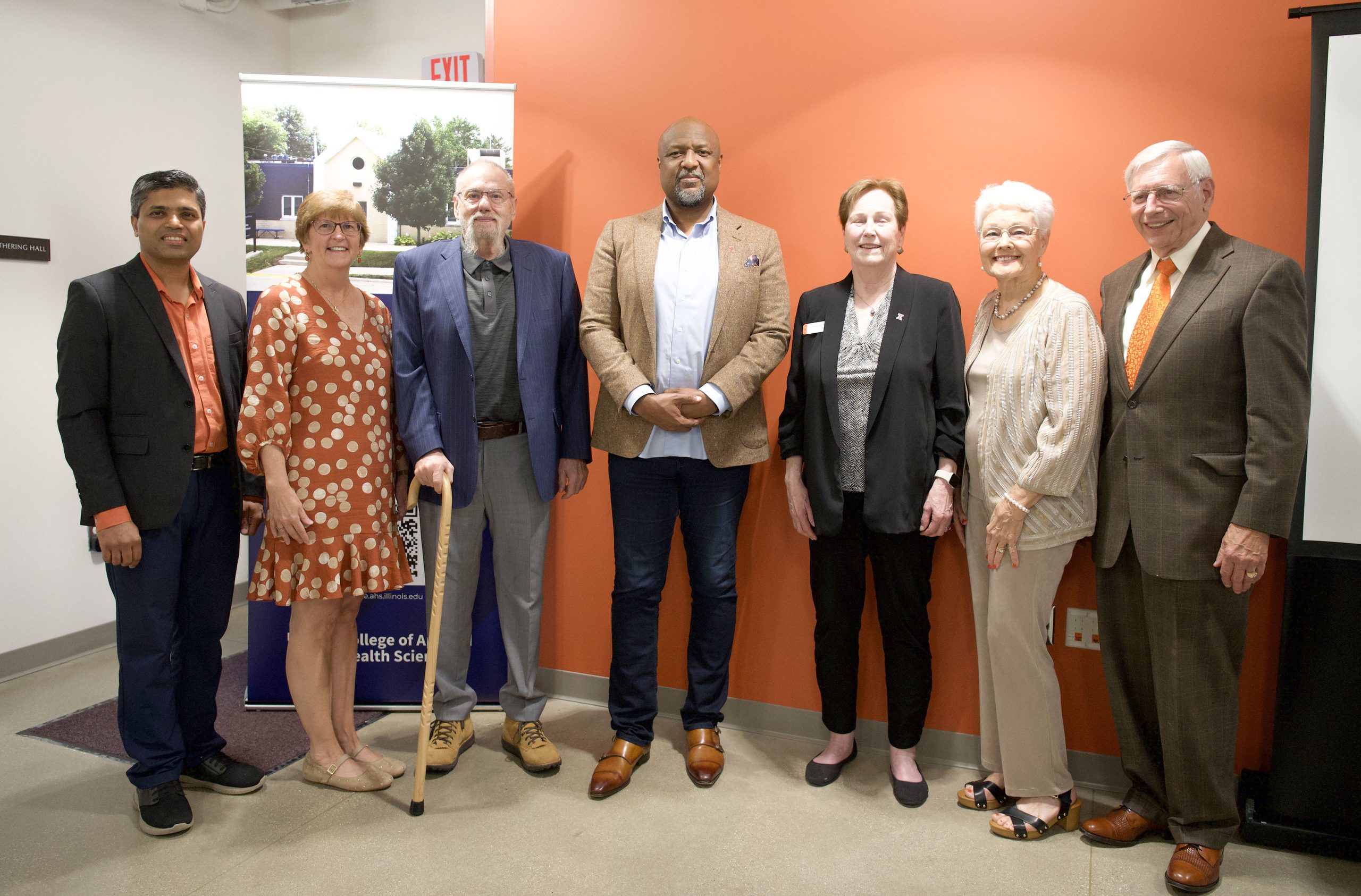
From left, Heather Stout, Brian Siemann, Maureen Gilbert, Jacob Tyree, Matthew Poland, Martrell Stevens, Stephanie Wheeler, U.S. Rep. Nikki Budzinski (D-Illinois) and Adam Bleakney (Photo by Ethan Simmons)

U.S. Rep. Nikki Budzinski (D-Illinois) spent part of her Tuesday on the campus of the University of Illinois Urbana-Champaign, where she toured Disability Resources and Educational Services and met with some of the coaches and athletes behind its nationally recognized adaptive athletics programs.

Budzinski met with a cross-section of DRES leadership, staff and athletes, including Director of Operations and Services Heather Stout; Maureen Gilbert, the coordinator of the office of campus life, wheelchair track coach Adam Bleakney, wheelchair basketball head coaches Stephanie Wheeler and Jacob Tyree and assistant coach Matthew Poland, DRES senior access specialist and Paralympian Brian Siemann and wheelchair basketball player Martrell Stevens.

Together, they highlighted both the day-to-day impact of DRES services and the broader significance of adaptive sports at the collegiate levels.

After seeing the main floor, Budzinski’s visit included a stop into DRES’ training facility, which was certified in September 2014 as a U.S. Paralympic Training Center. The basement facility, long regarded as a pipeline for Paralympic talent, served as a backdrop for conversations about access, equity and the future of disability services in education and athletics.

Bleakney showed Budzinski the adjoining Human Performance and Mobility Maker Lab, where he produces 3D-printed wheelchair racing gloves and collaborates on design projects with campus researchers. Siemann, who works with Illinois students with learning disabilities for DRES, showed Budzinski the two bronze medals he won in the 2024 Paris Paralympics as a wheelchair racer for Team USA.

The coaches, athletes, Gilbert and Stout all emphasized to Budzinski the importance of DRES for University of Illinois students, since more than 5,600 students applied for accommodations through DRES in academic year 2025-26. They also made sure Budzinski knew of the trailblazing work of DRES founder Tim Nugent, known as the “father of accessibility.” Nugent, who died in 2015, founded DRES in 1948 to help those returning from World War II.

Nugent advocated on the Urbana campus for wheelchair-accessible buses, curb cuts and other amenities that those with disabilities now take for granted. Many of his ideas have been adopted nationally. Nugent also helped create the National Wheelchair Basketball Association, as well as wheelchair football, track, archery and square dancing.

At the end of the tour, Budzinski was asked about the importance of sustained federal investment in programs like DRES. She underscored how policy decisions in Washington directly shape opportunities on campuses like Illinois.

Coach Adam Bleakney showed Nikki Budzinski the Human Performance and Mobility Maker Lab (Photo by Ethan Simmons)

“I’ve been supportive at the appropriations level of making sure that we’re supporting all of our sports, that we’re supporting the able-bodied and the disabled community to be able to fully participate in all athletics,” Budzinski said. “And you could do that through the appropriations process. I’ve been a big advocate of that for federal funding. I’m one of the bigger champions of Special Olympics as well. I lead our appropriations letters as it relates to that. So, I think just finding more opportunities through our appropriations process to invest in programs like this is so critically important, and we’ve made it a priority in the House.”

Budzinski’s comments connected federal appropriations work with on-the-ground outcomes—something visible in the athletes she met. DRES leaders also spoke about building programs that not only compete at the highest levels but also create pathways for students with disabilities to thrive academically and socially.

Editor’s note:

To reach Vince Lara-Cinisomo, email vinlara@illinois.edu.
 

Share on social
Related news

RST: A history of Black American runners at the Boston Marathon


Ted Corbitt (center) crosses the Boston Marathon finish line in 1956. Thanks in part to his stellar finishes in the Boston Marathon, Corbitt became the first Black American to run the Olympic Marathon in 1952. (Courtesy of Gary Corbitt)

The Boston Marathon’s first known Black finishers. The first Black American to run the marathon in the Olympics. A charismatic road race organizer who ran the Boston Marathon more than 15 times—without a single recorded time. 

Jacob Fredericks, teaching assistant professor in the Department of Recreation, Sport and Tourism at the University of Illinois Urbana-Champaign, researches the history of race and long-distance running. His newest written project covers many of the overlooked accomplishments of Black runners in one of the premiere stages of the sport: the Boston Marathon. 

Fredericks’ essay, “The Colorful Boston Marathon: A History of Race and Long-Distance Running in Boston” will appear as a chapter in “Black Identity and Sport in Boston: New Essays on Racialized Space and Performance,” a book edited by Rob Cvornyek and Doug Stark and expected for release by the University of Tennessee Press later this year. 

Fredericks ties together the accomplishments of a handful of Black long-distance runners who left their mark on the Boston Marathon, visibly and invisibly, alongside the modern-day efforts to organize a more inclusive long-distance competition in the city. 

“Black Americans in this sport are really shaping their own destinies. They have a lot of agency in creating clubs, establishing their own races. And it’s not separate,” Fredericks said. “The things that they’re doing affect the Boston Marathon—they’re still running alongside white runners and international runners. It’s not as segregated as it seems on paper.” 

To uncover the history, he leaned heavily on newspaper clippings from publications in Boston’s Black press, like the Boston Guardian and Boston Chronicle. In the early to mid 20th century, the marathon got scant coverage in the mainstream press like the Boston Globe, rarely going deeper than the winners or the size of the crowd.  “[What] really comes through in the Black press: these runners having this agency at a time when most of America was heavily segregated—if not structurally, then informally. Even in Boston, those issues still remain.”

Early contenders

The first figures he uncovered—Aaron Morris and Clifton Mitchell—were club teammates from New York. In 1919, a full 22 years after the marathon’s founding, Morris became the first known Black American to cross the Boston Marathon finish line, with his sixth place finish of 2 hours and 37 minutes. 

“[Morris] is in the Black press, they’re celebrating him: ‘We have a breakthrough,’” Fredericks said. “And he disappears. Maybe he has an injury, and there’s this hope among sportswriters of ‘He’ll be back,’ but we never see him again in the results.” 

Teaching Assistant Professor Jacob Fredericks.

The very next year, their hopes were renewed with Clifton Mitchell, a fellow member of the New York St. Christopher Club for runners. Mitchell finished eighth in the 1920 Boston Marathon. Almost immediately, writers in the Boston and New York Black press rallied around him as a candidate to represent the U.S. in the summer Olympic marathon.  

Despite their fervent support, he wasn’t selected. 

“In this chapter, I think of the Boston Marathon as a stage where you can display your athletic abilities—it’s very visible, and people are watching you, and it’s being recorded. There are Black people among white people in the 1920s, running together.” 

Nearly 30 years later, another New Yorker—Louis “Lou” White—broke through in the race and the Boston press. He finished third in the 1949 Boston Marathon, seizing the highest placing for an African American runner in the first year the race was televised. 

He soon became a Boston transplant, joining the Boston Athletic Association and putting up several great performances: “Lou White, a Black man—is Boston’s man in the marathon, a symbol of the city on the world stage,” Fredericks said. 

White had a protege of sorts: Ted Corbitt, who in 1952 became the first African American to run the marathon in the Olympic Games. One of the most prolific marathoners in history, he finished the Boston Marathon 22 times. 

“He is a big proponent of running for health, but also integration, and trying to challenge the status quo and build these new structures,” Fredericks said. 

A fixture and “father figure” in the long-distance running community, and a committed member of the integrated track-and-field New York Pioneer Club, Corbitt later helped found the New York City Marathon. 

An invisible organizer and the ‘true’ Boston Marathon

Perhaps the most unique figure in Fredericks’ chapter is O’Neil Shannon, a professional boxer and Bostonian. Shannon ran the Boston Marathon at least 16 times without ever receiving a runner’s bib. 

“His name comes up again and again as this guy who’s training for the Boston Marathon and running the Boston Marathon. And I’m looking at the results, and I just never see his name,” Fredericks said. “I finally found from his own interview that officials told him the first time he stepped up to the line, ‘We know you. You’re that boxer who was at the Garden last night. You can’t run here officially.’”  

So Shannon joined the Boston Marathon’s long tradition of race “bandits,” runners who participate in the 26.2-mile race without registering. At the time, race officials mostly tolerated these bandits, who ran alongside official runners on public roads.

Though he remained invisible in the record books, Shannon continued to build an athletic legacy in Boston. He founded the Blockbuster Athletic Club, where boxers came to both spar and train to run long-distance. 

Reverend O’Neil Shannon (left) shakes the hand of Boston Mayor John F. Collins in August 1965. Though he never recorded an official time, boxer and road race organizer Shannon ran the Boston Marathon at least 16 times. (City of Boston).

Shannon began organizing his own road races, all weaving through Boston proper, and fielded serious competitors—including Ted Corbitt. In the mid-1950s, Carter Playground on the Northeastern University campus became a common site where he’d start and finish his own races.

It’s the same playground where, a decade later, Rev. Martin Luther King Jr. organized a march downtown to advocate for desegregation and equal access to schools and transportation. 

“Shannon becomes this cornerstone of the Boston Black community, where he’s a leader of his own club,” Fredericks said. “He’s hidden in the marathon results. We never see him, but he’s present. You can feel his impact on the sport and the city.” 

Over the decades, qualifying for the Boston Marathon has become increasingly competitive. Just this year, the time requirement to qualify was upped by 5 minutes. 

The race path itself has begun in Hopkinton since 1924, a town 25 miles west of Boston. Local runners have responded by founding a new, unsanctioned marathon, called 26.TRUE, meant to highlight the city’s neighborhoods and celebrate its cultural and ethnic diversity. 

“The Boston Marathon’s earned its prestige over one hundred years; it’s a great course. But the question is: is it really Boston?” Fredericks said. “What kind of Boston is this presenting? And so that’s the 26.TRUE: they organized a marathon, but held it entirely within the city limits, in front of Boston people and to inspire people who live in Boston.”

To Fredericks, the existence of 26.TRUE reminds him of the resolve Black American runners showed to compete and organize in the face of formal and informal barriers 

“They’re choosing to run the Boston Marathon because they want to, and they’re part of these clubs, these networks, because they want to push themselves,” Fredericks said. “They find a lot of meaning. And they brought a lot of pride to the Black community through their participation.” 

Editor’s note

Teaching Assistant Professor Jacob Fredericks teaches management and contemporary issues in Recreation, Sport and Tourism. To reach Fredericks, email jfred@illinois.edu 

“Black Identity and Sport in Boston: New Essays on Racialized Space and Performance,” is expected for release by the University of Tennessee Press later this year.

Share on social

Related news

Wheelchair athletes lead Illinois’ first Adaptive Rec Day, inviting campus to play and pay it forward


Faculty, students and staff engaged in a spirited game of wheelchair football during Adaptive Rec Day (Photo by Ethan Simmons)

It wasn’t even 11 a.m. and Gym 2 at the Activities and Recreation Center on the campus of the University of Illinois Urbana-Champaign was already buzzing.

Illinois’ first annual Adaptive Rec Day had just begun, drawing students, faculty and staff. Inside the gym, sport wheelchairs gleamed beneath the lights. Basketballs and footballs echoed across hardwood.  At center court, members of Illinois’ wheelchair athletics teams smiled, ready to welcome newcomers with open arms.

Illinois’ Campus Recreation held the inaugural Adaptive Rec Day as a way to celebrate the National Intramural-Recreational Sports Association’s (NIRSA) Recreational Sports and Fitness Day.

Developed by Recreation, Sport and Tourism graduate student Noah Eckelberg, students got the opportunity to learn about adaptive sports and recreation while competing alongside Illinois’ wheelchair athletes. Students enrolled in RST courses Community Planning and Engagement and Inclusive by Design also participated in the day’s scrimmages.

Campus Recreation was awarded $16,168 as part of the Christopher & Dana Reeve Foundation National Paralysis Resource Center (NPRC) 2025 Direct Effect 2nd Cycle. The funding was used to put on the event and purchase adaptive recreation equipment, including harnesses for the climbing wall, hand cycles that will be available at the Campus Bike Center and adaptive sleds for use at the Ice Arena, said Alex Williamson, associate director of marketing-programming at Campus Recreation, as well as body-weight straps and a boccia ball set that can be checked out during open recreation.

Martrell Stevens, a Recreation, Sport and Tourism major and captain of the Illini men’s wheelchair basketball team, spun lightly in his chair, greeting a student who had never seen a sport wheelchair up close.

“This is a really, cool experience and an opportunity to just teach other people about adaptive athletics, and not just wheelchair basketball, but all the different sport there is to know,” Stevens said, gesturing toward courts set up for wheelchair basketball, football and volleyball.

“Growing up playing wheelchair basketball has changed my life so much. It’s allowed me to meet the best friends of my life who are going to be in my life for a very long time. It’s allowed me to travel, see the world. It’s allowed me to go to college. If I can teach other people about the sport, and they can teach other people, we can spread awareness and get as many people as possible playing adaptive athletics so they can have the same similar opportunity as me growing up.”

Paralympic medalist Susannah Scaroni nodded vigorously. Scaroni, whose racing career has taken her from campus tracks to the world stage as the defending champ of the Boston, New York and Chicago Marathons, leaned into the question about what an Adaptive Rec Day could teach people.

“Man, I agree with that,” she said with a grin. “And I’d just say we want to change perceptions to be what is right. We just want people to know what recreation sport is, and sport is, and disabled sport—as oxymoronic as that sounds—people learn hands-on.”

And that was exactly what was happening.

Some faculty and staff climbed into a sport chair for the first time, wobbling before finding balance. Students experimented with the wheels, marveling at the speed. Laughter broke out as people discovered just how much upper-body strength the sports demanded.

Mak Nong, a former captain of the Illini wheelchair basketball team and now program manager for Great Lakes Adaptive Sports Association (GLASA) in Lake Forest, Illinois, talked to a crowd gathered after the sport demonstrations were done. His tone carried both urgency and excitement.

Being physically active, moving, it’s what the College of Applied Health Sciences is all about: wellness across the lifespan.”

Jean Driscoll

Paralympic medalist and associate dean of advancement, College of Applied Health Sciences

“I think just for you guys, just really understanding that you’re at a point in time where adaptive sports is in a frying pan right now,” he said. “It can jump off at any second and you guys can trail blaze that. Please use the people that came before you to help you champion that and continue to grow these different opportunities.

“… there’s so many different things that you guys can grow adaptive sports, whether it’s (Name, Image and Likeness) deals for intercollegiate sports, the different equipment that the athletes will eventually use. The sky’s the limit for you guys. And I’m so excited to see what you guys do with this.”

In the gym, Paralympic multi-medalist Jean Driscoll watched as people navigated their chairs, some for the first time, in competition. A legend in wheelchair racing and a longtime advocate for adaptive athletics, Driscoll smiled at the sight of recreation in its purest form.

“Well, I know this is Rec Day,” she said when asked what the event meant to her. “And we all took sport beyond recreation, and we’re elite-level athletes. But I think to Susannah’s point, recreation is the name of the game. Being physically active, moving, it’s what the College of Applied Health Sciences is all about: wellness across the lifespan.”

She gestured toward the swirl of activity.

Women’s wheelchair basketball coach Stephanie Wheeler, left, and Paralympic medalists Jean Driscoll, center, and Susannah Scaroni took part in Adaptive Rec Day (Photo by Ethan Simmons)

“And so being active some way, you don’t have to be a superhero every day. Just do things for yourself, what makes you happy. For us, training makes us happy. But you can do it for fun too. And if you do it for fun, if you’re having fun, you’ll keep doing it. And that’s really what’s important.”

For Illinois women’s wheelchair basketball coach Stephanie Wheeler, the event was also an opportunity to quash some misconceptions about adaptive sports.

“I would say the biggest misconception that we have is it’s not physical or that it’s not real sport,” Wheeler said. “I think that’s what we try to do here at U. of I. is introduce wheelchair basketball, wheelchair racing, whatever sports it might be as a sport. I think that’s the biggest misconception is that it’s not a sport, that it’s not hard, it doesn’t require skill because we are disabled, that anybody can play, and that anybody can be good. I think what that aligns with is the way we think about disability in society.

“It’s not necessarily a positive representation. Whenever we’re encountered with that, we always say come to a game come to a practice because as soon as you see it, you’ll fully understand that skill is required. It’s physical. It’s fast. It’s fun. Just coming to watch it, I think, kind of washes that away pretty quickly.”

Near the end of the event, Nong—who played professional wheelchair basketball in Europe—addressed the crowd, mostly composed of students.

“What I love the most about today is that it has been led by quite a few of our student athletes. And so shout out to all of our student athletes who have played a huge role in making today happen,” he said. “And that’s really important to us because in our program, one of our biggest founding philosophies is that we pay it forward.”

As the final basketballs and footballs were rolled away and chairs lined neatly along the wall, the energy in the ARC felt less like an ending and more like a starting line.

Illinois’ first annual Adaptive Rec Day had been about t-shirts and snacks. But it had also been about perception, possibility and paying it forward.

And if the laughter, shouting and spinning wheels were any indication, this was only the beginning.

Editor’s note:

To reach Vince Lara-Cinisomo, email vinlara@illinois.edu.
 

Share on social

Related news

Study: Access to parks linked with greater physical activity for some, but not all, residents


Parks’ proximity has a small positive effect on residents’ physical activity levels, and the effect is greater in counties with higher household incomes and larger populations of white, non-Hispanic residents, according to a study led by recreation, sport and tourism professors Mikihiro Sato and Toni Liechty.

Photos by L.Brian Stauffer

CHAMPAIGN, Ill. — A new two-year study found that U.S. residents who lived near parks and recreational facilities had small increases in their leisure-time physical activities, but the relationship was stronger in more affluent counties with largely white, non-Hispanic populations.

Mikihiro Sato, a professor of recreation, sport and tourism at the University of Illinois Urbana-Champaign, used data from the University of Wisconsin County Health Rankings database for 2019 and 2020 to look at the percentages of counties’ populations that had adequate access to parks and recreational facilities. The study defined adequate access as living in a census tract that was within a half mile of a park or one square mile of recreational facilities in urban areas or within three miles of them in rural areas.

According to the study, published in the journal Leisure Sciences, more than 55% of each county’s population had such access. The final datasets represented more than 96% of U.S. counties, the team said.

“We found that the association between the prevalence of leisure-time physical activity and access to parks and recreational facilities was stronger in counties that had greater proportions of non-Hispanic white residents,” Sato said. “The relationship strengthened further as median household income increased, which suggests that residents of higher-income counties may be more likely to visit parks and facilities to engage in leisure-time physical activity.”

The co-authors of the paper were Toni Liechty, a professor in the department at Illinois; Lance Warwick, a sport management professor at Ithaca College and current doctoral candidate at Illinois; and Nicholas Pitas, a professor of public health and health education at the State University of New York at Brockport.

While the role of parks and recreation facilities in providing greater opportunities for engagement in physical activity has been highlighted in some recent public policies, the research findings have been mixed, the team wrote.

In a 2019 study published in the Journal of Leisure Research, Sato and his co-authors reported that counties with greater access to parks and recreational facilities had lower health care costs among older adults, most likely because living near these amenities encouraged residents to engage in physical activity. That paper was co-written with Yuhei Inoue, a current sport management professor at Illinois then at the University of Minnesota; James Du, a professor of sport management at Florida State University; and Daniel C. Funk, a professor and the Ed Rosen Senior Research Fellow at Temple University.

In addition to exploring the relationship between facility availability and adults’ physical activity levels in the current study, the team investigated whether it changed depending on county demographics such as income and racial composition. Sato said they used county-level data because most local parks and recreation agencies operate within a county-based structure. However, the team’s methodology also accounted for state-level policy differences that might affect residents’ physical activity, he said.

About 75% of each county’s population was non-Hispanic white. The median household income levels were $57,500 in the 2019 dataset and $55,700 the following year.

The study included adults age 20 or older. About 69% of those in the 2019 dataset said they exercised or engaged in some form of recreational physical activity during the prior 30 days, and that proportion increased to more than 74% the following year, the researchers found.

While some public health initiatives have highlighted the role of parks and recreation facilities in boosting communitywide physical activity levels and mitigating health care costs, the research findings have been inconsistent, suggesting that the impact is not universal and that there may be differing factors at play that affect community members’ abilities and willingness to use these amenities, the team wrote.

While providing adequate access is important, “Making facilities more welcoming and accessible is also essential,” Liechty said. “We recommend community-centered approaches and partnerships with local organizations to co-design programs that are inclusive and reflect local needs and cultural contexts. These initiatives could include providing family-oriented activities, creating subsidized fee structures that make programs more affordable for low-income residents, and improving the walkability of neighborhood parks.”      

The work was funded by the Campus Research Board at the U. of I.


Editor’s note:

To reach Mikihiro Sato, email mikisato@illinois.edu.

To reach Toni Liechty, email tliechty@illinois.edu.

The paper “Park and recreational facility availability, leisure-time physical activity, socioeconomic status and race” is available online or from the News Bureau.
DOI:10.1080/01490400.2025.2566939

The paper “Access to parks and recreational facilities, physical activity and health care costs for older adults: Evidence from U.S. counties” is available online or from the News Bureau.

DOI: 10.1080/00222216.2019.1583048

Social identification with a team boosts fans’ social well-being


Professor Yuhei Inoue most recent study with his team shows that consumers’ identification with service organizations, such as sports teams, has a real impact on their social wellbeing. Photo taken at the University of Illinois Urbana-Champaign on Thursday, Sept. 25, 2025. (Photo by Fred Zwicky / University of Illinois Urbana-Champaign)

CHAMPAIGN, Ill. — Sport fans all know that rosy feeling of happiness when we hang out with others who support our favorite team. A new study conducted with sport consumers in the U.S. and the United Kingdom suggests that organizations that want to enhance their supporters’ health and well-being can achieve that by bolstering their social identification with the group.

University of Illinois Urbana-Champaign recreation, sport and tourism professors Yuhei Inoue and Mikihiro Sato say that social identification with organizations boosts our social well-being — our ability to form and sustain meaningful relationships — by giving us access to three important social and psychological resources: in-group trust, a sense of purpose and meaning, and perceived progroup norms  which are the beliefs that all group members are prioritizing our collective best interests.

Share on social

Online Allies: How Black travelers view DMO social advocacy statements


RST Assistant Professor Charis Tucker: “Tourism marketing must go beyond surface-level representation.”

In the summer of 2020, when streets across the U.S. filled with protests for racial and social justice, something unusual happened in the world of tourism. Destination marketing organizations—better known as DMOs—suddenly became vocal online allies. Their Instagram grids turned black. Their feeds carried hashtags of solidarity. Their captions spoke of inclusion, equity and justice.

It was a striking moment for an industry that historically has not been known for inclusivity. But it raised an important question: did these digital gestures matter to Black travelers, the very audience the messages were meant to support?

That question became the focus of a new study entitled “Online Allies? Exploring Black travelers’ perceptions of DMO social advocacy statements” and published in the Journal of Travel Research. For the researcher behind the project—Dr. Charis Tucker, an assistant professor in the Department of Recreation, Sport and Tourism at the University of Illinois—the motivation was straightforward.

“Organizations in various industries, including tourism, began engaging in digital advocacy, posting their support for racial diversity, the Black community, and/or the Black Lives Matter Movement,” Tucker said. “What was missing from the conversation, however, were the voices of the community for whom this advocacy was directed. I wanted to understand how these statements resonated with Black travelers.”

In this context, “social advocacy statements” means the public messages organizations choose to share online—on websites, social feeds or campaigns—about issues such as racial justice, LGBTQ rights or mental health.

“These statements are usually made during key moments after a major social event or movement,” Tucker said. “They’re meant to show that the organization cares about more than profit; they care about people and justice, too.”

But do they succeed? Or do they come off as hollow gestures?

To find out, the Tucker and her colleagues reviewed real-world posts from DMOs, looking at the kinds of images and captions they used. Then, they designed a set of mock posts that reflected different advocacy approaches:

  • A simple black square.
  • A black square with a short statement of solidarity.
  • A photo of a Black family holding a sign that read “United Against Hate.”
  • The same photo, paired with a written statement.

Nearly 200 participants evaluated the posts through an online research platform. Their reactions revealed not only what felt meaningful, but also what felt empty.

The black square, a widely used digital symbol in 2020, flopped in the experiment. Participants dismissed it as vague and performative.

A mockup of a black square Instagram post. Many corporations, including DMOs, posted similar images during 2020’s racial justice protests, in an effort to show solidarity. Tucker asked participants to evaluate different responses from DMOs on how meaningful, or hollow, the gestures felt.

The black square paired with a written statement prompted the most critical reflection. It made travelers stop and ask: does this organization actually understand us? Do they back up these words with action?

“I think this is a little lackluster compared to the other statements I have seen. I don’t want to be represented by just a black square” one participant said.

Posts that combined imagery with text—especially featuring Black people—were seen as more sincere and intentional. The message was clear: gestures need words and words need actions.

So how can DMOs avoid looking performative? According to the study, the key lies in specificity and consistency.

“Organizations must explicitly state their stance,” Tucker said. “Their posts should include who they are supporting, why, and—perhaps most importantly—how. This will limit scrutiny that is sure to come with vague or ambiguous messaging.”

Equally critical is aligning statements with a track record of action. Many participants questioned whether DMOs had been inclusive in the past. Without history to back them up, even the most polished posts risked falling flat.

The implications for tourism marketing are significant. For decades, Black travelers have been underrepresented—or completely absent—in promotional campaigns. In response, they created their own spaces for community and representation.

“Tourism marketing must go beyond surface-level representation,” Tucker said. “Genuine inclusion requires more than simply featuring Black travelers in promotional materials. It demands thoughtful, consistent effort that reflects a genuine understanding of and engagement with Black communities.”

One concept that emerged from the research is something called “relational legitimacy.” Put simply, it’s the trust that grows when organizations affirm the identities, values, and lived experiences of marginalized communities.

“To rebuild trust, DMOs should get to know their community, not just in its present state, but from a historical perspective as well,” Tucker said. “This means recognizing the past experiences, contributions, and challenges of these communities, and using that knowledge to inform more respectful, inclusive engagement.”

That means celebrating local Black voices—entrepreneurs, artists, and cultural leaders—while also listening closely to community feedback and adapting accordingly.

The study’s findings offer a roadmap for an industry that wants to do better. Social advocacy can’t be performative, and it can’t be a one-off post during a crisis. For Black travelers, sincerity shines through when organizations pair words with action, history with honesty, and representation with respect.

As Tucker noted, real trust is built not through hashtags, but through consistency.

For DMOs, the message is as clear as it is challenging: it’s time to move beyond the black square.

Editor’s note:

To reach Charis Tucker, email cntucker@illinois.edu.
The paper “Online Allies? Exploring Black travelers’ perceptions of DMO social advocacy statements” can be found online here: https://journals.sagepub.com/doi/full/10.1177/00472875241294235
 

Share on social

Related news

Tattoos as anchors of transformative travel


A tattoo one traveler obtained on a visit to Japan. Participants in the study were asked to share images of their tattoos, which embodied personal change, collaboration, and reminders of the travel experience. (Provided)

At the intersection of body art and travel lies a fascinating phenomenon: tattoos serving as anchors of transformative experiences.

A new study from Recreation, Sport and Tourism faculty members Toni Liechty and Joelle Soulard, along with recent RST graduate and current Western Michigan University Assistant Professor Xin Du—which earned a Silver Award at the TTRA International Conference—sheds light on how travelers inscribe their journeys into their skin—quite literally—turning fleeting moments into enduring symbols of change. Drawing on the theory of aesthetic reflexivity, Soulard and her team examined how tattoos reflect not only personal transformations but also the broader cultural contexts in which they are created.

At the heart of this study is aesthetic reflexivity, a lens that emphasizes how individuals make sense of their lives through aesthetic, embodied, and sensory practices. Rather than viewing tattoos as static souvenirs, Liechty and Soulard’s research frames them as dynamic expressions of ongoing transformation. Placement, style and design become as important as the stories behind them. Three themes consistently surfaced: tattoos as embodiments of personal change, tattoos shaped through collaboration with others, and tattoos serving as enduring reminders long after the journey ended.

In other words, the tattoo is not the final word on the experience—it continues to “speak” over time. A novel aspect of this research was the use of photo elicitation, where participants were asked to share images of their tattoos.

“This combination of stories and images provided a fuller picture of how tattoos expressed transformation and helped us notice patterns that might have been missed otherwise,” Soulard said.

This visual approach often unlocked memories and meanings that words alone did not capture. For instance, some travelers reflected on the significance of tattoo placement in relation to scars, or the choice of a particular design that tied back to their journey. By combining narrative and visual data, Soulard and Liechty were able to trace patterns of transformation that might have remained invisible otherwise.

The study included 31 U.S. travelers who had gotten a tattoo after what they considered a transformative trip. Participants were recruited to reflect diversity across age, gender, life stage, and destination. From backpacking in Asia to volunteering abroad or embarking on solo pilgrimages, the contexts varied widely. Yet, despite the diversity of stories, a shared thread emerged: the tattoo as both artifact and anchor of change. Recruitment continued until theoretical saturation was reached, ensuring that the insights reflected recurring themes rather than isolated anecdotes.

RST professors Toni Liechty and Joelle Soulard.

One of the more striking findings involved tattoo placement. Several participants deliberately chose sensitive spots—like ribs or spine—where pain intensified the meaning of the act. For them, the researchers said, enduring the process was part of the ritual, underscoring resilience and adding layers of depth.

“Across their stories, we also noticed common patterns,” Soulard said. “Tattoos used to cover scars, tattoos placed where others would see them as signs of transformation, and tattoos with symbolic designs, such as ancestral motifs, that carried personal significance. These layers of interpretation became visible when we looked at the tattoos alongside the participants’ accounts.”

Although the research did not include formal long-term follow-up, many participants described how their tattoos continued to serve as daily reminders of their journeys. In moments of stress or uncertainty, glancing at the tattoo provided grounding, calm, or renewed strength. This suggests that tattoos function not only as memory devices but also as active tools for navigating everyday life, anchoring identity and resilience across time.

A floral tattoo obtained by a traveler after a trip to New Zealand.

The findings hold valuable insights for tourism operators. Rather than offering only conventional souvenirs, Soulard suggests that operators could facilitate co-creation experiences with local artists—tattooists, calligraphers, or printmakers—that allow travelers to express transformation in deeply personal ways. Maker studios for engraved tokens, stitched patches, or memorial jewelry could provide meaningful alternatives. Post-trip reflection kits, blending journaling prompts with art, might also extend the transformative power of travel once travelers return home. These approaches recognize that identity work does not end when the trip concludes; it evolves.

Of course, tattoos are not free from cultural complexity. The researchers said they approached the subject with care, ensuring ethical research practices, IRB approval and respect for participants’ privacy. Photo sharing was optional, and aliases were used to protect identities.

“We also ensured that participants’ own stories and meanings were at the center of the research by giving them space to guide the conversation, and interpreting their tattoos through the explanations they offered,” Soulard said.

Importantly, the researchers acknowledged broader issues, such as the colonial suppression of Indigenous tattoo traditions, as well as the risks of cultural appropriation or stigma in modern practice.

Soulard and Liechty’s insights raise possibilities for future research. Longitudinal studies using diaries or repeat interviews could explore how the meanings of tattoos evolve over decades. As tattoos continue to gain cultural prominence, particularly among younger generations, their role as anchors of transformative travel is likely to expand.

What remains clear, Liechty and Soulard suggest, is that tattoos are more than body art—they are living, breathing narratives etched into skin, carrying the echoes of journeys that reshape lives.

Editor’s note:

To reach Toni Liechty, email tliechty@illinois.edu.
To reach Joelle Soulard, email jsoulard@illinois.edu.
 

Share on social

Related news

A friendship forged in RST: Dan Bernstein and Alex Roux’s journey at Illinois


Alex Roux (Photo provided)

Both arrived on campus passionate about Illini sports, uncertain of exactly where their paths might lead. What they discovered together in the Department of Recreation, Sport and Tourism was a sense of community, mentorship and shared ambition that defined their time at Illinois.

Roux, a Champaign native, was steeped in Illini culture. “I grew up in Champaign-Urbana as an Illini fan and high school athlete, and when I realized my athletic dreams of competing in college would fall (way) short, I wanted to stay connected to the sports world professionally,” he said. “The RST program stood out as my lane to remain close to the athletic programs I grew up cheering for.”

Bernstein, meanwhile, came from Glenview, a northern suburb of Chicago. A lifelong Illini basketball fan who idolized the 2004–05 team, he initially enrolled as a psychology major. But as his friendship with Roux deepened, his focus shifted. “After becoming close friends with Alex and given my passion for sports and interest in marketing, I transferred into RST during my sophomore year.”

Their friendship began in the residence halls. Roux’s roommate at Bromley Hall had been one of Bernstein’s high school friends, creating a natural introduction. Roux remembered noticing Bernstein early on in class: “I recognized Dan on one of our first days of class freshman year because he frequently wore Illinois gear, so we struck up some initial conversations about Illini sports. Once I realized he ‘knew ball’ and I could talk sports at length with him, our friendship took off from there.”

Bernstein echoed that sentiment with his characteristic humor: “It was ‘close friends at first sight.’ Kidding … In reality, we bonded quickly because Alex knew so much about Illinois sports and sports in general. We also shared the same questionable taste in Burnett’s vodka and bagged wine back then, which, at the time, felt like the perfect foundation for friendship.”

What began as hallway conversations grew into years of shared experiences. They were roommates for three of their four years, sat together in RST classes, and spent countless evenings at Illini basketball games. Roux explained the impact of that constant companionship: “Having Dan around to bounce class schedules, homework assignments and ideas off of helped my development both as a student and motivationally. When he secured a coveted internship with the Philadelphia Flyers, I wanted to pursue similar high-profile opportunities in my own career.”

For Bernstein, Roux’s local ties eased the transition into campus life. “Alex being from Champaign was especially helpful for me as a freshman who was unsure of what he was getting into. Through him, I met great local friends and felt more at home.”

Both immersed themselves in campus opportunities. Roux worked at the Illinois Ticket Office throughout his undergraduate years, including alongside his grandfather, whose legacy is now honored at State Farm Center. Bernstein became deeply involved in student organizations, writing for The Daily Illini—as did Roux—and serving as vice president of Orange Krush, Illinois’ famed student cheering section. “That role was particularly meaningful—it wasn’t just about going to games, but also about learning to run a successful nonprofit that gave back to the community,” he said. “I gained hands-on experience in marketing, operations, fundraising, etc.”

Their shared academic journey was guided by faculty like Clinical Associate Professor Mike Raycraft, whom both cite as a lasting influence. Roux described him as “someone who invests his time and energy with students past and present,” while Bernstein emphasized Raycraft’s perspective that careers in sport and tourism often extend well beyond traditional roles.

After Illinois, Roux and Bernstein lived together in Chicago for three years before their paths diverged geographically. Roux launched his career at Big Ten Network in Chicago, where he has grown from entry-level social media work to management roles overseeing content, partnerships, and coverage of major events. Bernstein took a less conventional route, working at startups, Allstate, and a global pharmaceutical company before landing at Lou Malnati’s, the iconic Chicago pizza brand.

Dan Bernstein (Photo provided)

Despite different industries, both credit RST with preparing them. Roux emphasized adaptability: “RST provided a pathway to explore a wide swath of opportunities in the sports industry, which required building communication and adaptability skills that still serve me well to this day.”

Bernstein pointed to transferable business skills: “For me, it is less about hard skills and more about the business and soft skills: marketing fundamentals, organization, collaboration, and communication. In the business world, especially in marketing, those skills are what set you apart. RST gave me a strong foundation in all of them.”

Today, both men still live and work in Chicago, a city they independently described as “the best in the world.” For Roux, it’s a hub of Big Ten culture that keeps him connected to alumni. For Bernstein, it’s a city where Illinois ties run deep: “Even in a city with the largest U of I alumni base, I still find myself saying ‘ILL’ to strangers in the gym, on the street, or in a bar. There is a real bond and sense of togetherness among Illinois alumni.”

Looking back, both reflect with gratitude on the friendship that defined their student experience. Roux called Illinois “truly immeasurable” in its value, while Bernstein put it simply: “Illinois gave me lifelong friends, unforgettable experiences, and the foundation for my career.”

Their careers may have taken different directions, but their story is a reminder of what makes the RST program special: the chance to turn passion into profession—and along the way, to find a lifelong teammate.

Editor’s note:

To reach Vince Lara-Cinisomo, email vinlara@illinois.edu.
 

Share on social

Related news

Teaching the next ‘champions for change’ in sport


A group photo from RST 199: IC-ChangeS first section in spring 2025, in Kenney Gym. The course had Recreation, Sport and Tourism undergrads teach local student-athletes about social justice through sport. (Provided)

A new Recreation, Sport and Tourism course—Inclusive Champions for Change through Sport, or IC-ChangeS for short—is challenging Illinois students to understand how sports can provide a platform for positive social change.

And what better way to learn than leading their own classes with local high school athletes?

Lead instructor Yannick Kluch, an assistant professor in RST, piloted this course in the spring. His team found a willing partner in University Laboratory High School, the small high school on the Urbana campus.

“I’ve always thought about why people are not doing more to engage high school athletes in social justice work, because they do tend to have a platform in their community,” Kluch said. “The idea had been brewing in my head for years, but I never felt like I could turn it into reality. But here at Illinois, I felt supported right away to make it happen.”

The pilot of this course felt like a step outside the comfort zone to many of the undergrads who enrolled. They would have to don their professors’ caps while wading through potentially prickly topics with their peers. But students left feeling transformed by the experience.

“Being in that smaller group made me feel comfortable sharing my ideas and thoughts, knowing I was in a safe space,” said Lauren Ratajczak, a senior in RST. “I felt like I actually was making a difference in people’s lives. These students can go on to pursue social justice and change in their futures.”

The syllabus explored key social justice topics, mapped onto the sports world: What does systemic injustice mean and look like? What are social identities and unconscious biases? How do these concepts play out for modern-day sport icons?

Kluch researches how sport is used as a platform to advance equity and inclusion on a societal level. When he arrived at Illinois, he quickly connected with Mariela Fernandez, an associate professor in RST who researches environmental justice.

When they heard about the University of Illinois’ Call to Action grants, the project seemed like a perfect fit. The annual grant program from the Chancellor’s office funds research and community engagement projects that tackle social inequities head-on.

With $90,338 from the Chancellor’s grant, and a team of collaborators including RST doctoral student Solomon Siskind, RST master’s student Kevin Gillooly, and Anna Baeth from the national sports inclusivity nonprofit Athlete Ally, the IC-ChangeS team got to work. The group later added two staff members from Uni High as well as a local high school student from Champaign Central High School to the team.

Uni High offered up four sessions of their normal Physical Education class periods for RST to work with. The organizers quickly realized, to best deliver the material, the students would have to become the teachers.

“I wanted to leave the students with a new sense of agency when it comes to social justice topics,” Kluch said. “That was a key goal, to make students not shy away from this. Especially when these topics are under attack.” 

‘You can make a difference’

In one of the first IC-ChangeS sessions, Uni High student Aldo Zepeda Flores walked up to a large piece of paper hanging on the wall, with the question “What does social injustice look like to you?” written on the top.

One by one, students jotted down their answers on the sheet before discussing with the group.

“It was really nice because you got to see everyone else’s perspective and everyone else’s opinions, but it also gives a sense of privacy when you can express stuff a lot more than when you’re called on in class,” Zepeda Flores said.

The Uni High students participated in four sessions during their usual gym class period, with the support of their high school PE teachers.

An IC-ChangeS group activity in action. Each class period was designed to be as interactive as possible.

With only a handful of sessions, each IC-ChangeS session was designed to be as interactive as possible. In one activity, the high schoolers played a card game called “Buffalo: The Name Dropping Game.” Two cards were quickly flipped, one with a noun and the other with an adjective. If the words were “Muslim” and “athlete,” for example, whoever can first think of a person that combined the two terms won the round. Unbeknownst to the high schoolers at the time, the game had been developed to address unconscious biases at play.

“It was no thinking, no time for analyzing the question or what you were about to say,” Zepeda Flores said. “And then you start to realize, maybe I’m thinking in a different way than I should be. You acknowledge your own biases.”

For Flores, who has played soccer his entire life, what resonated most was the sense of belonging: “I’ve done club sports my entire life, a person’s sense of belonging can affect their style of play. I reflected on my own experience, on the times I wasn’t as welcoming, or the times I felt excluded.”

“It gave me perspective of how in every environment, not just sports, my class, and home, you want everyone to feel a sense of belonging, where they all feel welcome,” he said.

Each session was interactive and carefully planned, but the RST undergraduates were the main shapers of the instruction, Kluch said. They were free to figure out how to best deliver lessons to the group of young athletes.

“It’s not just us telling the undergrads, ‘teach that,’ it’s us asking the undergrads, ‘How would you teach that? What would you teach?’ and then they take agency and facilitate,” Kluch said. “They were super creative, and it resonated with the high schoolers because they found engaging ways to talk about these issues.”

The RST students began to make connections between their own lives and the class content – and used that to connect with the high schoolers. “We were teaching the high school athletes, no matter how small the community, you can make a difference,” Ratajczak said. These young athletes do have power and they do have a voice.”

Having supervised the pilot run of the course at Uni High, Uni Physical Education Teacher Luke Bronowski feels the innovative format would be appealing for other high schools. At Uni, the students looked forward to the interactive sessions.

“We have a diverse population at Uni High, some students who’ve experienced social injustice, and so I think it was eye-opening not only for the high school students to hear some of these stories, but I felt the college students were learning from our students, too,” Bronowski said. “Our students were getting tools to use their platform as athletes to be agents of change.” 

Lasting bonds

Lexie Breymeyer came to the University of Illinois in 2021 from Hoopeston, a town of 5,000 roughly an hour drive away from campus. Prior to enrolling in this course, concepts like microaggressions and cultural competence were relatively foreign to her, she said.

“This class has singlehandedly changed my mindset, my values, how I look at the world. I could not ask for more from a class—it’s truly changed me as an individual,” Breymeyer said. 

After graduating in the spring from the RST program, Breymeyer was accepted to the Medill School of Journalism at Northwestern University. She credits IC-ChangeS’ content for inspiring her to go into sports journalism.

“Sport is not just a game, it’s a tool, and learning how to use sport as a tool for change opens countless amounts of doors. For journalism, I want to do sports broadcasting, setting up a platform to have these uncomfortable conversations,” Breymeyer said. 

Even at Northwestern, she’s still in touch with her IC-Changes classmates: after the semester of IC-ChangeS concluded in May, their group chat is still active, updating each other on their lives and keeping up with the news, just like they did in class.

It’s not just us telling the undergrads, ‘teach that,’ it’s us asking the undergrads, ‘How would you teach that? What would you teach?’ and then they take agency and facilitate.

Yannick Kluch

Assistant Professor in Recreation, Sport and Tourism

“We would spend time processing what was going on in higher ed,” she said. “The world we live in is hectic right now, having a safe space to discuss those things and how it relates to what we were teaching students was one of my favorite things about the class overall. It was a community where we could talk about tough topics.”

The plan for this course is to “scale up,” Kluch said. He hopes the peer-to-peer class framework is replicable for other high schools and colleges in-state and throughout the country, which can be adapted for topics with a specific social justice focus, such as inclusion for people with disabilities or sexual violence prevention. He’s submitted for the course to become a permanent part of the Recreation, Sport and Tourism curriculum.

“The pilot run couldn’t have gone better, and I am so proud of our RST students, the IC-ChangeS athletes, and our partners at Uni High for keeping an open mind and making the course as impactful as it has been,” Kluch said. “This course represents the very fabric of what we do in RST; we use our passion for recreation, sport and tourism to make a difference in the world.”

Editor’s note:

To reach Yannick Kluch, email ykluch@illinois.edu

Interested in enrolling in an RST course this spring? Visit https://courses.illinois.edu/schedule/2026/spring/RST for the full offerings.

Share on social

Related news

College of Applied Health Sciences
110 Huff Hall
1206 South 4th Street
Champaign, IL 61820
(217) 333-2131