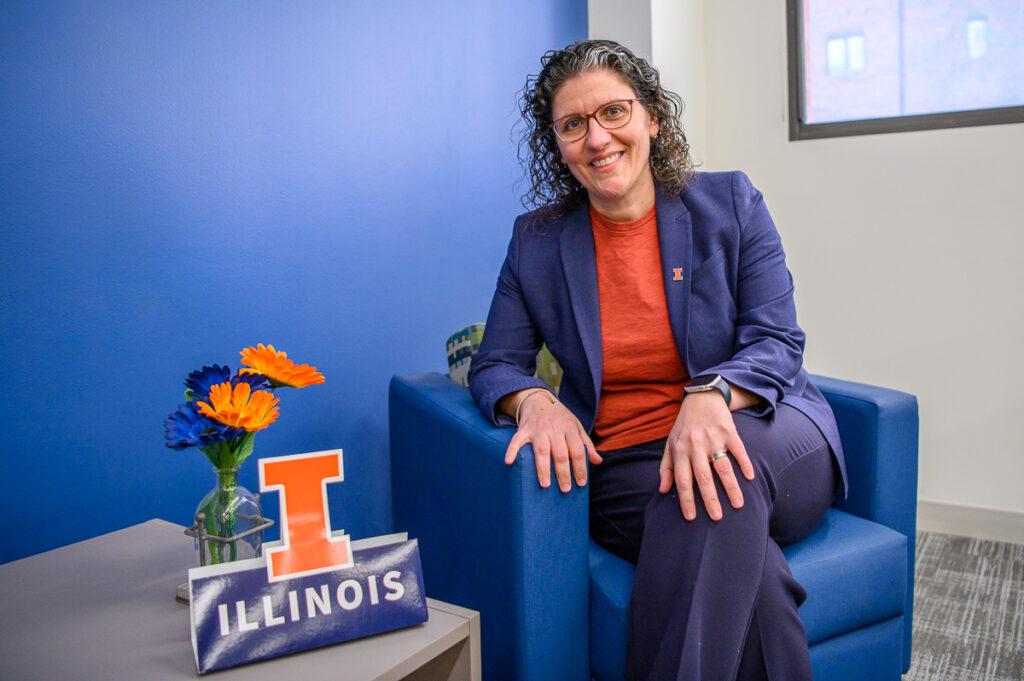
Rachel Hoopsick, Assistant Professor in the Department of Health and Kinesiology, studied teens’ misuse of inhalants in two recent papers. (Photo by Michelle Hassel)
Two new studies co-authored by Health and Kinesiology Assistant Professor Rachel Hoopsick offer insights into the spread of nitrous oxide misuse among adolescents.
What Hoopsick found in two studies: Millions of Americans were exposed to content about recreational nitrous oxide use from just 30 social media videos uploaded in early 2025. And younger teens were more likely to engage in inhalant misuse than older adolescents, with teenage girls being more likely to develop inhalant misuse disorder than boys.
Hoopsick led the two studies with University of Mississippi public health professor Andrew Yockey, who will join the University of Illinois Urbana-Champaign faculty in August.
“Inhalant use can cause serious harm, including neurologic damage, hearing loss, liver and kidney dysfunction, cardiac arrhythmias, psychological dependence and even sudden death after a single episode of use,” said Hoopsick.
HK Associate Professor Laura Rice (right) joined WCIA 3 News for University Updates, to share her research on the risks of falls for wheelchair users. (WCIA 3 News)
The U.S. Centers for Disease Control and Prevention (CDC) reports falls are the leading cause of injury for adults 65 and older. People in wheelchairs are at an even higher risk. That’s a primary focus for Health and Kinesiology Associate Professor Laura Rice and her research at the University of Illinois Urbana-Champaign.
Rice spoke with WCIA 3 News on the University Updates segment, to shed light on fall statistics and how users of wheelchair and scooters can manage the risks of falling.
“A lot of times, the wheelchair isn’t fit for the person very well, maybe they got a hand-me-down that wasn’t set up for them, people don’t have training on transfers when they’re moving the person from one place to another. Those are all very common reasons for falls,” she explained.
This summertime enrichment program for local youth run by Health and Kinesiology at Illinois is back in Champaign
A day in the iPALS program provides academic enrichment, playtime, social-emotional learning and nutritious snacks. (Photo provided)
A group of Illinois physical education alumni are supporting one of the College of Applied Health Sciences’ longest-running youth programs as it returns to Champaign.
Three graduates of the former Department of Physical Education for Women at Illinois—Carolyn Bechly, Jean Snuggs and Lyndell Wilken—have pooled their resources into an endowment to help fund the Illinois Physical Activity and Life Skills program, also known as iPALS. The summer wellness program for local children is also a steppingstone for Illinois student educators to develop their skills.
“We’re hoping iPALS can be part of their practical experience, building on what they’ve learned in a classroom,” said Wilken, who graduated in 1972 and became a coach, physical educator and athletics administrator.
The eight-week iPALS program run by the Department of Health and Kinesiology in Applied Health Sciences brings in local schoolchildren every summer for a full day-camp experience, with structured playtime, academic enrichment, social-emotional learning and nutritious snacks available each day.
Beyond a summer opportunity for at-risk youth—every child participant qualifies for SNAP benefits or free-and-reduced lunch—the program doubles as a research study, funded by the U.S. Department of Agriculture.
The premise of the study: to see if regular physical activity, summertime enrichment and specialized nutrition can curb “learning loss,” the regular backsliding of academic achievement that occurs over summer break. Enrollment in iPALS is completely free.
The University of Illinois has a long history of youth summer programs. iPALS was originally the “Sport Fitness” program, where physical activity was the focus. With community input from partnering local school districts, faculty leaders have developed a more balanced approach over the years, between academic and social enrichment, exercise and nutrition.
Many of the daily snacks served to iPALS kids contain lutein, a carotenoid common in leafy green vegetables that settles in our eyes and brain, supporting our eyesight and cognitive health. The iPALS participants, ages 6 to 11 years old, take fitness, academic and cognition assessments at the beginning and end of the program to measure its direct impacts.
“Given that physical activity participation is among the most robust behavioral approaches to support both physical and cognitive health, we anticipate that the iPALS program has the potential to have a meaningful impact on children in our community,” said principal investigator Naiman Khan, associate professor in the Department of Health and Kinesiology.
During iPALS days, the kids move from station to station, with each stop run by Illinois graduate students. The researchers purposely use students with diverse backgrounds: nutrition majors running the snack station, education majors running academic enrichment, and physical educators structuring the playtime.
“For me, the most important aspect is that we provide a safe space for eight hours a day where kids are guaranteed meals and snacks, surrounded by adults who care about them, and they’re able to build relationships with peers experiencing similar realities,” said HK Associate Professor Kevin Richards, who researches the teaching of physical education. “That impact is difficult to capture with data, but it is the most meaningful part of the program.”
Interested families can visit the iPALS website and complete the eligibility survey to see if their child qualifies for the program. This year’s iPALS will take place at Booker T. Washington STEM Academy in Champaign on weekdays from June 3 to July 17.
Booker T. Washington STEM Academy in Champaign will be the hosting venue for this year’s iPALS program. (Champaign Unit 4)
A Motivated Donation
Illinois alumnae Carolyn Bechly, Lyndell Wilken and Jean Snuggs on a trip to Alaska. The three graduated from Illinois Department of Physical Education for Women just as Title IX took effect. (Photo provided)
The teaching experience available in the iPALS program mirrors the student teaching opportunities that were available to prior generations of Illinois physical education majors. Months after the passage of landmark Title IX legislation in 1972, the Illinois departments of Physical Education for men and women were fused, just as Bechly, Wilken and Snuggs happened to embark on their careers.
Under Title IX, every education program that received federal funding had to ensure equal access for students regardless of sex. Schools nationwide had an imperative to start girls’ sports teams, and a dire need for coaches. Some states, including Illinois, mandated that coaching slots be filled by women.
Suddenly, these new Illinois physical education graduates had their work cut out for them.
“It was an amazing time, and busy,” Wilken said. “The opportunities were huge, also the workload you sustained, because you were a full-time teacher and you weren’t given anything extra for coaching—just the love of sport and wanting girls to have opportunities that drove most of us to essentially do it for free.”
The three women quickly discovered the lessons from the Illinois’ physical education program were useful in the field. They had learned under department legends such as professors Phyllis Hill and Beulah Drom, who instilled foundations in childhood motor skills and structuring class-time for physical education. The pedagogy of P.E. was scientific and practical: to help students understand the joy of movement, you’ll have to get them to line up single file as well.
“The science of it was really fascinating … you learned how to learn things, which carried over into how to teach,” Snuggs said. “In retrospect, it was always incredibly teaching-oriented.”
Wilken, Snuggs, Bechly and their cohort have retired, mostly, from long careers in physical education and coaching, spanning secondary schools, colleges and universities. They owe much of their lasting bond with their classmates to the passage of Title IX, and the whirlwind of entering the field together, giving student-athletes—particularly young women—opportunities that didn’t exist for themselves.
“We graduated, Title IX happened, and we fell into wonderland,” Bechly said. “Us starting as brand-new teachers, to be able to coach and experience stuff we didn’t really experience to that level, it was just fabulous.”
Naturally, shared professional experiences led the cohort to stay in touch and collaborate. Wilken made a spirited call to Snuggs back in 1979: Wilken was leaving her post at the American River College in Sacramento after founding its women’s track and field team. The school would need a new athletics administrator, and a new coach.
Inspired by how iPALS mirrors their own student-teaching experiences at Illinois, these physical education alums set up a fund to support the program indefinitely. (Photo provided)
“I had never run a track race in my life, but Lyndell said, ‘Hey, you might like this, why don’t you apply?’” Snuggs said. Snuggs got the job and stayed at American River College for more than 30 years, retiring as its dean of physical education in 2012. Wilken went to work at Lane Community College in Oregon, coaching its cross country and track teams to four conference championships.
Today, more than 53 years after the passage of Title IX, these alums have reconnected with their alma mater. After dialogues with the current faculty of Health and Kinesiology, the iPALS program seemed a good target for their financial support, mirroring their own student-teaching experiences at Illinois.
Their Supervised Teaching of Physical Activity/Nutrition Fund will support iPALS indefinitely. The founders have put out an open call for alums, including fellow physical educators, to donate.
“We’d like the students working there in the summer to be future physical educators, and that they continue being mentored and teaching,” Bechly said.
Families can register their kids for this summer session of iPALS now. In the meantime, the PEW alums hope more supporters help sustain the program.
“Physical education is a wonderful opportunity for kids to make decisions at whatever level, in terms of how they deal with others, how they deal with winning and losing. It’s heavy-duty stuff they can use for the rest of their lives,” Snuggs said.
Editor’s note:
To learn more about iPALS or sign up your child, visit the program’s webpage.
Want to contribute to the Supervised Teaching of Physical Activity/Nutrition Fund (Fund #778014)? Donate or email our AHS Office of Advancement at advancement@ahs.illinois.edu.
A study on nature-based videography took this Recreation, Sport and Tourism doctoral student to parks and forest preserves in Florida
RST graduate student Darcy Lu visited several parks and forest preserves in Florida to record video and sounds as part of a study on nature-based videography’s impact on mindfulness and well-being. Lu, who collected the samples while studying at the University of Florida in 2022, recently published her findings in the Journal of Sustainable Tourism. (Photo by Fred Zwicky / University of Illinois Urbana-Champaign)
New research led by a scholar at the University of Illinois Urbana-Champaign suggests that watching and creating videography of scenic locations cultivates nature-based mindfulness — conveying the same cognitive and emotional benefits as outdoor activities and fostering a deep sense of connection with nature.
Yue (Darcy) Lu, an Illinois doctoral student in Recreation, Sport and Tourism at the College of Applied Health Sciences, conducted a two-phase study that began with an ethnographic exploration of her experiences with mindfulness while she was recording audio and video of scenic destinations in Florida for another project.
Lu text-mined more than 3,000 reviews — which included videography of cherry blossoms and forest bathing in Japan, a live wildlife safari in South Africa and a sunset hike with a geologist in Thailand — to explore whether immersive digital experiences offered the same benefits as physical engagement with nature.
Read the full story online by Illinois News Bureau research editor Sharita Forrest.
Faculty members in the Department of Speech and Hearing Science brought “World Voice Day” to both cities and the University of Illinois.
Our vocal folds are roughly the length of our thumbnail, and yet they enable us to speak, sing, laugh and share our favorite stories.
On April 16, the twin cities of Champaign and Urbana—home to the University of Illinois—will recognize World Voice Day, an international celebration of the human voice that shines a spotlight on vocal health.
Behind the scenes, both proclamations were driven by clinicians and instructors at the Department of Speech and Hearing Science, based in the College of Applied Health Sciences.
“We wanted to bring World Voice Day to both Champaign and Urbana to raise awareness at the community level and emphasize that voice health is relevant to everyone, not just professionals or individuals already seeking care,” said Mariana Mendes Bahia, assistant professor of speech and hearing science. “Voice disorders can affect anyone in our community, and recognizing this day at the city level helps extend awareness beyond the clinic or classroom.”
Bahia was inspired by the advocacy of Dysphonia International, an association that supports people with voice disorders. Clarion Mendes, clinical associate professor at SHS, encouraged her to get the day recognized locally. The Department of SHS and officials from both cities were fully supportive.
Champaign city council member Matt Gladney reads the World Voice Day proclamation for the city, with Speech and Hearing Science students and faculty in attendance. (Jeff Hamilton | City of Champaign)
On Tuesday, April 14, Champaign city council member Matthew Gladney read the World Voice Day proclamation in the city council chambers, with Speech and Hearing Science faculty and students present.
On Thursday, April 16, at 11:15 a.m., Urbana city council member James Quisenberry will come to the Speech and Hearing Science building to proclaim World Voice Day for Urbana, with the whole department in attendance.
A wide range of professions rely on the voice—not just performers. Actors, singers and broadcasters may come to mind, but retail workers, healthcare providers and teachers also lean on their vocal ability and presence every day at work.
Mariana Mendes Bahia outside the Speech and Hearing Science Building. (Photo by Ethan Simmons | Applied Health Sciences)
And for reasons that aren’t fully understood, the rate of voice disorders appears to be rising in the United States, Mendes said. An estimated 17.9 million adults in the U.S. reportedly experienced a problem with their voice in the last year, according to the National Institute on Deafness and Other Communication Disorders.
“I think of individuals who may not realize the demands they place on their voice, and individuals experiencing voice disorders, for whom communication becomes effortful, limited or even distressing,” said Bahia, who researches swallowing disorders, clinically known as dysphagia.
To Mendes, World Voice Day is an “extraordinary confluence of art and science,” exciting her students about anatomy and physiology, while showcasing an important part of the speech-language pathology vocation: outreach, education and illness prevention.
“This day is a reminder that even if we studied and analyzed the voice 24/7, mysteries would still abound, and sometimes we can benefit from taking a pause and simply enjoy the wonder that is the human voice and its capacity for moving us through song or story,” Mendes said. “The Department of Speech and Hearing Science has a legacy of championing the human voice, and it’s incredible to share this with our students and the public.”
Undergraduate and graduate students in Speech and Hearing Science helped develop educational materials for World Voice Day; explainers on how to protect the voice and when to seek medical attention.
“Our goal is for individuals to better understand how their voice works, recognize early signs of potential problems, and adopt simple habits to protect their voice,” Bahia said. “We also hope these events encourage people to seek care when needed and to view voice health as an important part of overall well-being.”
The Department of Speech and Hearing Science will celebrate “World Voice Day” on Thursday, April 16, at 11:15 a.m. at the Speech and Hearing Science Building.
One embarrassing moment produced viral fame and lifelong lessons for this Recreation, Sport and Tourism alum.
In Derek Dye’s 2012 internship with the Daytona Cubs, he sold concessions, cleaned the bleachers, worked the soundboard, even dressed as the mascot. (Provided)
At their best, college internships are valuable learning experiences. Derek Dye didn’t expect his to involve getting tossed out of a baseball game.
That was the viral story for this University of Illinois alum’s first big-time summer job with Minor League Baseball, working as a stadium operations intern in August 2012. Back then, Dye was a rising senior in the Recreation, Sport and Tourism program at Illinois, eager to break into the sports industry.
“I would’ve done anything to work in sports,” Dye said. “The minor league was the main target for me, a lot of people wanted to get their foot in the door.”
Growing up in Moline, Illinois, sports were truly his life: Dye ran a backyard football club in high school and developed a passion for sports data of the major leagues. His dream was to become the general manager for the Chicago Cubs.
When college neared, he applied to relevant programs across the state that could help him reach his goals. He eventually broke through the waitlist for the University of Illinois’ Recreation, Sport and Tourism program in the spring of 2009.
“The RST major was the first thing I was looking at, I thought it was the perfect fit,” Dye said.
It’s customary for RST students to work an internship in the field before they graduate. Baseball’s minor league was his main target, including the Quad City River Bandits in his hometown.
The summer before his senior year at Illinois, he landed a seemingly perfect role: an internship with the Daytona Cubs, the Minor League Baseball team in Daytona Beach, Florida, and affiliate of the Chicago Cubs.
He ended up taking out a $1,700 loan from his grandma to live in a Daytona Beach apartment. When the summer of 2012 began, Dye began a do-everything internship for the Cubs: serving stadium food and beverage, cleaning the bleachers, selling tickets and running the soundboard, all for a $50-a-week stipend.
“You’re gone!”
A picture of the Daytona Cubs soundboard’s options for “bad call.” (Provided).
August 1, 2012. The Fort Myers Miracle faced off against the Daytona Cubs.
At the top of the eighth inning, a Fort Myers batter hit a ground ball to short. The Cubs threw it first, and the umpire called it safe. But Dye, sitting up in the press box, thought it was an out. Earlier that week, Daytona had added an array of audio snippets on the soundboard to play for a “bad call.”
One of them was an organist’s rendition of “Three Blind Mice.” Dye clicked on it.
Umpire Mario Seneca’s head perked up, then he turned and pointed to the press box. “You’re gone!”
The crowd was puzzled, and Seneca continued to gesture up to the soundboard, where Dye was at the helm. “Turn the sound off the rest of the night.”
Fear washed over him.
“As you can imagine, being 21 years old and 1,200 miles away from home, my first reaction is ‘what just happened? I’m gonna get fired,” Dye said. “I can’t believe this is actually happening.”
Ejected from his post, the press box was silent: no batter walkups, no anything. The fans started to announce the game themselves, standing from the stands and shouting out the players’ names who were up to bat.
After the game, Dye resumed his usual grunt work, leaf-blowing peanuts from the stands. Then his phone started ringing off the hook: calls came in from reporters at CBS, ESPN, Major League Baseball.
News of his ejection was trending on Twitter. Everyone wanted to know about the soundboard guy—an intern—who was thrown out of the game for playing Three Blind Mice.
“I tried to talk to as many people as I could,” Dye said. He took calls until 2 a.m.
After waking, WGN called him. Unbeknownst to him, it was live on air. He answered questions from his closet so he wouldn’t wake up his roommates.
Dye’s ejection contended for the Minor League Baseball “Moment of the Year.”
He went to the ballpark the next day, and 45 more publications were there to talk to him.
The fallout from the league arrived immediately. Florida State League Commissioner called the incident a “mockery of the game” and fined the team $525.
Dye was banned from the press box for the remainder of his internship. But the team’s general manager, Brady Ballard, covered the fee for his barely paid intern.
“It showed me he saw the big picture,” Dye said. “I was a 21-year-old intern doing my work to engage the crowd and cut my teeth in sports. He didn’t shy away from it, and his support also helped the story grow legs.”
And the Daytona Cubs sold out their stadium the very next game.
“I think the legend behind it had more sticking power than it would nowadays,” Dye said. “Every year it comes up in August for the anniversary.”
‘Your rep is your personal brand in the industry’
When Dye returned for his senior year at Recreation, Sport and Tourism, advisor and instructor Ryan Gower—now chancellor of Illinois Eastern Community Colleges—asked one of his classes: “Anyone have any funny stories from their internships?”
Everyone looked back at Dye and laughed. He had gotten texts from classmates about his ejection for the whole month.
After working in the sports world, Dye is now the director of marketing for Chicagoland’s Affy Tapple.
“Instead of putting my head down, I was able to turn what could’ve been a really negative thing into a really fun story,” Dye said.
He took classes from RST’s many memorable professors, including Clinical Associate Professor Michael Raycraft and Adjunct Instructor Kyle Emkes, and experienced the breadth of the leisure and tourism side of the major in classes with Professor Carla Santos and Professor Emeritus Kim Shinew.
He also took on new roles in his budding sports career, working 40-hour weeks while interning for Illinois Division of Intercollegiate Athletics. He helped the kids club and worked with spring sports teams, such as softball and tennis.
Words from instructor and former Illinois volleyball coach Don Hardin lingered with him: if you want to work in sports, you’ll have to handle the tough stuff.
“There’s going to be grunt work, not everything is going to be a glamorous stop,” Dye said, paraphrasing Hardin’s advice. “You’re going to have to be on the front lines, and your rep is your personal brand in the industry.”
After graduating in 2013, Dye interned with Tampa Bay Rays and later managed eCommerce for Sports Collectibles, a sports memorabilia seller. Today, he’s the marketing director for Affy Tapple, a caramel apple producer in Chicagoland.
His degree at RST continually comes in handy at his newest role, where he’s had to manage people and organize big events. Dye hasn’t become a Major League general manager, but the moment he feared would stain his reputation ended up shaping how he shows up for others.
“Being on the ground level, you see everything and learn how to make the best of tough situations,” Dye said. “I’ll never be hard on someone for trying their best.”
The second Physical Activity Symposium at Illinois was hosted by the Department of Health and Kinesiology on April 3, 2026.
The Illini Physical Activity Symposium celebrates the widening research field of physical activity and its connections to public health across the globe.
The second edition hosted at the University of Illinois Urbana-Champaign added a couple new traditions, including live student presentations and a guest speaker, but things kicked off the same way as last year: with a sunny walk to the Main Quad.
“We felt very happy with our event and the feedback we received from the students, and we feel motivated to continue with this initiative for next year,” said Health and Kinesiology Assistant Professor Otavio Leão.
This year, students and faculty members also celebrated the launch of the concentration in physical activity and health in the Master of Public Health program at Illinois.
The Illini Physical Activity Symposium is hosted by labs at the Department of Health and Kinesiology in the College of Applied Health Sciences:
The Lifetime Physical Activity Lab run by Assistant Professor Rafael Tassitano and Teaching Assistant Professor Cecília Tenório.
The Longitudinal Analysis in Physical Activity, Sleep, Sitting, Screen Time, and Accelerometry Lab run by Assistant Professor Leão. (LA-PASSSTA Lab)
The Epidemiology, Physical Activity and International Collaboration Lab of Professor Pedro Hallal. (EPIC Lab)
University of California San Diego Professor Michael Pratt visited campus to present the research on the potential benefits of vigorous physical activity, and why it may be more important than current physical activity guidelines indicate.
Michael Pratt (center) visited campus from UCSD to present his findings on vigorous physical activity. Health and Kinesiology professors (from left) Bruno Nunes, Otavio Leao, Pedro Hallal, Thayna Flores, Cecilia Tenorio, Emerson Sebastiao and Rafael Tassitano pose at the second Illini Physical Activity Symposium.
Afterwards, several graduate and doctoral students presented their findings from physical activity studies, covering topics such as step counts, obesity, screen-time, and childhood development.
Doctoral students Tayo Folorunso and Alisha Chuhdry won the inaugural Bill Kohl Awards for best poster presentation and oral presentation at the event. Folorunso presented her research into physical activity and abdominal obesity among U.S. women, and Chuhdry presented a study on motor competence among preschool children in Brazil.
Health and Kinesiology doctoral student Tayo Folorunso was honored for her outstanding poster presentation at the second Illini Physical Activity Symposium, on April 3, 2026.Health and Kinesiology doctoral student Alisha Chuhdry was honored for her outstanding poster presentation at the second Illini Physical Activity Symposium, on April 3, 2026.
“Having doctoral students present their research at the symposium is a valuable experience. It allows them to practice communicating their work to a broader audience, receive feedback, and gain confidence in public speaking,” Tenorio said. “Experiences like this also help young researchers build their professional network and encourage them to continue pursuing a career in research.”
The latest Illini Success Report surveyed University of Illinois graduates from Aug. 2024 to May 2025. Most found employment or enrolled in a new academic program.
The majority of 2024-25 University of Illinois graduates have found a next destination post-grad, with most gaining employment or continuing their education.
The Illini Success initiative surveys recent Illinois graduates on their post-grad destinations, experiential learning participation and salaries, if applicable. The most recent Illini Success Report gathered responses from students who obtained their bachelor’s degree in August 2024, December 2024 or May 2025.
Sixty-five percent 2024-25 U. of I. graduates disclosed their landing spots. Of those respondents, 58% of Illinois graduates found employment, 34% continued their education and roughly 1% committed to volunteering or service opportunities.
In all, 392 recent graduates from the College of Applied Health Sciences responded to the Illini Success survey, good for 60% of the 2024-25 graduating class.
Ninety-six percent of them secured their “first destination,” with 60% opting to continue their education for graduate degrees or other academic programs and 36% of them finding employment straight out of college. Twelve AHS graduates disclosed their first-year salaries, averaging $58,177.
In 2024-25, 655 students graduated from the College of Applied Health Sciences at Illinois, up from 616 in 2023-24.
Of all recent U. of I. graduates who resided in Illinois, 80% of them found employment or continued education in their home state. Overall, 70% of graduates reportedly remained in Illinois post-graduation.
“Our university is by far the top choice for enrollment in graduate and professional school programs, reflecting that students find meaning and value in continuing their studies at Illinois,” wrote Illinois Chancellor Charles L. Isbell, Jr.
But this class still traveled far after flipping their tassels: surveyed graduates found employment or academic enrollment in 48 U.S. states and 24 foreign countries.
Recognized by the Office of the Provost: Speech and Hearing Science Associate Professor Mary Flaherty and Health and Kinesiology Instructor Christy Bazan
SHS Associate Professor Mary Flaherty (left) and HK Adjunct Instructor Christy Bazan were recognized for excellence in instruction.
Every year, the University of Illinois Office of the Provost recognizes faculty members for excellence in instruction, who are nominated by committees of faculty, staff and students at each college.
This year, two Applied Health Sciences faculty members won campus awards for their teaching and mentorship in the classroom: Speech and Hearing Science Associate Professor Mary Flaherty won for Excellence in Undergraduate Teaching, and Health and Kinesiology Adjunct Instructor Christy Bazan won for Excellence in Online Teaching.
Both instructors will be recognized at the university’s Celebration of Academic Excellence on Wednesday, March 25, at the Krannert Center for the Performing Arts.
On top of mentoring student researchers through her Child Speech Research Lab, Flaherty teaches undergraduate- and graduate-level courses in Speech and Hearing Science, such as SHS 358: Understanding Research Methods in Communications Sciences and Disorders and SHS 352: Hearing Health and Society, along with advanced SHS 552: Pediatric Audiology and SHS 570: Evidence-Based Practice for SLPs and AuDs.
Bazan, a licensed environmental health practitioner, teaches several community health-oriented classes in the college and Department of Health and Kinesiology, including AHS 199: Applied Data Solutions in Health Sciences, HK 204: Drug Use and Misuse—a subject she co-authored a book on—HK 207: Introduction to Epidemiology and HK 408: Environmental Health.
The College of Applied Health Sciences asked them about what this recognition means to them, and what they’d like to say to students past and present.
What does this recognition mean to you?
Bazan: I am honored and grateful to receive this online teaching award. With support from AHS and my colleagues, many doors were opened to me that allowed me to grow in teaching in online environments. From course redesign, Open Education development, video recoding lectures and developing online content, I have placed emphasis in my courses that shows how important it is to ensure students learn and have experiences just like they might when taking an in-person course.
Flaherty: This recognition means a great deal to me because my undergraduate teaching is centered on helping students learn how to evaluate information responsibly and use evidence thoughtfully in real-world decisions. Many students encounter an overwhelming amount of health and science information online, and a core goal of my teaching is to help them distinguish credible evidence from oversimplified or misleading claims. I aim to make research feel accessible and relevant, while also supporting students as individuals through structure, feedback, and mentorship. Being recognized for this work affirms the importance of teaching students not just what to learn, but how to think, question and apply evidence with care.
Anything you’d like to say to past and current students?
Bazan: My goal as an educator is to cultivate learners who are critical thinkers, empathetic communicators and lifelong learners. I want students to leave my courses not only with knowledge of content but with the confidence and tools to apply that knowledge ethically and creatively in their own lives and in their own communities. Keep learning, learn things in new ways, connect with your professor and your peers in your online classes and engage thoughtfully in an increasingly interconnected world.
Flaherty: This award belongs to my students. I love teaching, and I care deeply about undergraduates and their growth, both inside and outside the classroom. My students show up with curiosity, honesty and a willingness to engage deeply, and they continually remind me why this work matters. Their questions, perspectives and trust shape how I teach, and their commitment to learning pushes me to be a better instructor every year. I am grateful to every student who has shared their time, effort and openness with me. This recognition reflects what we have built together.
A new essay from a Recreation, Sport and Tourism professor shows these runners “shaping their own destinies” on a premier stage of the sport.
Ted Corbitt (center) crosses the Boston Marathon finish line in 1956. Thanks in part to his stellar finishes in the Boston Marathon, Corbitt became the first Black American to run the Olympic Marathon in 1952. (Courtesy of Gary Corbitt)
The Boston Marathon’s first known Black finishers. The first Black American to run the marathon in the Olympics. A charismatic road race organizer who ran the Boston Marathon more than 15 times—without a single recorded time.
Jacob Fredericks, teaching assistant professor in the Department of Recreation, Sport and Tourism at the University of Illinois Urbana-Champaign, researches the history of race and long-distance running. His newest written project covers many of the overlooked accomplishments of Black runners in one of the premiere stages of the sport: the Boston Marathon.
Fredericks’ essay, “The Colorful Boston Marathon: A History of Race and Long-Distance Running in Boston” will appear as a chapter in “Black Identity and Sport in Boston: New Essays on Racialized Space and Performance,” a book edited by Rob Cvornyek and Doug Stark and expected for release by the University of Tennessee Press later this year.
Fredericks ties together the accomplishments of a handful of Black long-distance runners who left their mark on the Boston Marathon, visibly and invisibly, alongside the modern-day efforts to organize a more inclusive long-distance competition in the city.
“Black Americans in this sport are really shaping their own destinies. They have a lot of agency in creating clubs, establishing their own races. And it’s not separate,” Fredericks said. “The things that they’re doing affect the Boston Marathon—they’re still running alongside white runners and international runners. It’s not as segregated as it seems on paper.”
To uncover the history, he leaned heavily on newspaper clippings from publications in Boston’s Black press, like the Boston Guardianand Boston Chronicle. In the early –to –mid 20th century, the marathon got scant coverage in the mainstream press like the Boston Globe, rarely going deeper than the winners or the size of the crowd. “[What] really comes through in the Black press: these runners having this agency at a time when most of America was heavily segregated—if not structurally, then informally. Even in Boston, those issues still remain.”
Early contenders
The first figures he uncovered—Aaron Morris and Clifton Mitchell—were club teammates from New York. In 1919, a full 22 years after the marathon’s founding, Morris became the first known Black American to cross the Boston Marathon finish line, with his sixth place finish of 2 hours and 37 minutes.
“[Morris] is in the Black press, they’re celebrating him: ‘We have a breakthrough,’” Fredericks said. “And he disappears. Maybe he has an injury, and there’s this hope among sportswriters of ‘He’ll be back,’ but we never see him again in the results.”
Teaching Assistant Professor Jacob Fredericks.
The very next year, their hopes were renewed with Clifton Mitchell, a fellow member of the New York St. Christopher Club for runners. Mitchell finished eighth in the 1920 Boston Marathon. Almost immediately, writers in the Boston and New York Black press rallied around him as a candidate to represent the U.S. in the summer Olympic marathon.
Despite their fervent support, he wasn’t selected.
“In this chapter, I think of the Boston Marathon as a stage where you can display your athletic abilities—it’s very visible, and people are watching you, and it’s being recorded. There are Black people among white people in the 1920s, running together.”
Nearly 30 years later, another New Yorker—Louis “Lou” White—broke through in the race and the Boston press. He finished third in the 1949 Boston Marathon, seizing the highest placing for an African American runner in the first year the race was televised.
He soon became a Boston transplant, joining the Boston Athletic Association and putting up several great performances: “Lou White, a Black man—is Boston’s man in the marathon, a symbol of the city on the world stage,” Fredericks said.
White had a protege of sorts: Ted Corbitt, who in 1952 became the first African American to run the marathon in the Olympic Games. One of the most prolific marathoners in history, he finished the Boston Marathon 22 times.
“He is a big proponent of running for health, but also integration, and trying to challenge the status quo and build these new structures,” Fredericks said.
A fixture and “father figure” in the long-distance running community, and a committed member of the integrated track-and-field New York Pioneer Club, Corbitt later helped found the New York City Marathon.
An invisible organizer and the ‘true’ Boston Marathon
Perhaps the most unique figure in Fredericks’ chapter is O’Neil Shannon, a professional boxer and Bostonian. Shannon ran the Boston Marathon at least 16 times without ever receiving a runner’s bib.
“His name comes up again and again as this guy who’s training for the Boston Marathon and running the Boston Marathon. And I’m looking at the results, and I just never see his name,” Fredericks said. “I finally found from his own interview that officials told him the first time he stepped up to the line, ‘We know you. You’re that boxer who was at the Garden last night. You can’t run here officially.’”
So Shannon joined the Boston Marathon’s long tradition of race “bandits,” runners who participate in the 26.2-mile race without registering. At the time, race officials mostly tolerated these bandits, who ran alongside official runners on public roads.
Though he remained invisible in the record books, Shannon continued to build an athletic legacy in Boston. He founded the Blockbuster Athletic Club, where boxers came to both spar and train to run long-distance.
Reverend O’Neil Shannon (left) shakes the hand of Boston Mayor John F. Collins in August 1965. Though he never recorded an official time, boxer and road race organizer Shannon ran the Boston Marathon at least 16 times. (City of Boston).
Shannon began organizing his own road races, all weaving through Boston proper, and fielded serious competitors—including Ted Corbitt. In the mid-1950s, Carter Playground on the Northeastern University campus became a common site where he’d start and finish his own races.
It’s the same playground where, a decade later, Rev. Martin Luther King Jr. organized a march downtown to advocate for desegregation and equal access to schools and transportation.
“Shannon becomes this cornerstone of the Boston Black community, where he’s a leader of his own club,” Fredericks said. “He’s hidden in the marathon results. We never see him, but he’s present. You can feel his impact on the sport and the city.”
Over the decades, qualifying for the Boston Marathon has become increasingly competitive. Just this year, the time requirement to qualify was upped by 5 minutes.
The race path itself has begun in Hopkinton since 1924, a town 25 miles west of Boston. Local runners have responded by founding a new, unsanctioned marathon, called 26.TRUE, meant to highlight the city’s neighborhoods and celebrate its cultural and ethnic diversity.
“The Boston Marathon’s earned its prestige over one hundred years; it’s a great course. But the question is: is it really Boston?” Fredericks said. “What kind of Boston is this presenting? And so that’s the 26.TRUE: they organized a marathon, but held it entirely within the city limits, in front of Boston people and to inspire people who live in Boston.”
To Fredericks, the existence of 26.TRUE reminds him of the resolve Black American runners showed to compete and organize in the face of formal and informal barriers
“They’re choosing to run the Boston Marathon because they want to, and they’re part of these clubs, these networks, because they want to push themselves,” Fredericks said. “They find a lot of meaning. And they brought a lot of pride to the Black community through their participation.”
Editor’s note
Teaching Assistant Professor Jacob Fredericks teaches management and contemporary issues in Recreation, Sport and Tourism. To reach Fredericks, email jfred@illinois.edu
“Black Identity and Sport in Boston: New Essays on Racialized Space and Performance,” is expected for release by the University of Tennessee Press later this year.