In the last decade in the U.S., the highest rates of postpartum depression were among racial and ethnic minority women.
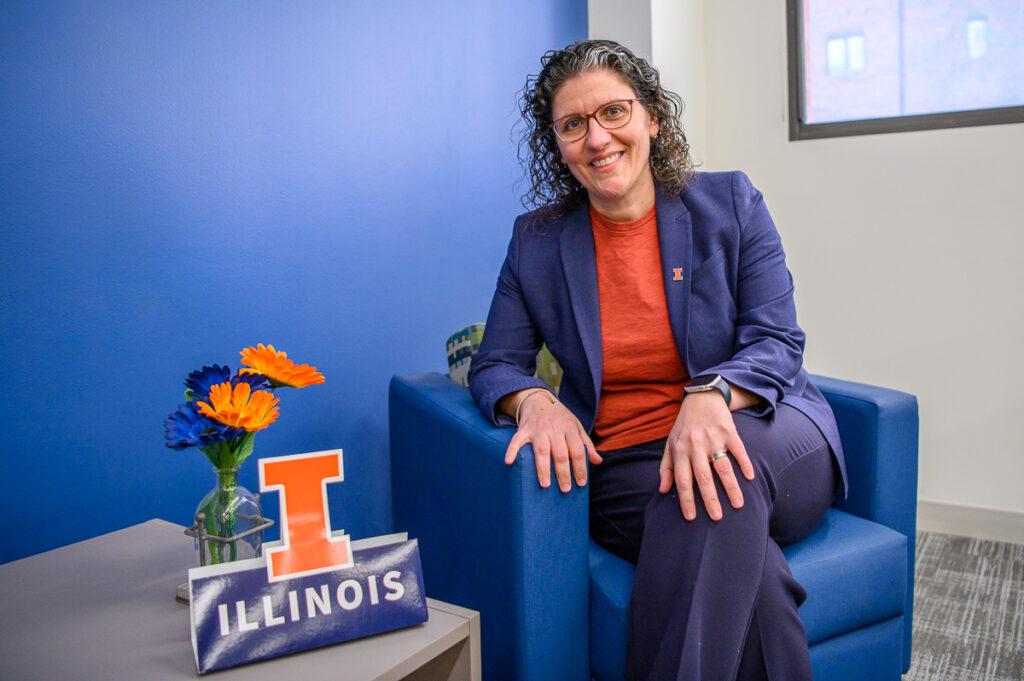
Prof. Sandraluz Lara-Cinisomo, center, worked with fellow researchers Melany Romero, left, and Sudhamshi Beeram on a study investigating links between postpartum depression and pain during and after childbirth in racial/ethnic minority women.
(Photo by Fred Zwicky / University of Illinois Urbana-Champaign)
A woman’s risk of developing postpartum depression is influenced by several pain-related factors before and after childbirth, including poor pain management, their prenatal mental health and the quality of patient-provider communication, researchers at the College of Applied Health Sciences at the University of Illinois Urbana-Champaign say.
Health and Kinesiology Associate Professor Sandraluz Lara-Cinisomo and her co-authors, graduate students Sudhamshi Beeram and Melany E. Romero, spoke to the Illinois News Bureau’s Sharita Forrest to share the findings of their analysis of postpartum literature: they identified seven interrelated risk factors of postpartum depression in racial and ethnic minority women.
Health and Kinesiology professors talked about early childhood nutrition with local news
Thaynã Flores and Pedro Hallal, professors of Health and Kinesiology, joined the University Updates segment of WCIA 3 News this week. (WCIA 3)
It’s no secret that the food you eat every day can impact your body or impact how you feel. Now, researchers at the University of Illinois are learning the link between what toddlers are eating, and how they think years later.
A team of professors from the College of Applied Health Sciences joined WCIA 3’s Amanda Brennan in the studio for Tuesday’s “University Update” to talk all about their new study, that found an association between unhealthy dietary patterns in early childhood and lowered cognitive test scores for kids years later.
“Our take home lesson today is that nutrition earlier in life really matters,” said Thaynã Flores, health and kinesiology assistant professor. “At age two, the brain is still developing fast and what the children eat during this period influences the brain’s outcomes later.”
Pedro Hallal, a professor with the Department of Health and Kinesiology added that it’s “no secret” that what you eat can influence your chronic disease risk or other physical impacts.
“What is new about this study is that what kids eat very early in life, at the age of two, will influence your brain, your cognition ability at age six. The more ultra-processed foods kids eat, the less developed their brains will be at age six. And that’s concerning,” Hallal said.
“I welcome perspectives from everyone (…) because the future we create together will be stronger for it.“
Georgia Malandraki, professor and department head of Speech and Hearing Science, has begun her second month as department head. (Ethan Simmons/College of AHS)
Dear Speech and Hearing Science community,
It is with pride and a deep sense of responsibility that I begin my role as Head of the Department of Speech and Hearing Science. Returning to Illinois, where I completed my Ph.D. and where many of our distinguished faculty shaped my early career, feels like coming home. It is both humbling and exciting to now have the opportunity to give back to the community that supported me from the start.
Over the past several months, I have begun to learn the many stories, strengths, and aspirations that make SHS such a vibrant community. Every conversation with faculty, staff, and students has reminded me of something I have known since I was a student here: SHS is a community where excellence and compassion go hand in hand, and where people genuinely care about making an impact. I am grateful to join you as we continue building on that foundation together.
I am thankful to be joining the department at a time of remarkable momentum, built under the leadership of former Head and Professor Pamela Hadley and Dean Cheryl Hanley Maxwell. The shared governance model, the selfless and dedicated service of faculty, the collective passion for impactful research and clinical training, and the strong commitment to inclusion that I have witnessed during this transition are outstanding.
Equally impressive is the work ethic and dedication of our faculty, staff, and students, clear indicators of the remarkable potential ahead. Importantly, the support and enriching environment provided by the College of Applied Health Sciences and the University as a whole foster collaboration, innovation, and sustained excellence, creating the conditions for SHS to grow and continue its legacy as one of the leading departments in the state and the country.
As we look toward the future, I see a department that not only sustains this legacy but continues to grow its reach locally, nationally, and globally. Together, we will focus on our shared goals:
Strengthening our position as a global leader in research and clinical training in communication sciences and disorders
Empowering students through exceptional and forward-thinking education
Expanding our engagement with communities and partners who rely on our expertise
Growing the resources and support needed to enhance discovery, education, and service
These are meaningful goals, and I am confident we can achieve them. The talent, commitment, and heart I see within SHS are truly remarkable.
In the coming months, I look forward to hearing your ideas, learning from your experiences, and working with you to shape the next chapter of SHS. I welcome perspectives from everyone—students, alumni, faculty, staff and friends—because the future we create together will be stronger for it.
Thank you for the very warm welcome. I am inspired by this department, energized by its potential, and honored to walk forward with you.
With warmest regards, Georgia A. Malandraki, Ph.D., CCC-SLP, BCS-S, ASHA Fellow Professor and Head
Extended high frequencies, above 8 kHz, can make speech more intelligible in noisy environments.
Associate Professor Brian Monson and Speech and Hearing Science Ph.D. student Rohit Ananthanarayana.
When we speak, the air moving through our vocal cords generates soundwaves vibrating at different frequencies: the higher the frequency, the higher the pitch.
Most of our modern audio technology, including hearing aids, headphones, and phone conversations chop off the “top end” of these soundwaves to compress the information coming in while keeping speech understandable.
But these extended high frequencies—8,000 Hz and above—contain important signals in the human voice, especially for comprehending speech in noisy environments.
Two researchers in the Department of Speech and Hearing Science at the University of Illinois Urbana-Champaign, Associate Professor Brian Monson and doctoral student Rohit Ananthanarayana, have patented an algorithm to identify and extract speech signals from noise by using extended high-frequency information.
The technique is novel, and with some investment, could be mapped onto existing modern hearing aids, earbuds and more.
Where are these high frequencies useful? Picture a restaurant date where you’re trying to pay attention to your partner speaking on the other end of the table, and voices of other customers are bouncing all around you.
“In those noisy settings in particular, that’s when these higher frequencies become valuable,” Monson said. “All the background noise masks out and interferes with those low frequencies, whereas these really high frequencies tend to stay pretty stable and unmasked, undegraded by the background noise.”
Humans can hear frequencies vibrating from 20 Hz all the way up to 20,000 Hz. Most modern hearing aids capture frequencies up to 6,000 Hz, which covers most everyday sounds. Most clinical hearing tests don’t test subjects’ hearing above this range.
Consonant sounds called “voiceless fricatives,” such as “s,” “sh,” “f” and “ph” sounds, contain energy above 8,000 Hz. Through grant-funded experiments, the researchers have shown the usefulness of these high-end frequencies—such as determining whether someone is facing you and speaking, or if they’re facing a different direction.
In those noisy settings in particular, that’s when these higher frequencies become valuable.
Brian Monson
Associate Professor, Department of Speech and Hearing Science at Illinois
One experiment conducted by Monson and Ananthanarayana asked participants to listen to another person speaking, with and without the high-frequency range, and determine whether the speech was directed at them or not.
“If you test listeners’ ability to perform this task, to determine whether someone’s looking at you or looking away, they do quite a bit better at that task if they have access to those really high frequencies,” Monson said.
While performing high-frequency research, the algorithm became an interesting side project to work on. The algorithm was developed to be retrofitted as well: the listening benefits could be implemented on existing tech with a firmware update.
“We wanted to find some way to utilize the information in those extended high frequencies to enhance the target speech signal,” said Ananthanarayana, who began his Ph.D. at Illinois in 2021. “We identified a way that was novel but also feasible to try out with the resources and time that we had.”
The patent itself was four years in the making; Monson filed the provisional patent in December 2021, and the two researchers used their backgrounds in electrical engineering to test, code and strengthen the algorithm further.
To test its efficacy, they ran the algorithm on simulated speech recordings, where the “target talker” uttered short sentences in a noisy environment. The algorithm was judged for its ability to enhance the target signal’s clarity while suppressing background noise.
Together with the Office of Technology Management, Ananthanarayana and Monson put together their patent application to safeguard their idea, which was awarded in October.
“Ideally, someone would take interest in this—whether that’s us or someone else—and run with it to see if it’s implementable in hearing aid technology or other assistive listening device tech, like over-the-counter hearing aids, earbuds, headphones,” Monson said. “We think there’s potential there.”
Editor’s note:
The patent “Speech Identification and Extraction from Noise Using Extended High Frequency Information” was approved in October 2025.
Did digital gestures from destination marketing organizations resonate with Black travelers?
RST Assistant Professor Charis Tucker: “Tourism marketing must go beyond surface-level representation.”
In the summer of 2020, when streets across the U.S. filled with protests for racial and social justice, something unusual happened in the world of tourism. Destination marketing organizations—better known as DMOs—suddenly became vocal online allies. Their Instagram grids turned black. Their feeds carried hashtags of solidarity. Their captions spoke of inclusion, equity and justice.
It was a striking moment for an industry that historically has not been known for inclusivity. But it raised an important question: did these digital gestures matter to Black travelers, the very audience the messages were meant to support?
That question became the focus of a new study entitled “Online Allies? Exploring Black travelers’ perceptions of DMO social advocacy statements” and published in the Journal of Travel Research. For the researcher behind the project—Dr. Charis Tucker, an assistant professor in the Department of Recreation, Sport and Tourism at the University of Illinois—the motivation was straightforward.
“Organizations in various industries, including tourism, began engaging in digital advocacy, posting their support for racial diversity, the Black community, and/or the Black Lives Matter Movement,” Tucker said. “What was missing from the conversation, however, were the voices of the community for whom this advocacy was directed. I wanted to understand how these statements resonated with Black travelers.”
In this context, “social advocacy statements” means the public messages organizations choose to share online—on websites, social feeds or campaigns—about issues such as racial justice, LGBTQ rights or mental health.
“These statements are usually made during key moments after a major social event or movement,” Tucker said. “They’re meant to show that the organization cares about more than profit; they care about people and justice, too.”
But do they succeed? Or do they come off as hollow gestures?
To find out, the Tucker and her colleagues reviewed real-world posts from DMOs, looking at the kinds of images and captions they used. Then, they designed a set of mock posts that reflected different advocacy approaches:
A simple black square.
A black square with a short statement of solidarity.
A photo of a Black family holding a sign that read “United Against Hate.”
The same photo, paired with a written statement.
Nearly 200 participants evaluated the posts through an online research platform. Their reactions revealed not only what felt meaningful, but also what felt empty.
The black square, a widely used digital symbol in 2020, flopped in the experiment. Participants dismissed it as vague and performative.
A mockup of a black square Instagram post. Many corporations, including DMOs, posted similar images during 2020’s racial justice protests, in an effort to show solidarity. Tucker asked participants to evaluate different responses from DMOs on how meaningful, or hollow, the gestures felt.
The black square paired with a written statement prompted the most critical reflection. It made travelers stop and ask: does this organization actually understand us? Do they back up these words with action?
“I think this is a little lackluster compared to the other statements I have seen. I don’t want to be represented by just a black square” one participant said.
Posts that combined imagery with text—especially featuring Black people—were seen as more sincere and intentional. The message was clear: gestures need words and words need actions.
So how can DMOs avoid looking performative? According to the study, the key lies in specificity and consistency.
“Organizations must explicitly state their stance,” Tucker said. “Their posts should include who they are supporting, why, and—perhaps most importantly—how. This will limit scrutiny that is sure to come with vague or ambiguous messaging.”
Equally critical is aligning statements with a track record of action. Many participants questioned whether DMOs had been inclusive in the past. Without history to back them up, even the most polished posts risked falling flat.
The implications for tourism marketing are significant. For decades, Black travelers have been underrepresented—or completely absent—in promotional campaigns. In response, they created their own spaces for community and representation.
“Tourism marketing must go beyond surface-level representation,” Tucker said. “Genuine inclusion requires more than simply featuring Black travelers in promotional materials. It demands thoughtful, consistent effort that reflects a genuine understanding of and engagement with Black communities.”
One concept that emerged from the research is something called “relational legitimacy.” Put simply, it’s the trust that grows when organizations affirm the identities, values, and lived experiences of marginalized communities.
“To rebuild trust, DMOs should get to know their community, not just in its present state, but from a historical perspective as well,” Tucker said. “This means recognizing the past experiences, contributions, and challenges of these communities, and using that knowledge to inform more respectful, inclusive engagement.”
That means celebrating local Black voices—entrepreneurs, artists, and cultural leaders—while also listening closely to community feedback and adapting accordingly.
The study’s findings offer a roadmap for an industry that wants to do better. Social advocacy can’t be performative, and it can’t be a one-off post during a crisis. For Black travelers, sincerity shines through when organizations pair words with action, history with honesty, and representation with respect.
As Tucker noted, real trust is built not through hashtags, but through consistency.
For DMOs, the message is as clear as it is challenging: it’s time to move beyond the black square.
A new RST study examines how tattoos from memorable trips continue to ‘speak’ over time
A tattoo one traveler obtained on a visit to Japan. Participants in the study were asked to share images of their tattoos, which embodied personal change, collaboration, and reminders of the travel experience. (Provided)
At the intersection of body art and travel lies a fascinating phenomenon: tattoos serving as anchors of transformative experiences.
A new study from Recreation, Sport and Tourism faculty members Toni Liechty and Joelle Soulard, along with recent RST graduate and current Western Michigan University Assistant Professor Xin Du—which earned a Silver Award at the TTRA International Conference—sheds light on how travelers inscribe their journeys into their skin—quite literally—turning fleeting moments into enduring symbols of change. Drawing on the theory of aesthetic reflexivity, Soulard and her team examined how tattoos reflect not only personal transformations but also the broader cultural contexts in which they are created.
At the heart of this study is aesthetic reflexivity, a lens that emphasizes how individuals make sense of their lives through aesthetic, embodied, and sensory practices. Rather than viewing tattoos as static souvenirs, Liechty and Soulard’s research frames them as dynamic expressions of ongoing transformation. Placement, style and design become as important as the stories behind them. Three themes consistently surfaced: tattoos as embodiments of personal change, tattoos shaped through collaboration with others, and tattoos serving as enduring reminders long after the journey ended.
In other words, the tattoo is not the final word on the experience—it continues to “speak” over time. A novel aspect of this research was the use of photo elicitation, where participants were asked to share images of their tattoos.
“This combination of stories and images provided a fuller picture of how tattoos expressed transformation and helped us notice patterns that might have been missed otherwise,” Soulard said.
This visual approach often unlocked memories and meanings that words alone did not capture. For instance, some travelers reflected on the significance of tattoo placement in relation to scars, or the choice of a particular design that tied back to their journey. By combining narrative and visual data, Soulard and Liechty were able to trace patterns of transformation that might have remained invisible otherwise.
The study included 31 U.S. travelers who had gotten a tattoo after what they considered a transformative trip. Participants were recruited to reflect diversity across age, gender, life stage, and destination. From backpacking in Asia to volunteering abroad or embarking on solo pilgrimages, the contexts varied widely. Yet, despite the diversity of stories, a shared thread emerged: the tattoo as both artifact and anchor of change. Recruitment continued until theoretical saturation was reached, ensuring that the insights reflected recurring themes rather than isolated anecdotes.
RST professors Toni Liechty and Joelle Soulard.
One of the more striking findings involved tattoo placement. Several participants deliberately chose sensitive spots—like ribs or spine—where pain intensified the meaning of the act. For them, the researchers said, enduring the process was part of the ritual, underscoring resilience and adding layers of depth.
“Across their stories, we also noticed common patterns,” Soulard said. “Tattoos used to cover scars, tattoos placed where others would see them as signs of transformation, and tattoos with symbolic designs, such as ancestral motifs, that carried personal significance. These layers of interpretation became visible when we looked at the tattoos alongside the participants’ accounts.”
Although the research did not include formal long-term follow-up, many participants described how their tattoos continued to serve as daily reminders of their journeys. In moments of stress or uncertainty, glancing at the tattoo provided grounding, calm, or renewed strength. This suggests that tattoos function not only as memory devices but also as active tools for navigating everyday life, anchoring identity and resilience across time.
A floral tattoo obtained by a traveler after a trip to New Zealand.
The findings hold valuable insights for tourism operators. Rather than offering only conventional souvenirs, Soulard suggests that operators could facilitate co-creation experiences with local artists—tattooists, calligraphers, or printmakers—that allow travelers to express transformation in deeply personal ways. Maker studios for engraved tokens, stitched patches, or memorial jewelry could provide meaningful alternatives. Post-trip reflection kits, blending journaling prompts with art, might also extend the transformative power of travel once travelers return home. These approaches recognize that identity work does not end when the trip concludes; it evolves.
Of course, tattoos are not free from cultural complexity. The researchers said they approached the subject with care, ensuring ethical research practices, IRB approval and respect for participants’ privacy. Photo sharing was optional, and aliases were used to protect identities.
“We also ensured that participants’ own stories and meanings were at the center of the research by giving them space to guide the conversation, and interpreting their tattoos through the explanations they offered,” Soulard said.
Importantly, the researchers acknowledged broader issues, such as the colonial suppression of Indigenous tattoo traditions, as well as the risks of cultural appropriation or stigma in modern practice.
Soulard and Liechty’s insights raise possibilities for future research. Longitudinal studies using diaries or repeat interviews could explore how the meanings of tattoos evolve over decades. As tattoos continue to gain cultural prominence, particularly among younger generations, their role as anchors of transformative travel is likely to expand.
What remains clear, Liechty and Soulard suggest, is that tattoos are more than body art—they are living, breathing narratives etched into skin, carrying the echoes of journeys that reshape lives.
A group photo from RST 199: IC-ChangeS first section in spring 2025, in Kenney Gym. The course had Recreation, Sport and Tourism undergrads teach local student-athletes about social justice through sport. (Provided)
This Recreation, Sport and Tourism course brought together undergrads and local high school student-athletes, to understand how sport can produce positive social change.
A new Recreation, Sport and Tourism course—Inclusive Champions for Change through Sport, or IC-ChangeS for short—is challenging Illinois students to understand how sports can provide a platform for positive social change.
And what better way to learn than leading their own classes with local high school athletes?
Lead instructor Yannick Kluch, an assistant professor in RST, piloted this course in the spring. His team found a willing partner in University Laboratory High School, the small high school on the Urbana campus.
“I’ve always thought about why people are not doing more to engage high school athletes in social justice work, because they do tend to have a platform in their community,” Kluch said. “The idea had been brewing in my head for years, but I never felt like I could turn it into reality. But here at Illinois, I felt supported right away to make it happen.”
The pilot of this course felt like a step outside the comfort zone to many of the undergrads who enrolled. They would have to don their professors’ caps while wading through potentially prickly topics with their peers. But students left feeling transformed by the experience.
“Being in that smaller group made me feel comfortable sharing my ideas and thoughts, knowing I was in a safe space,” said Lauren Ratajczak, a senior in RST. “I felt like I actually was making a difference in people’s lives. These students can go on to pursue social justice and change in their futures.”
The syllabus explored key social justice topics, mapped onto the sports world: What does systemic injustice mean and look like? What are social identities and unconscious biases? How do these concepts play out for modern-day sport icons?
Kluch researches how sport is used as a platform to advance equity and inclusion on a societal level. When he arrived at Illinois, he quickly connected with Mariela Fernandez, an associate professor in RST who researches environmental justice.
When they heard about the University of Illinois’ Call to Action grants, the project seemed like a perfect fit. The annual grant program from the Chancellor’s office funds research and community engagement projects that tackle social inequities head-on.
With $90,338 from the Chancellor’s grant, and a team of collaborators including RST doctoral student Solomon Siskind, RST master’s student Kevin Gillooly, and Anna Baeth from the national sports inclusivity nonprofit Athlete Ally, the IC-ChangeS team got to work. The group later added two staff members from Uni High as well as a local high school student from Champaign Central High School to the team.
Uni High offered up four sessions of their normal Physical Education class periods for RST to work with. The organizers quickly realized, to best deliver the material, the students would have to become the teachers.
“I wanted to leave the students with a new sense of agency when it comes to social justice topics,” Kluch said. “That was a key goal, to make students not shy away from this. Especially when these topics are under attack.”
‘You can make a difference’
In one of the first IC-ChangeS sessions, Uni High student Aldo Zepeda Flores walked up to a large piece of paper hanging on the wall, with the question “What does social injustice look like to you?” written on the top.
One by one, students jotted down their answers on the sheet before discussing with the group.
“It was really nice because you got to see everyone else’s perspective and everyone else’s opinions, but it also gives a sense of privacy when you can express stuff a lot more than when you’re called on in class,” Zepeda Flores said.
The Uni High students participated in four sessions during their usual gym class period, with the support of their high school PE teachers.
An IC-ChangeS group activity in action. Each class period was designed to be as interactive as possible.
With only a handful of sessions, each IC-ChangeS session was designed to be as interactive as possible. In one activity, the high schoolers played a card game called “Buffalo: The Name Dropping Game.” Two cards were quickly flipped, one with a noun and the other with an adjective. If the words were “Muslim” and “athlete,” for example, whoever can first think of a person that combined the two terms won the round. Unbeknownst to the high schoolers at the time, the game had been developed to address unconscious biases at play.
“It was no thinking, no time for analyzing the question or what you were about to say,” Zepeda Flores said. “And then you start to realize, maybe I’m thinking in a different way than I should be. You acknowledge your own biases.”
For Flores, who has played soccer his entire life, what resonated most was the sense of belonging: “I’ve done club sports my entire life, a person’s sense of belonging can affect their style of play. I reflected on my own experience, on the times I wasn’t as welcoming, or the times I felt excluded.”
“It gave me perspective of how in every environment, not just sports, my class, and home, you want everyone to feel a sense of belonging, where they all feel welcome,” he said.
Each session was interactive and carefully planned, but the RST undergraduates were the main shapers of the instruction, Kluch said. They were free to figure out how to best deliver lessons to the group of young athletes.
“It’s not just us telling the undergrads, ‘teach that,’ it’s us asking the undergrads, ‘How would you teach that? What would you teach?’ and then they take agency and facilitate,” Kluch said. “They were super creative, and it resonated with the high schoolers because they found engaging ways to talk about these issues.”
The RST students began to make connections between their own lives and the class content – and used that to connect with the high schoolers. “We were teaching the high school athletes, no matter how small the community, you can make a difference,” Ratajczak said. These young athletes do have power and they do have a voice.”
Having supervised the pilot run of the course at Uni High, Uni Physical Education Teacher Luke Bronowski feels the innovative format would be appealing for other high schools. At Uni, the students looked forward to the interactive sessions.
“We have a diverse population at Uni High, some students who’ve experienced social injustice, and so I think it was eye-opening not only for the high school students to hear some of these stories, but I felt the college students were learning from our students, too,” Bronowski said. “Our students were getting tools to use their platform as athletes to be agents of change.”
Lasting bonds
Lexie Breymeyer came to the University of Illinois in 2021 from Hoopeston, a town of 5,000 roughly an hour drive away from campus. Prior to enrolling in this course, concepts like microaggressions and cultural competence were relatively foreign to her, she said.
“This class has singlehandedly changed my mindset, my values, how I look at the world. I could not ask for more from a class—it’s truly changed me as an individual,” Breymeyer said.
After graduating in the spring from the RST program, Breymeyer was accepted to the Medill School of Journalism at Northwestern University. She credits IC-ChangeS’ content for inspiring her to go into sports journalism.
“Sport is not just a game, it’s a tool, and learning how to use sport as a tool for change opens countless amounts of doors. For journalism, I want to do sports broadcasting, setting up a platform to have these uncomfortable conversations,” Breymeyer said.
Even at Northwestern, she’s still in touch with her IC-Changes classmates: after the semester of IC-ChangeS concluded in May, their group chat is still active, updating each other on their lives and keeping up with the news, just like they did in class.
It’s not just us telling the undergrads, ‘teach that,’ it’s us asking the undergrads, ‘How would you teach that? What would you teach?’ and then they take agency and facilitate.
Yannick Kluch
Assistant Professor in Recreation, Sport and Tourism
“We would spend time processing what was going on in higher ed,” she said. “The world we live in is hectic right now, having a safe space to discuss those things and how it relates to what we were teaching students was one of my favorite things about the class overall. It was a community where we could talk about tough topics.”
The plan for this course is to “scale up,” Kluch said. He hopes the peer-to-peer class framework is replicable for other high schools and colleges in-state and throughout the country, which can be adapted for topics with a specific social justice focus, such as inclusion for people with disabilities or sexual violence prevention. He’s submitted for the course to become a permanent part of the Recreation, Sport and Tourism curriculum.
“The pilot run couldn’t have gone better, and I am so proud of our RST students, the IC-ChangeS athletes, and our partners at Uni High for keeping an open mind and making the course as impactful as it has been,” Kluch said. “This course represents the very fabric of what we do in RST; we use our passion for recreation, sport and tourism to make a difference in the world.”
Can regular exercise reduce the protein needs of adults with type 2 diabetes?
From left: University of Illinois Professor Nick Burd, postdoc Mikaela Kasperek, Ph.D. student Gena Irwin, and Associate Professor Jacob Allen pose inside Freer Hall’s gym, where their labs will train participants in a 12-week exercise program for a clinical trial.
For healthy adults, roughly .8 grams of protein per kilogram of bodyweight per day is enough to maintain muscle mass and support daily function.
But for adults with type 2 diabetes, an estimated 1 in 10 adults in the United States, their protein requirements remain relatively undefined, but are believed to be elevated when compared to their non-diabetic counterparts. Especially as diabetic individuals age, their bodies often become more anabolic resistant: less responsive to the muscle-building effects of exercise and protein intake.
Researchers from the Department of Health and Kinesiology at the University of Illinois Urbana-Champaign are recruiting participants for a human clinical trial to understand the protein needs of older adults with type 2 diabetes, and whether regular exercise can help their bodies use protein more efficiently.
“The problem with current strategies for type 2 diabetes is they largely try to keep throwing protein in people’s diets: eat more, eat more, eat more,” HK Professor Nicholas Burd said.
Piling on the protein could have detrimental effects. There’s evidence that circulating amino acids, including branch chain amino acids that promote muscle mass, are associated with poorer outcomes for people with diabetes, said HK Associate Professor Jacob Allen.
Their upcoming study, “Exercise impact on dietary protein efficiency in older adults with type 2 diabetes,” is funded by a grant from the American Diabetes Association. The principal investigators are Burd, who researches protein metabolism, and Allen, who studies how exercise and nutrition impact the gut microbiome.
Health and Kinesiology professors Jack Senefeld and Steve Petruzzello are co-investigators on the study.
HK Assistant Professor Jack Senefeld and Professor Steve Petruzzello are co-investigators on the study, bringing expertise on training diabetic individuals and psychological well-being during exercise. Ph.D. candidate Gena Irwin and postdoc Mikaela Kasperek will lead the work from the Burd’s Exercise Performance Lab and Allen’s Integrative Microbiota Physiology labs respectively.
Starting this fall, the researchers will recruit 30 older adults to participate in this study—15 individuals living with type 2 diabetes and 15 without—and bring them into Freer Hall’s gym for a 12-week fitness program that mixes weight training with endurance exercise.
The researchers will use sensitive tools in their labs to figure out how efficiently participants’ bodies utilize protein, and whether that efficiency varies for older adults with and without diabetes. After participants wrap the exercise program, the team will test whether resistance training improved their bodies’ usage of protein overall, lessening their daily protein needs.
“To make an older person’s muscles more youthful, you can exercise them,” Burd said. “But we don’t know how the gut’s being impacted, and we don’t know how type 2 diabetes interferes with some of the ‘youthfulness’ effects of exercise.”
Some of our dietary protein ends up in our skeletal muscle, through muscle-protein synthesis, and some of it is used for energy. But there’s a “black box” around where the rest of our protein goes in the body, Allen said.
“We think that the microbes in the gut, the gut microbiome, might be responsible for some of this, but this has never been studied,” Allen said. “We’ve run some pilot work that fueled part of this study, where we can show that indeed, ingested amino acids are converted into these microbial metabolites.”
Why might that matter? Some of these metabolites are important for human health overall, Allen said. For example, short chain fatty acids—the byproducts of dietary fiber being processed in our gut—bring a host of benefits for metabolism and the immune system.
The research teams will host intervention days at the beginning and end of the 12-week exercise program, to see how participants’ bodies are using the protein in their muscle and gut.
Participants will consume amino acids labeled with stable isotope tracers. The labs will collect breath samples to see how much of the labeled amino acid is showing up in the breath—if more of that labeled protein appears in participants’ breath, their bodies aren’t as good at incorporating it into muscle.
Blood samples will help the scientists understand how the gut is taking those amino acids and converting them into potentially beneficial metabolites.
The second intervention day at the end of the trial will determine whether an exercise program changed the way participants’ bodies use protein.
“There are very few labs in the U.S that not only have the expertise, but have the infrastructure to be able to do this kind of work, so we’re very fortunate for Illinois and our department,” Burd said. “Stable isotope tracers require expensive machines to analyze.”
What’s in it for participants? On top of helping the scientists form dietary guidelines for older adults with type 2 diabetes, they’ll receive progressive exercise training from expert students and faculty at the college, that will hopefully serve them well beyond their last visit.
“A big goal is to change behavior, too, to make them healthier,” Allen said. “That’s ultimately what we’re trying to do.”
Editor’s note:
Interested in participating in this study? Take the survey to see if you qualify, or email the organizers at HK-ADA-Study@illinois.edu
‘This was by far the most difficult and I think impactful work that I have done’
Photos from Medyka, a Polish village near the Ukraine border, a few months after the Russian invasion of Ukraine in 2022. Millions of Ukrainian refugees have passed through Poland, with more than 990,000 settling there under temporary protected status.(Provided by Monika Stodolska)
Sitting face-to-face with Ukrainian refugees who had escaped to Poland after Russia’s invasion of Ukraine, Recreation, Sport and Tourism Professor Monika Stodolska asked a set of questions many of them hadn’t considered. Namely, what do you do in your leisure time?
She wanted to understand what they had done to cope with their psychological trauma from the conflict, and whether their participation in leisure activities had helped to relieve some of the stress they’d experienced. But Stodolska wasn’t prepared for how difficult it would be to even broach the subject, or how the refugees’ reactions would affect her personally.
“The look on their faces when I asked that really stuck with me. ‘How can you even be asking about leisure when everything else is going on, when my family lives on the front lines, when I’m separated from my children?’” Stodolska said. “I knew as a researcher how important leisure can be in helping people cope with those most difficult moments in their lives. But these people didn’t realize that.”
Stodolska, professor of RST at the University of Illinois Urbana-Champaign, researches how leisure and recreation can improve health and well-being, especially among racially and ethnically minoritized populations. In 2025, she released the first paper in a series studying the human consequences of the Russian war on Ukraine, specifically in the neighboring country of Poland.
By Feb. 2024, more than 18.8 million Ukrainians had crossed the country’s border with Poland since Russia’s invasion of Ukraine. By Sept. 2025, roughly 993,000 Ukrainian refugees remained in Poland under temporary protected status, with the majority resettling elsewhere or returning to Ukraine. (Germany is the only country with more Ukrainian refugees, at nearly 1.2 million).
In the fall of 2022, Stodolska—who happened to be on sabbatical—traveled back to her home country of Poland and began conducting in-depth interviews with three groups of people who were thrust into action as the war intensified.
She interviewed Ukrainian refugees who moved westward to Poland to escape the war, administrators of the aid effort such as Polish city mayors and organizers of mass refugee shelters, and “helpers,” Polish residents who housed refugees when the conflict escalated and volunteers who assisted the aid effort at home or on the frontlines.
Her first paper in the series, “The Roles of Leisure in Trauma Coping Among Ukrainian War Refugees in Poland,” was published in the journal Leisure Sciences this April. The paper contains firsthand narratives from her interviews with the Ukrainian refugees, which took place from Nov. 2022 to May 2023.
Among the 21 refugees she interviewed for the study, 19 were women, matching the ratio of Ukrainians initially displaced by the war. Until this August, men of military age were not allowed to leave Ukraine while the fighting continued.
Stodolska conducted interviews in a mix of Polish, English and some Russian, while research assistant Tala Naumovska, from the Department of Slavic Languages & Literatures, conducted interviews with subjects who spoke only Ukrainian.
Polish and Ukrainian flags on the gates to the Warsaw University campus. Polish national attitudes toward Ukrainian refugees have shifted since the invasion began. (Monika Stodolska)
Using Lazarus and Folkman’s framework to explain how individuals cope with psychological stress, Stodolska divided their leisure activities into either emotion-focused or problem-focused coping. The emotion-focused coping, among others, included checking Ukrainian news or staying in touch with family and friends, while problem-focused coping included collecting materials that could be sent the war’s frontlines, using leisure to build a sense of belonging, and traveling across Poland to learn about their new environment.
“We knew that leisure is a good buffer against trauma,” she said. “But there was so much more that surfaced in this study.”
Many of the refugees she interviewed developed strong relationships with their Polish host families, and found purpose in joining the community’s volunteer activities for the war effort, such as weaving camouflage nets intended for the war’s trenches.
Stodolska was continually struck by the immense humanitarian response she witnessed in the wake of the second invasion of Ukraine.
“It was not only the Polish population—Czech, Slovaks, Germans, everyone wanted to help. The scale and magnitude of the assistance that was given to people was just extraordinary,” Stodolska said. “To me, it was not only extremely moving from a humanitarian perspective, but from a research perspective, I thought that this was unprecedented and needed to be studied.”
But the process of acclimation was painstaking for many of the refugees, who often struggled to find purpose in their free time. Eartha, a 38-year-old mother who escaped from Ukraine with her three children, compared leisure activities like visiting the local park or zoo to “doing time” in prison while awaiting her return.
“Because it’s like you don’t live, you’re just there, you’re just passing the time. You’re ‘doing time’. I mean, you’re safe; everything is fine, but you are just like a piece of paper,” Eartha said in her interview.
What has lingered with Stodolska are the traumatic memories of escape her interviewees recalled. Three years after beginning this study, she feels irrevocably changed.
“This was my first encounter with people who just crossed the border escaping death,” Stodolska said. “The gruesome stories that they were telling me, people whose families were murdered or who witnessed death during the escape … I was shell-shocked doing this study.”
“I’ve studied race and ethnicity and discrimination for decades now, but this was by far the most difficult and I think impactful work that I have done.”
The look on their faces really stuck with me. ‘How can you even be asking about leisure when everything else is going on, when my family lives on the front lines, when I’m separated from my children?
Monika Stodolska
Professor of Recreation, Sport and Tourism
While working on her second paper chronicling Polish “helpers” of Ukrainian refugees, Stodolska decided to pause and reevaluate. Polish citizens’ attitudes toward Ukrainian refugees who had settled in the country have deteriorated in the last year, Stodolska said, and she wants to return this fall to collect more data to trace the reasons for this shift.
“They were, at the beginning of the conflict, incredibly supportive and pro-Ukrainian, including here in the United States, but especially in Eastern Europe. The narrative was, ‘They’re fighting our war. Poland is next, right?’,” Stodolska said. “However, we have since seen a marked shift in the attitudes towards migrants—to the point where the majority of the Polish population says that they want the refugees to leave and go back home.”
Why the shift? New perceptions have emerged in Poland and in the region; that Ukrainian refugees are a drain on the country’s resources, or that they’re receiving preferential treatment through government assistance programs. In an opinion poll from the Warsaw-based Centre for Public Opinion Research, 50% of Poles believed the scale of government assistance for Ukrainian refugees was “too great” in general, while 58% believed Ukrainian refugees must work to receive social benefits.
“It was not only the Polish population—Czech, Slovaks, Germans, everyone wanted to help. The scale and magnitude of the assistance that was given to people was just extraordinary,”Stodolska said.
Stodolska is planning to re-interview many of the Poles who brought Ukrainian refugees into their homes and who offered assistance through other means, and ask, “if you were in this situation again, would you still help to the extent you did?”
“I want to have two snapshots in time,” she said. “Take a more longitudinal approach.”
While war negotiations remain at a standstill, the suffering continues. Yet, as Stodolska wrote in the closing paragraph of her paper, Ukrainian refugees’ experiences are only the tip of the iceberg: more than 100 million people globally have been forcibly displaced worldwide by war, oppression and persecution.
She wrote that it was her “sincere wish” that research on refugees was not needed, but that until they are able to return to their homelands, “their fight for survival and dignity [must be] brought to the witness of the world.”
“Don’t lose interest, don’t lose compassion. Compassion is never wrong. Doing the right thing is never wrong,” Stodolska said. “Research is only one tool of that. If I can use research to make sure that this stays in the news cycle, and that people don’t lose interest in helping Ukraine or helping other people who are in need, I’ve done my job.”
New Speech and Hearing Science instructors Lesli Williams and Jerri Seremeth are both “native signers”—they grew up learning American Sign Language as their first language and primary mode of communication. They joined the Department of Speech and Hearing Science this fall, and teach classes remotely.
Lesli Williams (Provided)
Which classes are you teaching this year?
Jerri: I’m teaching two ASL III (SHS 321) courses and re-designing SHS 222: Language & Culture of Deaf Communities.
Lesli: This year, I’m teaching SHS 121: American Sign Language I, SHS 221: American Sign Language II and SHS 321: American Sign Language III.
Why did you want to become an ASL Instructor for the U. of I.? What attracted you to the role?
Jerri: It’s a great opportunity to teach at U. of I., which has a well-known and highly respected team in the U.S. I come from a Deaf family and love sharing my authentic background.
Lesli: I was drawn to the position because of its commitment to inclusive education and strong support for language and cultural diversity. The opportunity to teach ASL at a university level allows me to share the richness of Deaf culture with a broader audience and help bridge communication between Deaf and hearing communities.
Tell us about your life and career experience. How did you become an instructor of American Sign Language, and where has that taken you so far?
Jerri: I began teaching ASL in 2014 at George Washington University in Washington, D.C.
Jerri Seremeth (Provided)
Lesli: My journey with ASL started at the age of 2, I learned from a Deaf Mentor, Bob Laughna, self-taught books and old VHS signing videos, and learned signs from the Deaf Community. I grew up in only-mainstream education with no Deaf programs in my elementary, middle and high school. I graduated from Negaunee High School in 2005. I graduated from Northern Michigan University with associate’s degree in cosmetology, which I worked in salons for 15 years.
Over time, I developed a deep appreciation not just for the language, but for the culture and history of the Deaf community. After finishing up my cosmetology journey, I pursued a bachelor’s degree in Deaf Studies from Gallaudet University in 2015 and Masters in Adult Education and Training, specializing in Technology from University of Phoenix in 2017. I eventually began teaching in 2017 at my alma mater Northern Michigan University while pursing my master’s with University of Phoenix at the same time.
Since then, I’ve taught in various settings—Northern Michigan University, where I did face-to-face and online teaching from 2017 to 2025, and Columbia College, where I taught online for the last two years, and I just started my new teaching career here at University of Illinois, Urbana-Champaign this semester —and have loved seeing students grow in both skill and cultural understanding.
If you had to choose, what is the most rewarding part of being an ASL instructor for you?
Jerri: The most rewarding part is being able to teach my language and culture, giving students exposure that helps them understand us better.
Lesli: One of the most rewarding parts of teaching ASL is witnessing students make meaningful connections—not just linguistically, but culturally. When students begin to understand Deaf culture and the importance of visual language, it opens their eyes to a whole new way of experiencing communication.
For those who haven’t taken any ASL classes, or those who aren’t familiar with the Deaf community, what do you think they would find the most surprising about American Sign Language or how it’s taught?
Jerri: They might be surprised by how important facial expressions are—they make up about 70% of our language.
Lesli: Many people are surprised to learn that ASL is a complete and complex language with its own grammar and syntax completely separate from English. They’re also often surprised by how interactive and visual ASL classes are—learning through movement, facial expressions, and storytelling is very different from traditional classroom learning.
Is there anything else you’d like folks in the department to know about you?
Jerri: My husband and I have eight children together. Our youngest is an exchange student from Africa, and all of our children are Deaf. Also, hiking is my favorite escape!
Lesli: I’m passionate about creating inclusive and engaging spaces for all learners. I also love collaborating with others in the department and beyond to promote awareness of Deaf culture and language. Outside the classroom, I enjoy walking, hiking, camping, playing with my beautiful daughters—ages 6, 5 and 2 years old—and attending Deaf events and traveling, which often feed back into my teaching.