Global opportunities


Jemimah Bakare, right, Emmanuel Dubure and Byron Juma, left, are parts of a growing contingent of Illinois students from Africa (Photo by Michelle Hassel)

The Republic of Ghana has the second-largest population in West Africa. Until recently, Emmanuel Dubure was one of its more than 32 million inhabitants. He said the part of the country where he grew up faces many health challenges, and he wanted to develop the expertise to make a difference. He chose to study in the United States, he said, because “the U.S. has the best educational system at the graduate level and is a hub for research and experts in many fields.”

Dubure aspires to work at the community level to improve health back home. He learned of Illinois on LinkedIn and liked the idea of obtaining his master’s degree in community health from a well-ranked Research 1 university. 

“Most importantly, I chose to come here because the College of Applied Health Sciences had faculty doing good research in my area of interest, which is the use of nutrition education to improve health, particularly in relation to chronic conditions,” he said.

Dubure described his experience at Illinois as “amazing” and said he would strongly recommend it to other international students.

“I have met a lot of wonderful people, both students and professors. The environment here is very stimulating and supportive of learning,” he said. “AHS is very multicultural, which gives you an opportunity to learn about different cultures. It also helps you feel at home because you meet other people from your home country.”

A common sense of humanity

The University of Illinois Urbana-Champaign boasts one of the largest international student populations among public institutions in the United States. According to the university’s Vision 2030 Global Strategy document, the first international students arrived on campus just four years after the university was founded. In 1907, the University of Illinois Urbana-Champaign became the first university in the nation to create the position of international student advisor, an early recognition of the benefits of worldwide perspectives in education and scholarship. 

Marta Schneider, associate director for global communication at Illinois International, said the university’s global strategy puts a high priority on intentional engagement in Global South countries. 

“The number of students from the African continent have indeed been increasing, with Nigeria being among the top 10 represented countries at Illinois in 2021 and 2022,” she said. “The university also is committing resources to increasing ties with Latin America and underrepresented parts of Asia.”

Bill Stewart, interim head of the Department of Recreation, Sport and Tourism, thinks encouraging international enrollments is a good idea.

“A world-class university needs a world-class student body to prepare future professionals for careers that will involve advancing relationships across international and cultural boundaries,” he said. “International students elevate class discussions and activities and research programs by sharing insights and cultural values.”

As a result, he adds, domestic students often better understand cultural differences and similarities and reflect on their own cultural heritage. International students can increase understanding of a common sense of humanity.

This has certainly been the case for Sandraluz Lara-Cinisomo, associate professor of kinesiology and community health. Her research addresses disparities in the mental health of women and mothers in different racial, ethnic and immigrant groups and the military. In her Laboratory for Emotion and Stress Assessment, she has graduate students from Nigeria, Ethiopia and The Republic of The Gambia. She said the insights that international students provide on perinatal mental health disparities are critical for addressing the diverse needs of mothers not only globally but also within the United States.

The University of Illinois Urbana-Champaign is a prestigious institution, and I am extremely proud of being a student here. I wouldn’t want other international students to miss out on these crucial opportunities.

MaryEllen Mendy

Doctoral candidate, Community Health

“International students have lived experiences that are valuable when considering risk factors for perinatal mental health, barriers to care and innovative strategies that respect diverse communities’ cultural and linguistic needs,” Lara-Cinisomo said. 

Domestic students also benefit from learning, she added, that while public health crises abroad may appear identical to ones in the United States, they may actually involve layers of complex cultural and political systems that aren’t observed here.

One of Lara-Cinisomo’s mentees, Mary Ellen Mendy, hails from the smallest country within mainland Africa, the Republic of The Gambia. Women in The Gambia face many challenges to their physical and mental health. After completing her Ph.D. in community health, Mendy hopes to apply all that she has learned from this program and her Master of Public Health program at the University of Illinois Springfield to making a difference back home.

“The skills I am developing are already paving the way for my future career as a researcher,” Mendy said. “I have received so much training in the Laboratory for Emotion and Stress Assessment lab, which I greatly value.”

Mendy said she already has recommended the program to friends back in The Gambia: “The University of Illinois Urbana-Champaign is a prestigious institution, and I am extremely proud of being a student here. I wouldn’t want other international students to miss out on these crucial opportunities.”

A wholehearted recommendation

Like their domestic colleagues, international students also benefit from the exposure to different cultures. Kenyan student Byron Juma said he has seen the months fly by as he’s grown “leaps and bounds” from his interactions with students from different parts of the world.

“I have taken classes from different departments and appreciated the opportunities to interact with students from diverse academic and social backgrounds and nationalities,” he said. “Such interactions have enriched my academic life and allowed me to view my research from different perspectives. Furthermore, these interactions have allowed me to learn and appreciate other cultures, thus building my emotional and social intelligence.”

Juma, who is pursuing a Ph.D. in recreation, sport and tourism, has researched doping in sport in Africa and Europe. The unique closed-league system and heavy commercialization of sport in the United States offered an exciting new perspective for his research. The possibility of studying with RST Assistant Professor Julian Woolf, one of the world’s leading scholars on the topic, was also enticing. 

“I firmly believe that AHS has some of the best faculty in the country,” Juma said. “Getting a degree in the college counts as a prestigious achievement.” 

Juma also noted that the outstanding diversity of the student body in AHS, where 33 percent of the students belong to historically underrepresented racial and ethnic groups and 149 students are from other countries, makes it easy to feel at home.
Nigerian student Jemimah Bakare, who is pursuing a master’s degree in community health, agrees.

“The campus’ commitment to diversity and inclusion makes it an attractive choice for an international student,” she said. “The sense of belonging and the opportunities for cultural exchange are enriching aspects of the university experience that I believe are essential for personal growth and academic success.”

Bakare’s interests focus on the management of type 2 diabetes and chronic kidney disease in older adults. She was drawn to the strong academic and research reputation of the campus and the college as well as the student body diversity. 

“The academic rigor and quality of instruction have exceeded my expectations,” she said. “Furthermore, the university’s emphasis on research and practical application of knowledge has provided me with valuable hands-on experiences that will undoubtedly contribute to my future career in community health.”

Because of this combination of academic excellence, diversity and translational research opportunities, Bakare would “wholeheartedly” recommend the University of Illinois Urbana-Champaign and the College of Applied Health Sciences to other Nigerian students. In addition, she said, the support services and resources available to international students at the university help to ensure a smooth transition to life in the United States.

Related news

Expanding global outreach


Brazilian student Jonathan Rocha de Oliveira thinks many more Brazilian students would be interested in attending Illinois if they knew about the opportunities here. (Photo provided)

In addition to Africa, the University of Illinois Urbana-Champaign’s Vision 2030 Global Strategy underscores the desire to increase student enrollments from other parts of the Global South, which includes Latin America, the Caribbean, and underrepresented parts of Asia including countries in the Middle East. Many of these countries already appear on the list of 126 that currently are represented in the university’s student body, but their numbers are small.

Iranian student Sahel Moein, who is pursuing a master’s degree in kinesiology, said that unlike other colleges and universities in the U.S. where Iranian students predominantly choose to focus on engineering and basic sciences, Iranian students at Illinois can also be found in the health sciences, art, literature, education and sociology.

“Thanks to the U. of I.’s outstanding reputation and high rankings, earning a degree here is perceived very positively in Iran,” she said. “Graduating from a top-ranked university is a significant advantage when seeking faculty positions there.”

Moein was working as a clinician at a rehabilitation hospital in Iran when she realized there was more that could be done to improve the quality of life of individuals with disabilities.

Given the quality of American institutions of higher education, she decided to pursue her graduate work here. She was drawn to the College of Applied Health Sciences because of its exceptional research in kinesiology and rehabilitation sciences.

“The diverse range of research, encompassing both physical and biomechanical, as well as social and behavioral aspects, greatly piqued my interest and influenced my decision to study here,” she said.

Brazilian student Jonathan Rocha de Oliveira thinks many more Brazilian students would be interested in attending Illinois if they knew about the opportunities here.

“Unfortunately, many folks there do not know what to do to attend such a prestigious institution as Illinois,” he said. “They believe it is impossible, but it is not. I did it so others can make it, too.”

De Oliveira, a Ph.D. student in the Department of Recreation, Sport and Tourism, had always dreamed of studying abroad. He believed the United States, with its significant investment in education and research, would be the place to become the world-class professional he envisioned. 

“Illinois’ strong reputation, research opportunities, outstanding resources and internationally renowned faculty drew me here,” he said. The strong interdisciplinary focus and diversity of the College of Applied Health Sciences also got his attention. 

“It has expanded my mind in ways I never thought possible. Having different perspectives makes you think outside the box and sparks innovative ideas.”

Fellow Brazilian Ana Laura Selzer Ninomiya, whose doctoral studies in kinesiology focus on exercise psychology, said because of the time involved in getting an advanced degree, choosing the right program is critical. She’s happy with her decision to study at Illinois.

“I’ve been able to form important connections with leaders in my field and with colleagues who have graduated and are pursuing careers. I also have a broader understanding of my professional aspirations and opportunities,” she said. “It definitely makes a difference to have great mentors, a safe and friendly lab environment, and good friends.”

Social contacts can be especially important to international students who are not only adjusting to a large university but also to a new country. 

Yadira Alonza Espinoza, a Doctor of Audiology student in Speech and Hearing Science who is from Mexico, said she initially was lonely on campus and had difficulty connecting with others. Over time, she has created long-lasting relationships and is having, in her words, “one of the best experiences of my life.”

“Graduate school is tough and really tests your resilience, but I have kept a positive mindset thanks to many of my close friends,” she said. “The Office of Vice Chancellor for Diversity, Equity, and Inclusion; La Casa Cultural Latina; and my SHS mentor, Dr. Fatima Husain, have made my experience at Illinois an incredible one thus far.

Related news

Pamela Hadley honored with Stenberg Endowed professorship


Pamela Hadley, center, with faculty and staff of the Department of Speech and Hearing Science (Photo by Craig Pessman)

The daughter of a farmer in rural Illinois, Pamela Hadley had no “schema” for becoming a university professor. But a high school career filled with self-expression helped guide her toward an illustrious academic career that was culminated with a top honor.

Hadley, the head of the Department of Speech and Hearing Science and a professor, was appointed as the inaugural Charles and Kay Stenberg Endowed Professor in Disability Research in a ceremony on April 30.

The appointment is a testament to Hadley’s decades-long dedication to advancing the science of language development in young children, particularly those with developmental language disorder, said Cheryl Hanley-Maxwell, dean of the College of Applied Health Sciences.  

“Pam Hadley has made significant contributions to language science through highly regarded translational research, mentored numerous students into clinical and academic careers, and benefitted the department, university and profession at large through a variety of service activities,” Hanley-Maxwell said.  

The named professorship “is an honor that is accorded to outstanding scholars who have well-established records of excellence in research, teaching, and public engagement,” Hanley-Maxwell added.

The professorship was made possible by a generous endowment from Charles and Kay Stenberg, both Illinois alumni who experienced firsthand the challenges of navigating life with disabilities in an era before the Americans with Disabilities Act. Though they have passed, their legacy lives on through their commitment to disability research and through the continued support of Kay’s brother, Hugh Wishart. 

“Chuck and Kay were passionate about accessibility and believed deeply in supporting research that improves the lives of people with disabilities,” Hanley-Maxwell said.
Hadley also expressed deep gratitude to the Stenberg family, colleagues, students, and family members who shaped her journey. 

“This is rightfully a shared honor,” she said. “I’m profoundly humbled to be named the Charles and Kay Stenberg Professor. The Stenbergs faced and overcame many barriers, and they endowed this professorship to help others do the same.”

Hadley reflected on a life shaped by both personal experience and professional purpose. Raised in rural Henry County, Illinois, she credited her parents for instilling in her a love for inquiry and compassion. Her father, a farmer, encouraged her to solve story problems at dinner. Her mother, a nurse, brought her along on Saturday visits to residents in a skilled nursing facility. “We’d call that volunteering as a conversational partner today,” she joked, noting it was her first exposure to the impact of communication in caregiving.

Her academic journey took her from Augustana College, where she experienced immersive clinical training, to the University of Kansas, where she joined a research preschool program that would shape her scholarly trajectory. 

“It was in that preschool that I first noticed how children with communication disorders were not socially integrated,” she said. That observation led to a research assistantship, publications, and ultimately a Ph.D. in  child language under the mentorship of Professor Mabel Rice.

Pam Hadley has made significant contributions to language science through highly regarded translational research, mentored numerous students into clinical and academic careers, and benefitted the department, university and profession at large through a variety of service activities.

Cheryl Hanley-Maxwell

Dean, College of Applied Health Sciences

Over her career, Hadley has led pioneering longitudinal studies that have reshaped how clinicians and researchers understand early language development. Her work has focused on early identification and intervention for children with Developmental Language Disorder (DLD)—a condition that affects 7 to 10 percent of school-aged children and often goes undiagnosed until it has already begun to impact learning and social development.

She led a groundbreaking multi-site clinical trial, supported by the National Institute on Deafness and Other Communication Disorders, evaluating a parent-implemented language intervention. 

“I’m thrilled to report that the caregiver-implemented intervention resulted in positive effects on vocabulary and grammar,” she said, noting that the professorship would play a critical role in disseminating these findings to clinicians and families.

As head of the Department of Speech and Hearing Science, Hadley led with empathy and pragmatism during the COVID-19 pandemic. She established virtual check-ins, championed remote accessibility, and helped the department resume clinical services quickly and safely. Her leadership style, she said, is grounded in the deep respect she holds for her colleagues and their shared mission: “to promote improved communication and health for individuals with disabilities across the lifespan.”

Throughout the ceremony, attendees were reminded of Hadley’s enduring commitment to education. Undergraduate and graduate students alike benefit from her guidance, both in the classroom and in the lab. As one of the few national experts on early grammatical assessment and intervention, her work translates directly into tools and strategies used by speech-language pathologists and parents.

In concluding her remarks, Hadley acknowledged her most personal source of support—her family. Her husband, Matt Rispoli, a retired SHS faculty member, and their daughters have shared in the journey. 

“They’ve always graciously shared me with my students and my work,” she said, adding that the family’s shared love of hiking serves as a cherished escape from her many professional responsibilities.

As Dean Hanley-Maxwell presented the medallion that accompanies a named professorship, she emphasized what the moment represented: a celebration of achievement, but also a reaffirmation of the university’s mission to foster research that has real-world impact. 

“Pam, your outstanding work has added to the prestige of this college and university,” she said. “We are grateful for and proud of your commitment to helping children with language disabilities get a better start in life.”

Editor’s note:

To reach Vince Lara-Cinisomo, email vinlara@illinois.edu.
 

Related news

DRES alumni unite to help students


The ‘Band of Brothers’ have come together to support the next generation of Illini wheelchair sport athletes through the establishment of an annual scholarship.

In the heat of an Illinois men’s wheelchair basketball season, intense morning practices roll into sociable team meals and lively late-night gaming sessions. The hours spent between busy student-athlete schedules—on buses and in residence halls—are where teammates became brothers.

For all that the Illinois men’s wheelchair basketball teams of the early 2010s accomplished on the court—a National Wheelchair Basketball Association intercollegiate championship and three second-place finishes under former coaches Mike Frogley and Matt Buchi—they’ve surpassed that off of it, starting careers and raising families.

Now, the alums of this so-called “Band of Brothers” have come together once more to support the next generation of Illini wheelchair sport athletes through the establishment of an annual scholarship.

Their contributions, through The Fighting Illini Wheelchair Basketball Alumni Legacy Scholarship Fund, have been granted to two wheelchair basketball athletes in the past two terms.

“This scholarship is born from people that truly love each other and care about the future of the program at the University of Illinois,” said Mak Nong, former Illinois wheelchair basketball player and founder of the fund. “For us to be able to give back and make things easier for the future generation, that’s our moral obligation: to make this place even better than it was for us.”

Tight bonds

Maureen Gilbert wears many hats as coordinator for the Office of Campus Life at Disability Resources and Educational Services, better known as DRES. To more than 29 classes of Illinois wheelchair student-athletes, she’s “Mo,” director of athletic programs, point-person for travel and eligibility questions and trusted confidante. Some lovingly call her “Mom.”

On bus rides to and from track and field and basketball events, one can usually tell if the team is gelling off the floor, Gilbert said. Team chemistry always takes work to develop, but some teams bond faster than others.

“Once in a while, you get those athletes who seem to click, and they make it happen themselves,” Gilbert said. “Like with Mak’s group.”

Martinez Johnson joined the team in 2013 as a transfer student from Atlanta. It didn’t take long for the memories to start stacking up with his teammates.

“[We’d] just hang out and make sure we were doing our best to balance our social life, school and basketball,” Johnson said. “And we leaned on each other to make sure everyone was doing OK mentally as well.”

Just before the school year, Johnson recalls the team traveling to the 4H campground of Allerton Park for several memorable exercises. In what was a yearly tradition under former Coach Matt Buchi, the players wrote down their individual fears for the season before throwing them into a burning campfire.

“When I came in 10 years ago as a coach, that was one of the first things that I tried to do: have a bonding experience to learn about each other outside of basketball,” said Buchi, who left DRES in November for a job in the Office of the Vice Chancellor for Institutional Advancement. “And that’s what really bonds a lot of these guys for a lifetime, a comfortable place to be vulnerable as young men with our team.

“That bonding took a while to get there, but it just needed activities and locations to blossom.”

Jacob Tyree’s favorite memories with the team tend to revolve around food: morning rushes to Original House of Pancakes or Merry Ann’s Diner after long, physical practices, or cherished visits to Cravings, an Asian cuisine restaurant.

“It could be a really crappy practice, like maybe things just were not clicking on the court—coach is yelling at you for things, your teammates are yelling at you for things—and then you go out afterwards and it’s now a positive bonding experience,” Tyree said.

As the teammates graduated and dispersed across the country and the world, those relationships stayed strong. 

A random, gloomy day in the early weeks of the coronavirus pandemic led Nong to check in with many of his old teammates. He’d been pondering ways to give back to the things “he truly cared about,” and Illinois neared the top of Nong’s list.

His calls gave way to proposals: “Would you want to contribute to a scholarship?”

After checking with DRES and the College of Applied Health Sciences advancement team, the groundwork was laid.

“Mak took the lead on all of that,” Gilbert said. “In fact, it was a great gift when they told me what they were doing. It gives a good example to our current students of paying forward and how to support those who come after you.”

The generosity didn’t stop with the scholarship, either. In the spring, program alumni used crowdfunding to finance customized, tailored suit jackets for the graduating seniors on the men’s and women’s wheelchair basketball teams.

“It was a surreal full-circle moment to see my alumni, the guys that I coached, are now taking care of the players that I’m coaching now,” Buchi said before he moved on from DRES.

Life after basketball

After graduating in 2017, Nong played professional wheelchair basketball in Europe for a spell, winning a league championship for LUC Handibasket in Lille, France. What stuck with him was the governance over the sport that was present overseas.

“To them, it was just sport. People without disabilities were playing wheelchair basketball and getting paid to do it,” Nong said. “So, I was thinking, ‘How do I spread this joy to people?’ Recreation is a big opportunity for that.”

How do I spread this joy to people?

Mak Nong

Former Illini wheelchair basketball player

Years after graduating, many members of the wheelchair basketball teams have stayed in the orbit of adaptive sports, committing time and effort to growing the scene in myriad ways.

Nong is a program manager for Great Lakes Adaptive Sports Association (GLASA) in Lake Forest, Ill., overseeing a wide range of sports programs—from football, tennis, track and field, swimming and soccer—suited to disabled athletes of all ages.

His journey truly began as a young boy pushing along his wheelchair in Los Cerritos Mall near Long Beach, Calif. Longtime coach Lisa Hilborn noticed Nong and asked if he’d be interested in trying wheelchair sports.

“I didn’t want to do it at all—I was freaking out—but then I went to a practice and I fell in love with it and kept going back,” Nong said. “I’m trying to spread the love she gave to me to other people.”

By the time he was a senior in high school, Nong was heavily recruited for wheelchair basketball. Coach Frogley’s pitch from the University of Illinois stood out from the pack.

“He stressed the importance of education; he catered to me as not only a person but an athlete as well. Just having that balance and showing that we can use sport as a tool to get to where our success is,” Nong said.

Tyree, too, has found a career in the field as training coordinator for Move United, a nonprofit committed to facilitating adaptive sports opportunities. He returned to his hometown of Roanoke, Va., to found the Roanoke Stars Wheelchair Basketball program.

Like other program alums, he repeatedly credits his coaches’ attention to detail for his professional success.

“We all saw ourselves as having our roles, and thought about how do we support each other to fill in the gaps where this is my weakness, but that’s your strength? When I’m struggling, I can lean on you a little bit more,” Tyree said. “I think that that mindset really fell into creating that excellence and trickled into what we do full time.”

Alums who haven’t found careers in adaptive athletics have stayed around the game in some way, like Derek Hoot and Johnson, who started recording podcasts about it.

In the Push Podcast, the pair of alums discuss the happenings of U.S. wheelchair basketball and bring on established guests.

“Wheelchair basketball has made a big impact on all our lives. Being able to find a sports community as individuals with disabilities is huge,” Johnson said. “I think that’s a big reason we have all stuck around adaptive athletics, is we know the change it made in our lives could be duplicated for the next generation.”

Buchi­­—who is being replaced as men’s coach by women’s wheelchair basketball coach Stephanie Wheeler—said he was beginning to see talented recruits who’ve been coached by his own wheelchair basketball alums.

“The next step is happening, I have so many of my guys that are actually coaching and are giving back to juniors programs,” Buchi said. “They get to put a little bit of our Illinois stamp on these kids before I even get them.

“Our alumni need to think as soon as they graduate, how do I give back to the guys that are coming up next? Because there’s always going to be that next person that comes up and you want them to have the best experience possible.”

Editor’s note:

To reach Ethan Simmons, email ecsimmon@illinois.edu.
 

Related news

AHS makes additional programs globally accessible


The College of Applied Health Sciences featured students in its annual magazine, Moving Forward: Emmanuel Dubure, left, Byron Juma and Jemimah Bakare, right. (Photo by Michelle Hassel)

In its 2020-2025 strategic plan, the College of Applied Health Sciences makes a commitment to improving the access and affordability of its programs and reducing barriers that have historically limited individual opportunity.

For international students, the prospect of pursuing degrees in the United States can be both alluring and daunting. While the U.S. system of higher education is widely regarded as among the best in the world, the expense of moving overseas, securing required visas, learning a new language in some cases and adapting to a new culture can be overwhelming. One way to increase educational opportunities for both international and U.S.-based students is to offer degree programs and professional certificates online. 

Currently, AHS offers a master’s degree and professional certificate in recreation, sport and tourism online, as well as a certificate of professional development in information accessibility design and policy. Efforts are underway to create two new online degree programs in the Department of Kinesiology and Community Health, the Master of Public Health and the Master of Health Administration. In addition, the online master’s degree in RST will be restructured into three specialized degrees. Each new program also will offer online certificates that focus on professional skills that are in demand. For example, non-degree students and other professionals can take advantage of the college’s expertise in public health and health administration by pursuing certificates in epidemiology, biostatistics, public health, physical activity and health, health promotion, health finance, healthcare quality and health informatics.

Cheryl Hanley-Maxwell, dean of AHS, said the college is always happy to welcome students to campus but recognizes the challenge residential learning poses for many. 

“We have incredible, internationally renowned scholars on our faculty and degree and research programs that are exceptional and visionary,” she said. “We want to continue our leadership in health and health-related education by sharing our outstanding resources with a global audience.”

According to the Investment for Growth proposal submitted by the college, the online MPH program could begin enrolling students by year three of the process, while the MHA program is expected to enroll students by the fourth year. As far as the RST plan, following two years of redesign, the department plans to enroll students by year three.

Related news

AHS honors four outstanding alumni


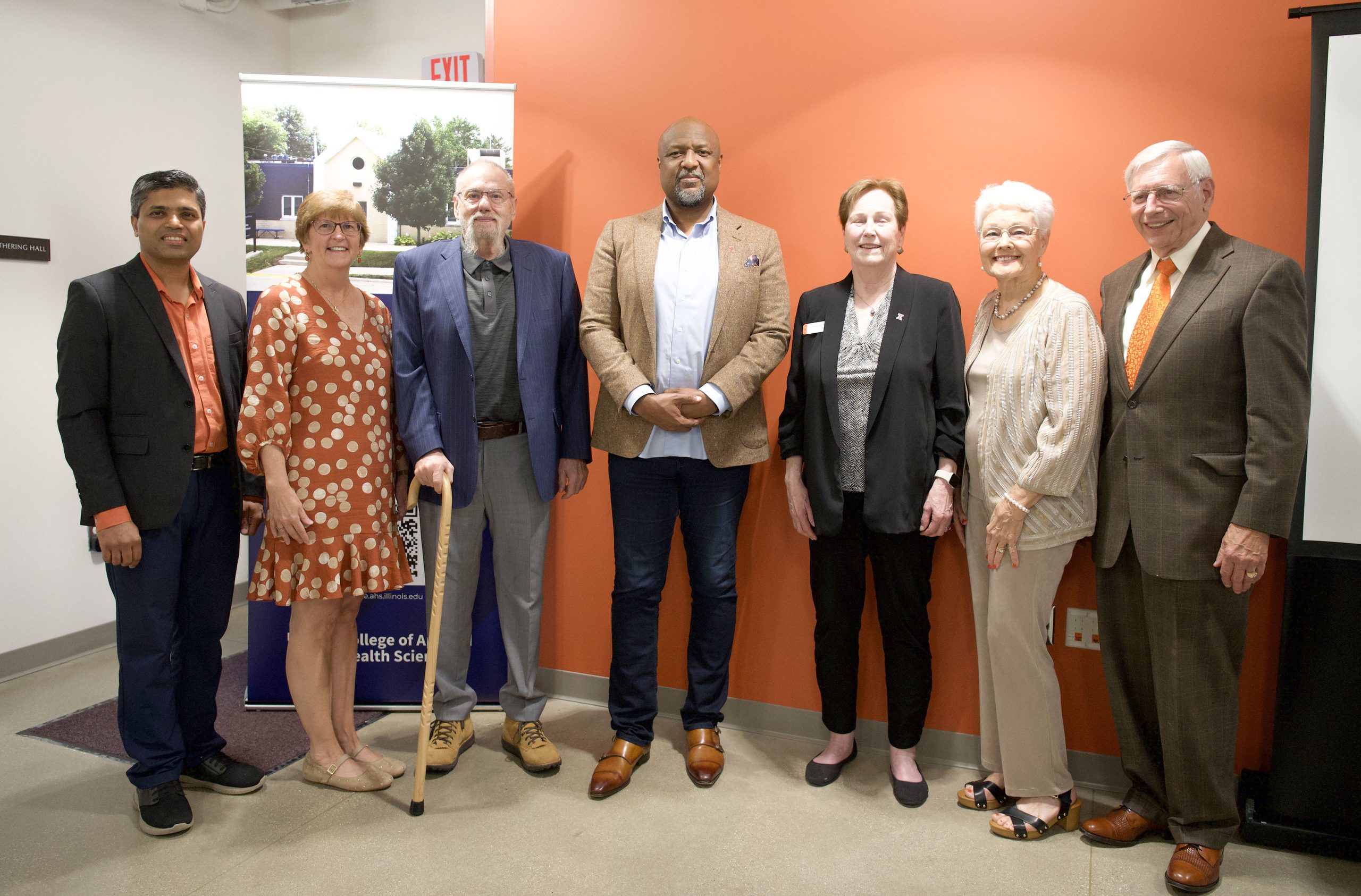
Dean Cheryl Hanley-Maxwell, left, stands with alumni award winners Michael Leach, Saul Morse and Walter Johnson. William Haskell was unable to attend the ceremony. (Photo by Jerry Thompson)

Young Alumni Award
Michael Leach
Recreation, Sport and Tourism

Michael Leach was appointed as the first-ever chief diversity and inclusion director for the White House in January of 2021. Leach, who earned his bachelor’s degree from RST in 2009, spent more than five years working for the National Football League on the NFL Management Council and later worked for the Chicago Bears and Miami Dolphins.

“I am truly humbled and honored to receive the 2023 Young Alumni Award from the University of Illinois at Urbana-Champaign,” Leach said. “My time in the College of Applied Health Sciences, and the institution more broadly, was nothing short of transformative.”

Harold Scharper Award
Saul Morse
Disability Resources and Educational Services

Saul Morse earned his bachelor’s degree (1969) and law degree (1972) at the University of Illinois and since has focused his practice on legislative matters, health law, insurance and municipal law. In 2010, with the passage of the Affordable Care Act, Morse was asked by the Illinois Department of Insurance to establish and manage an insurance pool for individuals with pre-existing health conditions.

“The Harold Scharper award is of great importance to me,” Morse said. “I came to the University of Illinois as a 17-year-old freshman. At the time, no other university in this country had a program which fully included students with a disability in all aspects of campus life, from academics to housing to activities. Most of what I have been able to do personally, professionally and within the broader community is due to the DRES program of the college.”

Distinguished Alumni Award
William Haskell
Kinesiology and Community Health

William Haskell is an internationally renowned researcher and emeritus professor of medicine at Stanford University. Haskell earned his Ph.D. in exercise physiology from the University of Illinois in 1966, and his work and achievements have clearly fulfilled the Illinois mission.

“It is truly an honor to receive the Distinguished Alumni award,” Haskell said. “Attending the University of Illinois at Urbana-Champaign offered me the opportunity to study and work with a large range of outstanding faculty and students, many of whom became exceptional leaders in exercise science research and teaching, as well as lifelong colleagues and friends.”

Walter Johnson
Recreation, Sport and Tourism

Walt Johnson was born in Watseka, Ill., and graduated from the University of Illinois in 1958 with an undergraduate degree from the RST program. Later he entered the graduate program in RST and had the privilege of learning from both Professor Charles Brightbill and Dr. Alan Sapora. Upon graduation from the RST master’s program in 1962, Johnson moved immediately into a career in parks and recreation, where he served in a number of key leadership positions.

“The University of Illinois has always been the reason for my success and the lifestyle I live today,” Johnson said. “It gave me knowledge, hope and encouragement. Growing up on a farm and spending hours on a John Deere tractor since age 8, and milking cows, planting, cultivating and raising cattle and pigs, I determined I did not want to be a farmer.”

Editor’s note:

To reach Vince Lara-Cinisomo, email vinlara@illinois.edu.
 

Related news

(Joe) Rank and file: Retired Naval officer became a Chez Center guide


Now retired, Joe Rank, left, is using his time to help support the Chez Veterans Center. (Photo provided)

By fall 1965, the conflict between North and South Vietnam had escalated, as had the United States’ military involvement. With the draft looming, Urbana teenager Joe Rank, newly enrolled at the University of Illinois, joined the Naval ROTC unit at the advice of one of his fraternity brothers a year after reserve officer training was no longer compulsory.

After four years as an undergraduate student majoring in advertising, Rank was deployed to Vietnam, where his responsibilities included pinging enemy submarines and managing gunners aboard the destroyer USS Lyman K. Swenson and the cruiser USS England.

Following his three-year tour, Rank returned to the university and embarked on several career journeys. He taught new cohorts of reserve officers, helmed a $20 million Navy advertising campaign, and developed two decades of relationships at the University of Illinois Alumni Association.

“If anybody 55 years ago said, ‘You’re going to make a career of the Navy,’ I would’ve told them they were absolutely crazy,” Rank said. “All of life’s twists and turns, I couldn’t have planned it.”

The retired Rank, now 76, is helping sustain a campus resource he could’ve used as a military veteran who returned for further education: the Chez Veterans Center.

“Joe is a bridge between the university’s deep history in the veteran community and what the future can be,” said Chez Director of Operations Andy Bender. “Joe has the passion for this work, being able to take the things we need and then bringing in the support to do it.”

“They’ve got a clear mission now to serve all veterans,” Rank said of the Chez Center. “Veterans bring diversity to the campus.”

Rank, who lives in Urbana with his wife, Pam, has strong ties with his identities as an Illinois alumnus and veteran. While visiting the Vietnam Memorial Wall, Rank made a charcoal rubbing of the etched name of Marine Corps 2nd Lt. David Skibbe, a fellow Illinois Naval ROTC officer who died during a mission in 1970.

When he returned from Vietnam, Rank became an instructor for Illinois ROTC classes, earning the title of assistant professor of naval science while obtaining his master’s degree in advertising.

Three years of 18-hour days in Vietnam made the daily study grind feel easy.

Veterans bring diversity to the campus.

Joe Rank

Illinois alumnus and retired Naval officer

“I was at the library at 8 o’clock in the morning, got my work done by 4 p.m.,” Rank said. “I had that discipline—I got one B in graduate school.”

Rank soon went back to sea, when the Navy did something that “didn’t make much sense” to him at the time: Brought Rank in as director of national advertising for Navy recruiting.

After 20 years of active-duty service, Rank faced the test of reintegrating into civilian life and passed with flying colors. The mission of the Chez Center has connected with him from the start.

While serving as vice president of membership and marketing at the Alumni Association, he was brought into an ad hoc committee to address the vision of Chez, then known as the Center for Wounded Veterans in Higher Education.

“The intent was it would be much like [Disability Resources and Educational Services] was for the World War II vets. It would accommodate severely, profoundly injured military veterans who wanted to come back to college.”

Like DRES, Chez has morphed its service to apply to a wider range of students and staff. On the advisory committee, the word “wounded” was eliminated from the title as Chez became a one-stop shop for military-connected people on campus.

“Originally, it was a welcoming cocoon for people to recreate that military atmosphere and camaraderie. But in reality, the whole idea is to get people comfortable enough with the university and the civilian environment and push them out, get them involved in their major,” Rank said.

“The idea is not to segregate them into a pseudo-military unit, but get them comfortable with what they’re going to experience in civilian life.”

Rank’s support of the Chez Center is multifaceted as both a donor and member of its advisory board.

“He’s a great sounding board for me,” Bender said. “He’s been a part of this project since the very beginning. “He’s a great supporter of us, of the veterans, and of the university at large.”

Editor’s note:

To reach Ethan Simmons, email ecsimmon@illinois.edu.
 

Related news

Pritzker to RST students: Stay in Illinois


J.B. Pritzker was the invited speaker at the kickoff to the 2024 Sapora Symposium (Photo provided)

If there is one thing Illinois Gov. J.B. Pritzker knows about, it’s hospitality.

A member of the family that owns the Hyatt hotel chain, Pritzker on Jan. 25 gave the opening remarks for the Sapora Symposium—organized by the Department of Recreation, Sport and Tourism at the University of Illinois Urbana Champaign—and implored students to “stay in Illinois.”

“My advice is stay in the state of Illinois because a lot is happening here that is going to be good for your careers,” said the 59-year-old Pritzker. “It’s not just the governor trying to convince you to do something that you don’t want to do. It’s the governor telling you that I have seen a real change in the way this state thinks of itself and the opportunity that exists, particularly in travel and tourism and recreation.”

Pritzker was the invited speaker at the recent kickoff to the Sapora Symposium, a semester-long class that features alumni and other professionals who share insight on current issues in recreation, sport and tourism. This year’s theme, according to instructor Michael Raycraft, a teaching associate professor, is the “important roles for recreation, sport, and tourism agencies in the revival of the economic, social, and environmental dimensions of Chicagoland in the post-pandemic era.”

Among the topics that came up during the discussion with Pritzker—moderated by Raycraft and RST alumni and adjunct faculty member Carmen Rossi—were contemporary issues in parks, tourism and sport and their importance to Illinois’ future. 

“Not just because I come from a family that’s been involved in tourism and the hospitality industry, but from a state perspective, it is one of the easiest ways to boost revenues,” Pritzker said.

Pritzker—a Democrat—touted his administration’s recent success in the tourism sphere, primarily securing the Democratic National Convention, slated for Aug. 19-22 at the United Center. 

“It is my job to get major conventions to come to the state,” he said. “In politics, it’s like the Super Bowl every four years. It brings 50,000 people, and they’re going to spend weeks on end beforehand, setting up and bringing people in. The delegations are going to fill all the hotels here.

“We won it for a couple of reasons. There are politics involved. But  … what mattered most was when (the DNC committee) came here, they were blown away. Because our hotels are in close proximity to one another. Hotels are close to all the places that the convention will take place. And everybody knows summer in Chicago is one of the best things in the world.”

Pritzker ended his remarks by saying the state’s “tourism economy is booming coming out of Covid.”

“My advice to you all is, stay in Illinois because we’re headed in the right direction if you want to be in this economy, in this tourism and recreation world.”

Editor’s note:

To reach Vince Lara-Cinisomo, email vinlara@illinois.edu.
 

Related news

Yogi, OT, teacher, researcher: Kinesiology Ph.D. candidate explores yoga for pain management


Stephanie Voss, a kinesiology Ph.D. candidate, is a yogi and occupational therapist. Her research blends the two interests together. (Photo by Ethan Simmons)

To doctoral candidate Stephanie Voss, chronic pain treatment and yoga have more in common than we think. 

Voss, now in her third year of a kinesiology Ph.D program at the University of Illinois, first came across the connection while working as an occupational therapist at the Shirley Ryan AbilityLab, a rehabilitation research hospital in Chicago. 

While she consulted patients who were dealing with persistent, chronic pain, Voss was training to become a yoga instructor—an out-of-class hobby that helped her overcome her own studying-induced back pain. 

“I couldn’t get over how similar the treatment approaches are,” Voss said. “Yoga is very much a holistic practice, and we address chronic pain in very much a similar way—it involves working as part of an interdisciplinary team on strength and muscle conditioning and posture and body mechanics. We also work on the psychological components, the emotional components and how we can integrate pain management strategies into daily life.” 

Today, Voss’s research at the College of Applied Health Sciences merges the two: How might yoga be used to manage lasting pain? 

This fall, she was named a recipient of the Paul D. Doolen Graduate Scholarship for the Study of Aging, an annual award given to two University of Illinois graduate students whose scholarly work advances research on the human aging process. 

With the help of the Doolen scholarship, Voss will develop a yoga protocol that specifically targets interoception, or the ability to perceive and interpret the sensations within one’s own body, an ability which may fade as we age. 

The project will explore whether yoga can improve older adults’ abilities detect and interpret feelings of pain and discomfort within their bodies. 

“I found [the scholarship] relevant to my research because most of my patients are older adults,” she said. “Chronic pain is immensely prevalent in older adult populations for various reasons but interestingly older adults tend to not be included in pain trials as often.” 

What the $4,250 scholarship gives her for now is “breathing room,” Voss said. “Being a grad student isn’t always easy from a financial standpoint, so having a little bit of extra support to free up my time and mental space, it’s one less thing to worry about.” 

She’s very smart, and very personable. It’s just refreshing for somebody to have such a good perspective on the science of what she does, but to also be very respectful and willing to take criticism for what it’s worth.

Steve Petruzzello

Health and Kinesiology professor

Voss received her B.S. in Communication Sciences and Disorders from Northwestern University in 2014 and her M.S. in Occupational Therapy from Rush University in 2018.

She began at the University of Illinois in August 2021, working under former Illinois KCH Associate Professor Neha Gothe in Gothe’s Exercise Psychology Lab. Gothe was one of the only academics exploring the connection between yoga and pain management. Voss, then fully working as an occupational therapist, reached out to Gothe over email, expressing her desire to pursue a Ph.D. under her.  

Since then, Voss has worked as a research assistant and teaching assistant, having instructed an introductory-level yoga class while periodically working with patients at the AbilityLab in Chicago. She recently taught the yoga intervention for one of Gothe’s research studies working with older adults. 

“That got to really challenge my clinical and yoga teaching skills to integrate modifying postures for people who live in different bodies than mine,” Voss said. “It’s so immensely important that my research questions are rooted in the clinical needs of the patients. I want to make sure I’m still in touch with that population.”

When Gothe departed Illinois for Northeastern University in Boston, Voss decided to stay and finish the final stages of her Ph.D. program, with KCH Professor Steve Petruzzello stepping up as her on-site doctoral co-advisor. 

“She’s very smart, and very personable,” said Petruzzello, who first met Voss while she made insightful comments in his class, KIN 443: Psychophysiology of Exercise & Sport. “It’s just refreshing for somebody to have such a good perspective on the science of what she does, but to also be very respectful and willing to take criticism for what it’s worth.” 

Both her mentors described Voss as a methodical, talented researcher whose clinical experience has given her unique perspective and a deft ability to communicate scientific concepts to different audiences.  

“She has an eye for translation and application of the research in clinical as well as real-life settings,” Gothe said. “Her years of yoga training and teaching also give her a unique advantage to work and communicate with her patients and research subjects.”

After her graduation, expected in spring 2025, Voss hopes to work in a hybrid clinical-academic position. In the meantime, Voss has seen great recruitment interest in her dissertation research, examining yoga as a strategy for chronic pain management.  

“I do feel like I will be leaving with a degree that gives me a lot of opportunity and flexibility that I can teach in occupational therapy departments. I’ll be fully qualified for that, but I’ll also be fully qualified to teach in more traditional academic university-based settings that are not necessarily a clinical program,” Voss said.  

Editor’s note:

To reach Ethan Simmons, email naverett@illinois.edu.
 

Related news

RST Ph.D. student helps student-athletes find belonging, in and out of his research


Solomon Siskind is leading a double life at the U. of I: While researching diversity and inclusion for student-athletes, he leads Illinois Athletics development program for them. (Photo by Ethan Simmons)

Solomon Siskind is living a double life at the University of Illinois Urbana-Champaign—two lives that are finely intertwined. 

While the Recreation, Sport and Tourism doctoral student researches diversity, inclusion and belonging for college athletes, he’s also applying those concepts as the Coordinator for Illini Way Student-Athlete Development in Illinois’ Division of Intercollegiate Athletics. 

“The research that I’m doing is what I’m doing in my every day,” Siskind said. “Who I’m advocating for, and who I’m empowering.” 

“No one day is the same” for Siskind in DIA. He’s laser-focused on preparing student-athletes for their transition to life after sport, whenever the ball stops bouncing or the track runs out for them. 

A Midwest transplant from the East Coast, Siskind’s own experiences—as a former college athlete himself on the University of Massachusetts Amherst football team—inform his new day-to-day as a young scholar-practitioner in the sports industry. 

Now, he’ll be studying these issues with his first grant-funded research project, entitled “Do we belong here? Examining Black student-athlete affinity groups as spaces for belonging at historically white institutions,” with a $7,500 grant from the NCAA. He spent the first year of his doctoral program ideating the project with his advisor, RST Assistant Professor Yannick Kluch. In his second year, he has started the research.

As one of five graduate students selected to receive the competitive grant, Siskind will conduct semi-structured interviews with Black student-athletes in NCAA Division I, predominantly white colleges across the country to better understand their experiences. Namely, what it’s like to be a Black student-athlete at a predominantly white institution and how being part of a racial affinity group affects their life on campus. 

The topic dovetails with Siskind’s professional and personal experiences. He was part of an affinity group for student-athletes of color at UMass Amherst, and he advises its equivalent at Illinois, called “EMPOWER.” 

“I’m interested in, what’s the impact going to be? How am I going to be able to take the findings from this research and provide recommendations to different institutions so they can better serve our Black student-athletes?” Siskind said. 

Kluch is excited for Siskind’s project getting off the ground on this “much-needed topic,” and grow his horizons in the field. 

“Solomon, in many ways, embodies many of the qualities I look for in doctoral students seeking to be advised by me. I care a lot about doing good work, doing rigorous research, knowing your expertise, but also applying that to industry contexts,” Kluch said. “With Solomon, he gets it. He has lived it. He lives it every day here at Illinois.” 

From the playing field to the classroom

From Brockton, Massachusetts, Siskind grew up in New England and stayed there for his undergraduate work, walking on to the UMass Amherst football team as a freshman. 
Even with sports in the foreground, Siskind was dead set on obtaining an advanced degree like his older brother and sister before him. 

“I’m a first-generation college student. My mother placed a big emphasis on higher education with me and my siblings from the beginning. She had both of my siblings in high school and as a single mother, her dream of going to college was no longer an option,” he said. 

Siskind had to confront his own athletic mortality far earlier than he would’ve liked. Multiple knee injuries and surgeries derailed his playing time at tight end for the UMass Minutemen.

“I’ve had a lot of time down off the field, I’ve had space to think about this, because I knew ‘I’m not going professional,’” Siskind said. 

It’s a concept he now talks about with his students at Illini Way: student-athlete identity foreclosure. What comes next after organized sports? Even the greats confront it eventually: Tom Brady is a football broadcaster now after 23 years in the NFL; Derek Jeter started preparing for the transition 10 years before his MLB career ceased; track and field star Allyson Felix started up her own lifestyle brand for women prior to retirement, Siskind recalled.

As an upperclassman, Siskind began to wrap his head around these concepts academically. In his junior year, he attended the Black Student-Athlete Summit in Austin, Texas, where presentations on student-athlete development and diversity, equity and inclusion in college sports lined the conference. 

“That was my first time seeing that type of research and the type of conversations I wanted to have,” Siskind said. “From that moment on, I was like, ‘I want to do that.’”  

For his first bite of research, he partnered with fellow college athlete Desiree Oliver of the UMass women’s basketball team to analyze the experiences of student-athletes of color at their university. 

The study aimed to better understand how their experiences as student-athletes were shaped by being at a predominantly white institution, or PWI. The data showed, among other trends, that student-athletes of color were three times as likely to report experiencing “culture shock,” and half reported feeling depressed or isolated at their institution.  

While obtaining his master’s, he learned under one of the top scholars in the diversity, equity and inclusion field as research assistant for Nefertiti Walker, now Senior Vice President for Academic Affairs, Student Affairs, and Equity for the UMass system.

“I knew this is what I wanted to do,” he said. 

Perfect timing, perfect opportunity

If you’d asked Siskind if he wanted to stay in the Midwest two years ago, he would’ve “thought you were absolutely out of your mind.” 

A postgraduate internship at the NCAA’s Office of Inclusion brought him from the East Coast to Indianapolis, Indiana, where he supported the office’s inclusion initiatives for a broad swath of student identities. 

Outreach from a familiar face, Elizabeth Hamlet, opened his eyes to the university two hours to his west, in Urbana-Champaign. Hamlet was the Senior Assistant Director of Academic Success at UMass while Siskind attended, but now she serves as the Assistant Director of Academic Services for Illinois Athletics. They discussed a new opening in the athletic department in student-athlete development.   

“Liz had been a mentor for me at UMass, and was someone who helped me develop off the field,” Siskind said. 

The opportunity was attractive. At the same time, another connection was making the move to Urbana: Kluch had applied for a tenure-track professorship at RST. The two got offered and accepted their Illinois positions at the same time. 

“When I thought about which Ph.D. programs I wanted to go into, he was the person I wanted to work with,” Siskind said. “I knew our research, our works and passions already aligned with one another.” 

“It was really perfect timing.” 

Siskind and Kluch had been acquainted for some time, following each other on social media platforms because they shared a research area. Their scholarly interest in diversity, equity and inclusion overlapped perfectly. 

“The professionals who care about these things in the sports industry, it’s a pretty small and tight-knit group,” Kluch said. 

Kluch had caught wind of Siskind’s social justice leadership on the UMass campus during his time as a student-athlete: “He was very big on elevating the athlete voice, promoting racial justice, social justice, DEI within those contexts.”  

What further connects them, Kluch said, is their shared philosophy as “scholar practitioners,” aiming to extend the impact of their research beyond the classrooms or academic journals and into the real world. When he learned Siskind wanted to pursue graduate school, Kluch hit the recruiting trail to bring him to Illinois’ RST program. 

“It’s so fun to work with him because a lot of grad students struggle with finding the connection between the theory, the theoretical, and the practical. And he walks that line seamlessly,” Kluch said. 

An advisor who’s “been in their shoes” 

Mary Long started at Illinois Athletics just a month after Siskind, and they’ve been crossing paths ever since. 

Long, a second-year Diversity, Equity, Inclusion and Belonging Fellow at DIA, coordinates cultural events for student-athletes, facilitates diversity training for staff, leads a mentorship program for students and advises Illini Allies, the LGBTQIA+ affinity group for Illinois athletes. She complimented Siskind’s ability to build rapport with student-athletes and quickly link them to scholarships or leadership opportunities. 

“He takes the time to connect with them on a personal level—he’s warm, friendly, and genuinely interested in each student-athlete. Once he’s in your corner, he’s all in,” Long said. “His biggest strength as a student-athlete development coordinator is that he has firsthand experience as a former student-athlete. He’s been in their shoes, so he gets the unique challenges they face.” 

He takes the time to connect with them on a personal level—he’s warm, friendly, and genuinely interested in each student-athlete.

Mary Long

Division of Intercollegiate Athletics

Siskind’s schedule is packed these days, balancing his part-time doctorate program with a full-time student support role. He leads sessions of RST 118: Transition to College for first-year student-athletes and helps them with major selection and grad school applications, resumes, leadership development and the like. 

On top of that, he heads Illini Way’s community outreach efforts and co-advises the Student-Athlete Advisory Committee (SAAC), which provides insights to athletics administration and leadership development for more than 40 Illinois student-athletes across each athletic team, all while advising EMPOWER’s student leaders. 

“I view student-athlete development as a part of DEI, because the work that we do has real implications in the lives of our students. whether it is through creating inclusive spaces, developing life skills, or growing civically and community engaged leaders, it all matters,” Siskind said. “The transition to life after sport is a very hard transition. I also think being able to help our student-athletes understand who they are as individuals, as leaders, and prepare them for life itself is super important.”

The job is fulfilling, but the opportunity to study in the Department of Recreation, Sport and Tourism was a huge draw. Siskind has particularly enjoyed taking “Theory and Methods of Leisure” as a student of Associate Professor Liza Berdychevsky this fall. 

“The number of things I’ve learned in the last few class sessions, it blows my mind. It’s not just sport management in RST—I’m excited to continue learning from all the faculty here,” he said.  

(Siskind’s study on racial affinity groups for student-athletes is actively recruiting. Visit the following link to complete the survey and see if you qualify for participation.) 

Editor’s note:

To reach Ethan Simmons, email ecsimmon@illinois.edu.
 

Related news

College of Applied Health Sciences
110 Huff Hall
1206 South 4th Street
Champaign, IL 61820
(217) 333-2131