University of Illinois researchers explore collaboration on innovative skilled nursing model


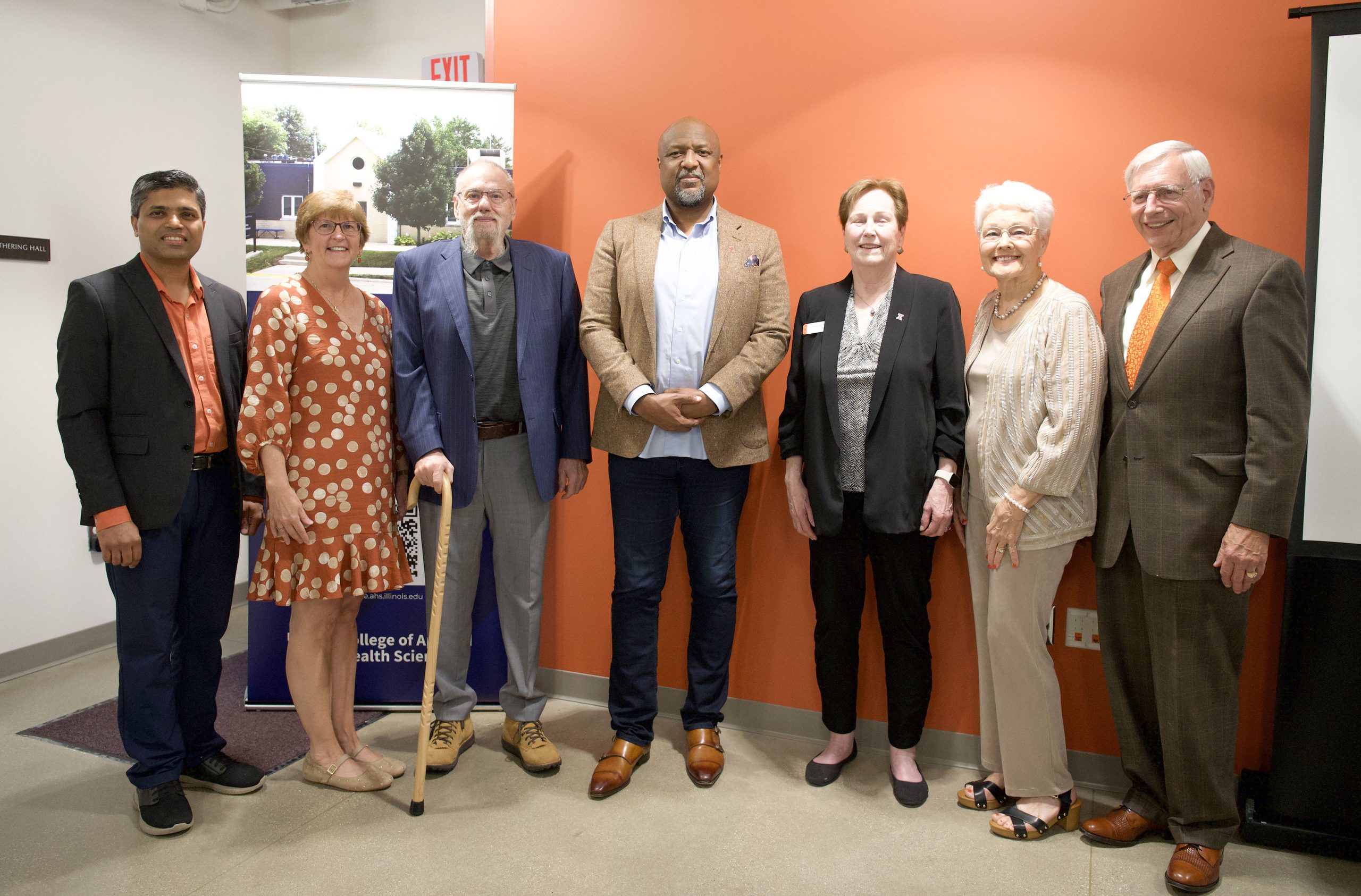
From left, Wendy Rogers, Raksha Mudar, Elizabeth Hsiao-Wecksler, Lynne Barnes and Cathy Emanuel (Photo by Carrie Wennerdahl)

Researchers from the University of Illinois Urbana-Champaign gathered Thursday to explore a strategic partnership with Advocates for Aging Care (AAC), a local grassroots organization working to bring an innovative skilled nursing facility to Champaign County.

The workshop brought together university faculty, clinicians and leaders to begin shaping how research, education and clinical practice could align to strengthen person-directed aging care.

The guest speaker was Susan Ryan, CEO of Maryland-based AgingIN, whose Green House model is a finalist for the project. 

Building an Innovative Model for Skilled Nursing Care

The overarching goal is to establish The Cottages as a quality, person-directed skilled nursing setting inspired by the Green House model. Through collaboration with the university, project leaders aim to embed research into practice, pilot new technologies and create hands-on educational opportunities for students across disciplines.

The long-term vision is for The Cottages to serve as a flagship model for Illinois and the nation—distinguished not only by its design, but by its integration with a leading research university and its strengths in aging research, technology, design and education.

Turning Shared Interests into Action

The workshop was designed to generate potential models for collaboration based on the mutual needs of university researchers, clinicians, educators and students, as well as residents, families, caregivers and staff at The Cottages. Insights gathered during the session will inform the formation of working groups to advance the partnership.

“AAC is pleased to welcome researchers from the University of Illinois Urbana-Champaign as we identify new ways to advance person-directed skilled nursing care,” said AAC Steering Committee Chair Cathy Emanuel. “This unique Green House model can be strengthened by applying the latest research in aging technology, safety, environmental design, and innovative care practices. By partnering with the university, we aim to create a truly distinctive, high-quality care environment grounded in leading-edge research.”

Broad University Engagement

Interest across campus has been strong.

“We have been impressed by the level of enthusiasm we have seen as we organized this event,” said Wendy Rogers and Elizabeth Hsiao-Wecksler of the University of Illinois Urbana-Champaign. “Nearly 100 have already expressed interest in being engaged with The Cottages. They represent a broad spectrum of areas, including The Grainger College of Engineering, the College of Applied Health Sciences, Carle Illinois College of Medicine, the College of Liberal Arts and Sciences, the School of Social Work, the College of Media, the College of Fine and Applied Arts, the Interdisciplinary Health Sciences Institute, the Beckman Institute, Illinois Extension and UIC Nursing. We expect a long and fruitful relationship with Advocates for Aging Care, AgingIN, and The Cottages.”

Project leaders hope the Champaign County location will become a destination site for organizations seeking to implement innovative skilled nursing models—recognized not only for its Green House–inspired design, but also for its deep integration with university research, education and community engagement.

Additional details about construction timelines and future collaborative initiatives will be shared as planning progresses.

Editor’s note:

To reach Sarah Laufenberg, email info@advocatesforagingcare.org.
 

Share on social

Related news

Master of Health Administration program receives accreditation


Lynne Barnes is director of the MHA program and a longtime healthcare executive.

The Commission on Accreditation of Healthcare Management Education (CAHME) Board of Directors approved the initial accreditation of the University of Illinois Urbana-Champaign College of Applied Health Sciences’ Master of Health Administration for a four-year term.

The accreditation affirms that the Illinois MHA program meets CAHME’s high standards for healthcare management education and demonstrates a strong commitment to academic excellence, professional preparation and continuous improvement.

“We are pleased to have the recognition of the premier accrediting body for master’s degrees in health administration,” said Lynne Barnes, clinical professor and director of the MHA program and a longtime healthcare administrator. “The requirements are rigorous and further strengthen the quality of education and number of opportunities that we are providing for our students. This distinction will allow us to continue to attract top students from across the country and internationally.”

The four-year term of accreditation marks a significant milestone for the Illinois MHA program and reinforces its commitment to educating the next generation of healthcare leaders. An online MHA degree program will launch in 2026, along with several graduate certificates that will enhance specialized training in the field.

Cheryl Hanley-Maxwell, dean of the College of Applied Health Sciences—where the MHA program is housed in the Department of Health and Kinesiology—emphasized the significance of the milestone for the university and its students.

“This accreditation reflects the dedication and collaboration of our faculty and staff in building a curriculum that prepares graduates to become highly effective healthcare management professionals,” Hanley-Maxwell said. “Our mission is to equip students with the leadership skills, analytical expertise, and ethical foundation necessary to improve healthcare delivery systems and advance health outcomes in Illinois and beyond.”

CAHME accreditation is widely recognized as the benchmark of quality in graduate healthcare management education. Programs that earn accreditation undergo an extensive self-study process and peer review to ensure alignment with standards designed to prepare graduates for leadership roles in healthcare organizations.

“CAHME’s mission is to advance the quality of healthcare management education,” said Al Faber, interim president and CEO of CAHME. “CAHME-accredited programs have successfully navigated a complex and careful accreditation process managed by experts in the study and practice of healthcare management. The program meets the rigorous standards set by leading academicians and practitioners who are experts in their fields.”

 For more information, visit cahme.org

Editor’s note:

To reach CAHME, email dalexander@cahme.org .
 

Share on social

Related news

News Bureau: Seven pain-related risk factors that magnify risk for postpartum depression


Prof. Sandraluz Lara-Cinisomo, center, worked with fellow researchers Melany Romero, left, and Sudhamshi Beeram on a study investigating links between postpartum depression and pain during and after childbirth in racial/ethnic minority women.

(Photo by Fred Zwicky / University of Illinois Urbana-Champaign)

A woman’s risk of developing postpartum depression is influenced by several pain-related factors before and after childbirth, including poor pain management, their prenatal mental health and the quality of patient-provider communication, researchers at the College of Applied Health Sciences at the University of Illinois Urbana-Champaign say.

Health and Kinesiology Associate Professor Sandraluz Lara-Cinisomo and her co-authors, graduate students Sudhamshi Beeram and Melany E. Romero, spoke to the Illinois News Bureau’s Sharita Forrest to share the findings of their analysis of postpartum literature: they identified seven interrelated risk factors of postpartum depression in racial and ethnic minority women.

Read the full story on the News Bureau website.

Editor’s note:

To reach Sandraluz Lara-Cinisomo, email laracini@illinois.edu.
 

Share on social

Related news

WCIA: The link between healthy eating and brain outcomes for toddlers


Thaynã Flores and Pedro Hallal, professors of Health and Kinesiology, joined the University Updates segment of WCIA 3 News this week. (WCIA 3)

It’s no secret that the food you eat every day can impact your body or impact how you feel. Now, researchers at the University of Illinois are learning the link between what toddlers are eating, and how they think years later.

A team of professors from the College of Applied Health Sciences joined WCIA 3’s Amanda Brennan in the studio for Tuesday’s “University Update” to talk all about their new study, that found an association between unhealthy dietary patterns in early childhood and lowered cognitive test scores for kids years later.

“Our take home lesson today is that nutrition earlier in life really matters,” said Thaynã Flores, health and kinesiology assistant professor. “At age two, the brain is still developing fast and what the children eat during this period influences the brain’s outcomes later.”

Pedro Hallal, a professor with the Department of Health and Kinesiology added that it’s “no secret” that what you eat can influence your chronic disease risk or other physical impacts.

“What is new about this study is that what kids eat very early in life, at the age of two, will influence your brain, your cognition ability at age six. The more ultra-processed foods kids eat, the less developed their brains will be at age six. And that’s concerning,” Hallal said.

Watch their full appearance on WCIA 3 News.

Share on social

Related news

U. of I. trial will test if exercise can improve protein efficiency for older adults with type 2 diabetes


From left: University of Illinois Professor Nick Burd, postdoc Mikaela Kasperek, Ph.D. student Gena Irwin, and Associate Professor Jacob Allen pose inside Freer Hall’s gym, where their labs will train participants in a 12-week exercise program for a clinical trial.

For healthy adults, roughly .8 grams of protein per kilogram of bodyweight per day is enough to maintain muscle mass and support daily function.

But for adults with type 2 diabetes, an estimated 1 in 10 adults in the United States, their protein requirements remain relatively undefined, but are believed to be elevated when compared to their non-diabetic counterparts. Especially as diabetic individuals age, their bodies often become more anabolic resistant: less responsive to the muscle-building effects of exercise and protein intake.

Researchers from the Department of Health and Kinesiology at the University of Illinois Urbana-Champaign are recruiting participants for a human clinical trial to understand the protein needs of older adults with type 2 diabetes, and whether regular exercise can help their bodies use protein more efficiently.

“The problem with current strategies for type 2 diabetes is they largely try to keep throwing protein in people’s diets: eat more, eat more, eat more,” HK Professor Nicholas Burd said.  

Piling on the protein could have detrimental effects. There’s evidence that circulating amino acids, including branch chain amino acids that promote muscle mass, are associated with poorer outcomes for people with diabetes, said HK Associate Professor Jacob Allen.

Their upcoming study, “Exercise impact on dietary protein efficiency in older adults with type 2 diabetes,” is funded by a grant from the American Diabetes Association. The principal investigators are Burd, who researches protein metabolism, and Allen, who studies how exercise and nutrition impact the gut microbiome.

Health and Kinesiology professors Jack Senefeld and Steve Petruzzello are co-investigators on the study.

HK Assistant Professor Jack Senefeld and Professor Steve Petruzzello are co-investigators on the study, bringing expertise on training diabetic individuals and psychological well-being during exercise. Ph.D. candidate Gena Irwin and postdoc Mikaela Kasperek will lead the work from the Burd’s Exercise Performance Lab and Allen’s Integrative Microbiota Physiology labs respectively.

Starting this fall, the researchers will recruit 30 older adults to participate in this study—15 individuals living with type 2 diabetes and 15 without—and bring them into Freer Hall’s gym for a 12-week fitness program that mixes weight training with endurance exercise.

The researchers will use sensitive tools in their labs to figure out how efficiently participants’ bodies utilize protein, and whether that efficiency varies for older adults with and without diabetes. After participants wrap the exercise program, the team will test whether resistance training improved their bodies’ usage of protein overall, lessening their daily protein needs.

“To make an older person’s muscles more youthful, you can exercise them,” Burd said. “But we don’t know how the gut’s being impacted, and we don’t know how type 2 diabetes interferes with some of the ‘youthfulness’ effects of exercise.”

Some of our dietary protein ends up in our skeletal muscle, through muscle-protein synthesis, and some of it is used for energy. But there’s a “black box” around where the rest of our protein goes in the body, Allen said.

“We think that the microbes in the gut, the gut microbiome, might be responsible for some of this, but this has never been studied,” Allen said. “We’ve run some pilot work that fueled part of this study, where we can show that indeed, ingested amino acids are converted into these microbial metabolites.”

Why might that matter? Some of these metabolites are important for human health overall, Allen said. For example, short chain fatty acids—the byproducts of dietary fiber being processed in our gut—bring a host of benefits for metabolism and the immune system.

The research teams will host intervention days at the beginning and end of the 12-week exercise program, to see how participants’ bodies are using the protein in their muscle and gut.

Participants will consume amino acids labeled with stable isotope tracers. The labs will collect breath samples to see how much of the labeled amino acid is showing up in the breath—if more of that labeled protein appears in participants’ breath, their bodies aren’t as good at incorporating it into muscle.

Blood samples will help the scientists understand how the gut is taking those amino acids and converting them into potentially beneficial metabolites.

The second intervention day at the end of the trial will determine whether an exercise program changed the way participants’ bodies use protein.

“There are very few labs in the U.S that not only have the expertise, but have the infrastructure to be able to do this kind of work, so we’re very fortunate for Illinois and our department,” Burd said. “Stable isotope tracers require expensive machines to analyze.”

What’s in it for participants? On top of helping the scientists form dietary guidelines for older adults with type 2 diabetes, they’ll receive progressive exercise training from expert students and faculty at the college, that will hopefully serve them well beyond their last visit.

“A big goal is to change behavior, too, to make them healthier,” Allen said. “That’s ultimately what we’re trying to do.”

Editor’s note:

Interested in participating in this study? Take the survey to see if you qualify, or email the organizers at HK-ADA-Study@illinois.edu

To reach Nick Burd, email naburd@illinois.edu
To reach Jacob Allen, email jmallen5@illinois.edu

Share on social

Related news

Message from HK Department Head Kim Graber


Dear Alumni and Friends,

Now that fall 2025 is underway, I’m excited to share some of the exciting stories from the Department of Health and Kinesiology. Each newsletter reminds me of how fortunate I am to work alongside such passionate faculty, students and alumni who are making a real difference in people’s lives.

In this issue, you’ll find a fascinating look at how our researchers are using fMRI technology to see how a new mother’s brain responds to pain. We’re also tackling an issue you may have seen in the news related to the growing misuse of nitrous oxide. Our faculty are at the forefront of this devastating issue. In the past decade, U.S. annual deaths from nitrous oxide poisoning are up by nearly 600 percent.

Another feature dives into how machine learning is helping us better understand cognitive function. The study offers insight into the health and lifestyle indicators—including diet, physical activity and weight—that align most closely with healthy brain function. And for those interested in nutrition, you won’t want to miss our story on potato-protein diet combinations. This research is showing creative, practical approaches to fueling both wellness and performance.

What ties all these stories together is the spirit of curiosity and care that defines our department. And, as always, none of this work would be possible without the encouragement of alumni like you. Your support inspires our students and drives our mission forward.

Thank you for staying connected with us—I hope you enjoy reading this issue as much as we enjoyed putting it together.

Warmly,

Kim Graber, Ph.D.

Head, Department of Health and Kinesiology

Share on social

Related news

Insights from the 2025 Chittenden Symposium


On October 8, faculty, students, and researchers from the Department of Industrial and Enterprise Systems Engineering and Department of Health and Kinesiology gathered at the iHotel for the 2025 Chittenden Symposium: “Lifelong Health by Design – Human-Centered Innovations in Chronic Disease Prevention.” The event united experts across disciplines to explore how engineering precision and health science insight can combine to design systems that foster long-term, equitable health outcomes.

Read more at this link.

Share on social

Related news

WCIA: Otavio Leão explains the Illini Kindergarten Cohort


Assistant Professor Otavio Leão on WCIA 3 News.

Health and Kinesiology Assistant Professor Otavio Leão appeared on WCIA 3 News segment “Community Spotlight” to explain a new research project recruiting young participants this fall.

Illini Kindergarten Cohort is a study seeking to estimate the physical activity, sleep and screen-time of kindergarten-age children. Families in the Champaign-Urbana area can complete a 20- to 30-minute survey and enroll their kindergartner, who will wear a basic accelerometer for a week. All participants will be awarded a $40 Amazon gift card.

Leão explained the details to WCIA’s Taylor Mitchell on Thursday, Oct. 9.

Editor’s note:

To learn more about the Illini Kindergarten Cohort and participate, visit their website.
 

Share on social

Related news

Exercise is Medicine On Campus month kicks off at Illinois


Exercise is Medicine Month on Campus kicked off with an in-person yoga event at Freer Hall lawn. (Provided)

Exercise is Medicine on Campus (EIM-OC) is an annual initiative that calls upon colleges and universities to promote physical activity as a core component of health and wellness. More than 200 campuses in the United States have registered for the program.

This month, Health and Kinesiology faculty and students at the University of Illinois Urbana-Champaign—led by this year’s EIM at Illinois committee chair Emerson Sebastião—have planned out several activities to bring campus together in movement. Representatives from the Illinois Counseling Center, Campus Recreation, McKinley Health Center, Carle Illinois College of Medicine and local health organizations joined this year’s committee.

All month, participants can join the online “Move More Challenge” by posting a video or photo of them exercising, and tagging @illinoishealthkin on Instagram.

Coming up:

Free Pilates

A free, introductory pilates class in front of Freer Hall, led by HK Teaching Assistant Professor Alana Harris. Bring your own mat!

When:
Wednesday, Oct. 15 at 12 p.m. at Freer Hall lawn

Check your vitals

Get your blood pressure and resting heart rate checked for free by HK students and faculty. Students will provide education on physical activity and exercise guidelines.

When:
Wednesday, Oct. 15 from noon to 1 p.m. at Illinois Street Residence Hall
Wednesday, Oct. 22 from 1:30 to 3:30 p.m. at Student Dining and Residential Programs building (SDRP)

Fall into Fitness 5K | Run, Walk and Roll

Join a 5K race that starts at Freer Hall and loops through campus. Check-in and registration begins at 7:30 a.m., and the race starts at 8:30 a.m.

When:
Sunday, Oct. 19 at 8:30 a.m. Check-in begins at 7:30 a.m.

Read Chancellor Isbell’s official proclamation for Exercise is Medicine Month on Campus:

Committee Members 2025-2026

  • Chair: Emerson Sebastião, Ph.D., Health and Kinesiology
  • Nicholas Burd, Ph.D., Health and Kinesiology
  • Alana Harris, Ph.D, Health and Kinesiology
  • Diana Morales (Graduate Student Representative)
  • Harrison Guo (Undergraduate Student Representative)
  • Maggie Verklan, the Counseling Center
  • Alexia Hammonds (Graduate Student Representative)
  • Brie Whitted, McKinley Health Center
  • Jared Willard, MD, Christie Clinic
  • Annie Tigranyan (Carle Illinois College of Medicine Student Representative)

Editor’s note:

To reach Emerson Sebastião, email esebast2@illinois.edu.
 

Share on social

Related news

AHS Faculty Q&A: Megan Huibregtse on traumatic brain injuries, MRI and coming to Illinois


Megan Huibregtse (Fred Zwicky / University of Illinois Urbana-Champaign)
Talk about what drew you to the College of AHS. Why did you choose to come to Illinois? 

Megan: I was looking for an environment where I could connect with a vibrant research community and work directly with undergraduate and graduate students. While my work spans multiple disciplines such as clinical neuroscience or psychiatry, traumatic brain injury is one of the most common neurological conditions (Maas et al., 2022 The Lancet Neurology), and there’s a real public health concern about acute and long-term neurobehavioral effects.

So, AHS’s mission of improving health and well-being across the lifespan is a great fit for my research program. Plus, the neuroimaging resources here are unparalleled, and I can’t wait to start using the 7 Tesla scanner. 

(The University of Illinois and Carle Health co-own a 7 Tesla MRI scanner, which provides a huge step up in quality for brain imaging.)

You’ve described yourself as ‘obsessed with the brain.’ When and how did your fascination with neuroscience begin? 

I was unlucky enough to get two concussions from playing volleyball when I was younger, and the second led to the discovery of a brain tumor in my left frontal lobe. It might have been a coincidence, but the tumor was right next to where I hit my head when I got the first concussion.

Fortunately, the surgery to remove it went well, and I’ve been fascinated by the brain and what happens in response to injury ever since. Having personally gone through many hours of magnetic resonance imaging, I learned what a powerful tool it is to non-invasively examine the brain. 

Within the area of traumatic brain injury, you’ve already investigated a wide variety of topics, from sub-concussive head impacts in high school football to head trauma from intimate partner violence. How do you generally describe your research interests? 

That’s right—I’ve been fascinated by various aspects of neurotrauma. In general, I would say that my interests revolve around comprehending how our experiences (brain injuries, traumatic events, and when they occur simultaneously) impact our brain health. I consider brain health in terms of both structural integrity and function. 

What are your priorities as you’re getting started here at Illinois? 

This year, I’m working on setting up my research program—recruiting graduate students and undergraduate research assistants, submitting my protocols to the Institutional Review Board, and getting acquainted with the excellent neuroimaging resources at the Beckman Institute. 

How has your experience in Urbana-Champaign been so far? Is there anything you’d like your colleagues to know about you? 

It’s been great so far! Having completed my degrees at another Big Ten school (Indiana), Urbana-Champaign feels familiar already. Outside of work, I love to cook and bake for my family and friends. 

Editor’s note:

To reach Megan Huibregtse, email mhuibreg@illinois.edu.

Share on social

Related news

College of Applied Health Sciences
110 Huff Hall
1206 South 4th Street
Champaign, IL 61820
(217) 333-2131